Please rate Ahnentafel Form

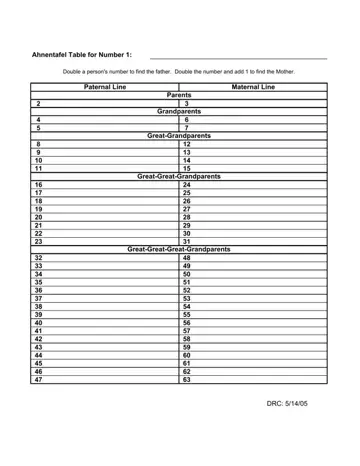
Delving into one's ancestry can often feel like unraveling a complex tapestry, where every thread leads to a new discovery about family histories and connections. Among the myriad of tools designed to aid in this exploration, the Ahnentafel form stands out for its systematic approach to genealogical research. Originating from a German term that literally translates to "ancestor table,” this form offers a simplified, numerical method for tracing an individual's lineage, spanning generations from parents to great-great-great-great-grandparents and beyond. The fundamental principle behind the Ahnentafel form is remarkably straightforward: by doubling a person’s number, one can identify the father, and by doubling the number and adding one, the mother can be located. This pattern repeats across the paternal and maternal lines, methodically expanding through grandparents, great-grandparents, and further into the past, enabling researchers to map out a comprehensive family tree. The layout facilitates a clear understanding of both paternal and maternal ancestries without the clutter often associated with traditional genealogical charts. Recorded as a moment in time—specifically noted with a document revision code (DRC)—it captures snapshots of ancestral generations, offering a timeless resource for those looking to uncover their family's history.
| Question | Answer |
|---|---|
| Form Name | Ahnentafel Form |
| Form Length | 2 pages |
| Fillable? | No |
| Fillable fields | 0 |
| Avg. time to fill out | 30 sec |
| Other names | ahnentafel number, ahnfatel chart, ahnentafel form pdffile, ahnentafel report form |
Ahnentafel Form isn’t the one you’re looking for?
Please rate Ahnentafel Form