

Form CA-20 at a glance
What it is: CA-20, the Attending Physician's Report of the U.S. Department of Labor Office of Workers' Compensation Programs.
Who signs: Box 13: Please sign and date the form.
What to bring and attach to Form CA-20
You will be asked to provide the patient's case number, last name, date of birth and date of injury to upload a document.
A filled-in Form CA-20 example: a totally disabled patient with a back sprain
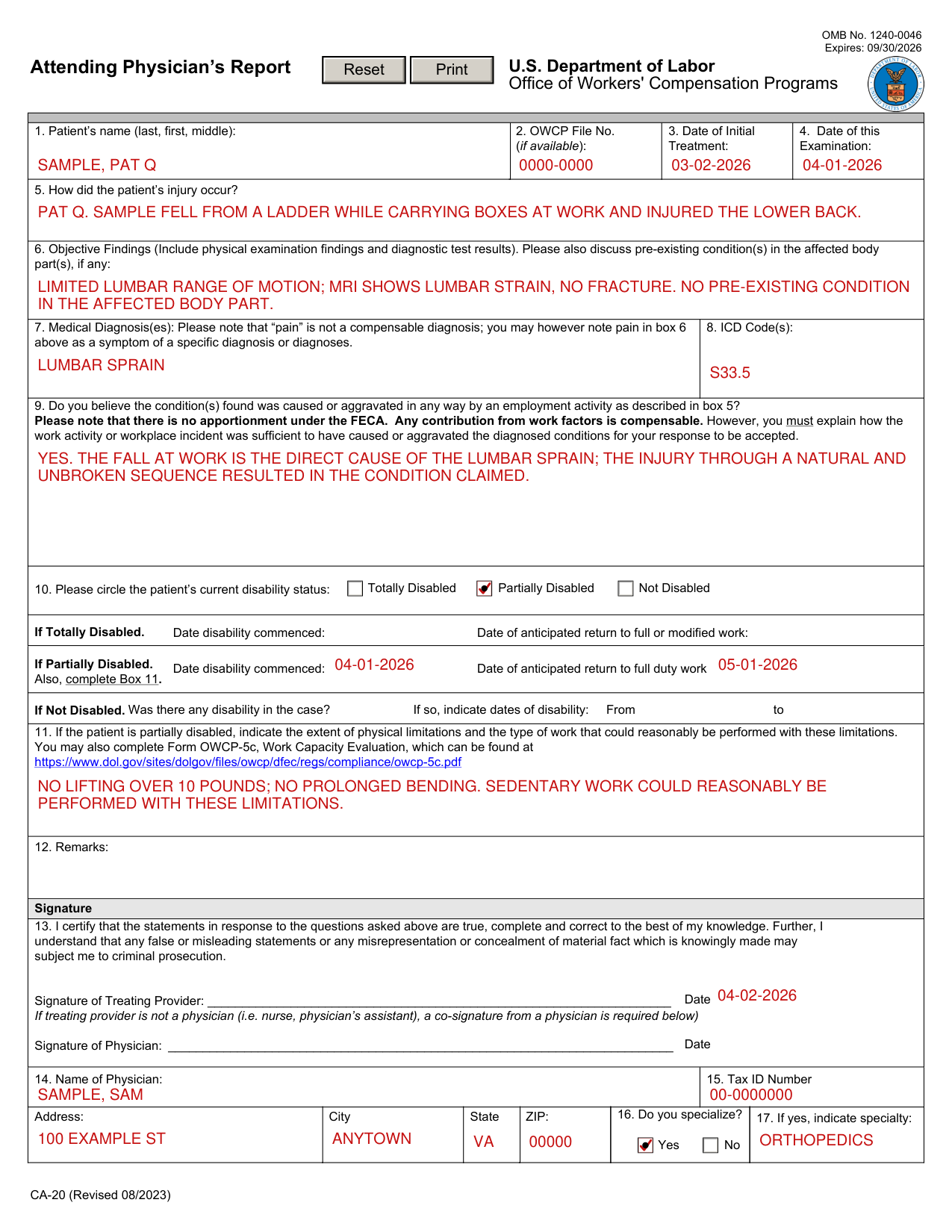
How to fill out Form CA-20, box by box
Boxes 1 to 4: patient's full name, OWCP File Number, first treatment date and examination date

Box 1: Enter the patient's full name. Box 2: If not prepopulated, enter the OWCP File Number provided to you by the patient. If unknown, leave blank.
Box 3: Enter the first known date this patient sought treatment for the work injury.
Box 4: Enter the date of this examination (i.e. the examination upon which your findings on the form are based).
Box 5: how the patient's injury occurred

Box 5: Provide an explanation as to how the patient's injury or disease occurred.
Be as specific as possible.
Box 6: objective findings

Box 6: Detail the patient's objective findings on physical examination as related to the work injury noted in Box 5.
Include results of any diagnostic testing performed.
Also, please reference any pre-existing injury or condition to the body part(s) affected by the work injury.
Boxes 7 and 8: diagnoses and ICD codes

Box 7: Provide specific diagnoses of each medical condition connected to the work injury.
Please note that “pain” is not a compensable diagnosis under the FECA.
Box 8: Provide corresponding ICD codes for each medical condition noted in Box 7.
Box 9: whether the work injury is causally connected to the diagnoses

Box 9: Address whether the work injury noted in Box 5 is causally connected in any way to the diagnoses in Box 7.
Your answer must be fully explained to be accepted by OWCP.
Note that there is no apportionment under the FECA and any contribution from work factors is compensable.
Types of causal relationship under the FECA include: Direct Causation.
This type of relationship occurs when the injury or factors of employment, through a natural and unbroken sequence, result in the condition claimed.
Aggravation.
This type of relationship occurs if a pre-existing condition is worsened, either temporarily or permanently, by the injury or factors of employment.
If you believe the work injury aggravated a pre-existing condition, please indicate whether such aggravation is temporary or permanent and if temporary, when the aggravation ceased or is expected to cease.
You may also include any consequential conditions that resulted from the initial work injury or disease.
Under the FECA, a subsequent injury, whether an aggravation of the original injury or a new and distinct injury, is compensable if it is the direct and natural result of a compensable primary injury.
Box 10: the patient's current disability status
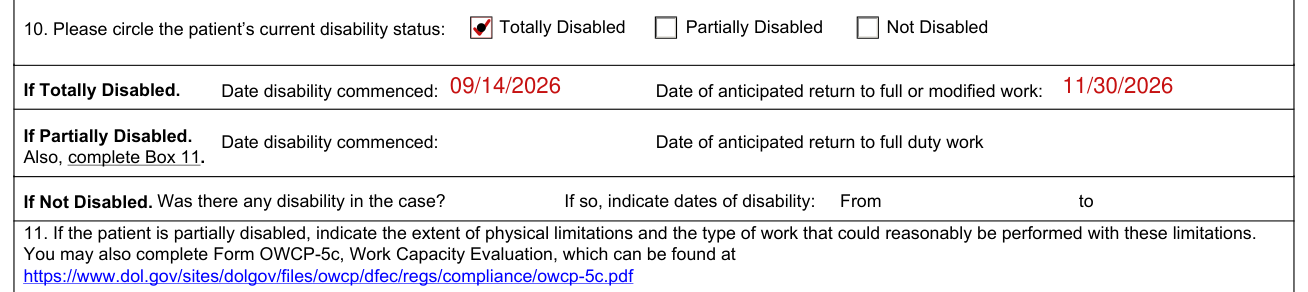
Box 10: Indicate the patient's current disability status: Totally disabled: The claimant is unable to perform any and all work.
Provide the date disability commenced and the date of anticipated return to regular or modified work.
Partially disabled, The claimant is incapable of performing the job held when injured, but is capable of some work.
Provide the date disability commenced and the date of anticipated return to regular duty work.
Not disabled: The claimant is capable of performing the job held when injured.
Indicate any previous dates of disability.
Box 11: physical limitations

Box 11: If you stated the patient was partially disabled in Box 10, please indicate the extent of physical limitations and the type of work that could reasonably be performed with these limitations.
A link is provided to Form OWCP-5c, Work Capacity Evaluation, for orthopedic conditions if you would prefer to provide work capacity information separately.
The OWCP website also has work capacity evaluation forms for psychiatric (OWCP-5a) and cardiac (OWCP-5b) conditions if needed.
Box 12: remarks

Box 12: If you have any additional remarks regarding this patient's work injury, please provide here.
If not, leave blank.
Box 13: sign and date the form

Box 13: Please sign and date the form.
By signing you certify that the statements in response to the questions asked in this form are true, complete and correct to the best of your knowledge. Further, you understand that any false or misleading statements or any misrepresentation or concealment of material fact which is knowingly made may subject you to criminal prosecution. If the treating provider is not a physician (i.e. nurse, physician's assistant), a co-signature from a physician is required; a physician must co-sign and date the form as well.
Under the FECA, medical evidence must be submitted by a qualified physician.
Nurse practitioners and physician assistants are not considered qualified physicians under the FECA unless the medical report is countersigned by a physician.
A “physician” includes clinical psychologists acting within the scope of their practice.
Also, under the FECA, a “physician” includes chiropractors only if there is a diagnosed spinal subluxation and it is demonstrated by x-ray.
Boxes 14 to 17: physician name, address, tax identification number and specialty

Box 14-17: Please provide the name, address and tax identification number of the physician signing the form.
If the physician is Board-certified in a particular specialty, please indicate such and provide the specific specialty in Box 17.
More rules for Form CA-20
OWCP requires that medical bills, other than hospital bills, be submitted on the American Medical Association health insurance claim form, HCFA 1500/OWCP-1500.
Common questions about Form CA-20
What is the CA20 form used for?
CA-20, the Attending Physician's Report of the U.S. Department of Labor Office of Workers' Compensation Programs. A medical report is required by OWCP before payment of compensation for loss of wages or permanent disability can be made to the employee.
What is eComp used for?
To expedite the processing of this patient's claim, you can concurrently upload this form directly into their case file using the Employees' Compensation Operations and Management Portal (ECOMP). ECOMP will then provide you with a Tracking Number so that you can verify when OWCP has received the CA-20.
Where do I file it?
Please send the completed form and bill to: Office of Workers' Compensation Programs Division of Federal Employees', Longshore and Harbor Workers' Compensation Federal Employees' Compensation Act (OWCP/DFELHWC-FECA) PO Box 8311 London, KY 40742-8311. You can access ECOMP from any internet browser at: https://www.ecomp.dol.gov/ When you access the website, choose the "Upload Document" option.
Sources
[1] Form CA-20 (Revised 08/2023), Attending Physician's Report, Office of Workers' Compensation Programs, U.S. Department of Labor (the Official source link on this page).
