
Calculating Salary Worksheet Form PDF Details

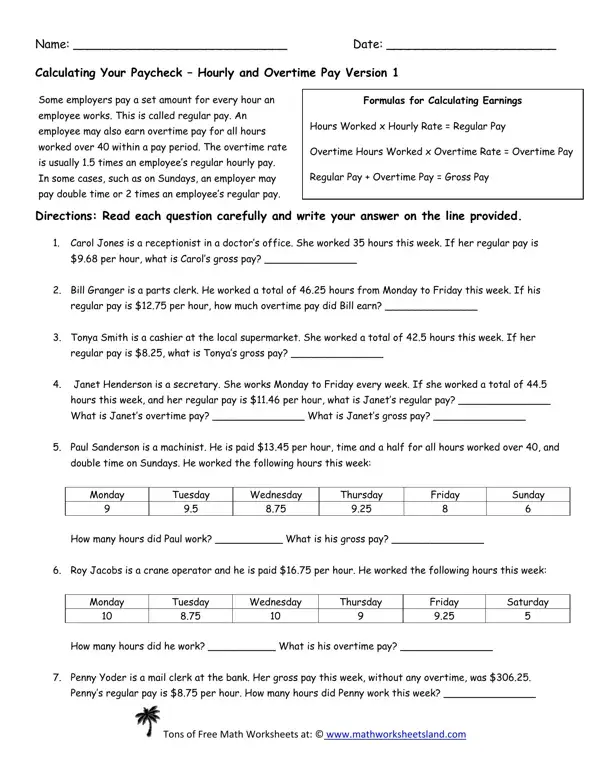
Understanding how to calculate salary is essential for both employees and employers to ensure accurate paychecks. The Calculating Salary Worksheet form begins with an explanation of regular pay, defined as a fixed amount paid for each hour worked, then covers overtime pay that compensates for hours worked beyond a standard 40-hour workweek at a rate of 1.5 times the regular hourly rate. Certain conditions, such as work on Sundays, may warrant double time pay at 2.0 times the base hourly rate.

How Regular Pay Is Calculated

Regular pay is the base wage an employee earns for each hour worked within the standard workweek. To compute regular earnings, multiply the hourly rate by the number of regular hours worked. For example, a receptionist earning $10.00 per hour who works 35 regular hours earns $350.00 in gross wages for that week with no overtime. This straightforward math formula makes it easy for anyone to verify expected take-home earnings before payday and confirm the hourly rate applied matches the employment agreement.

Overtime Pay Rates and How They Work

Overtime wages apply to any hours worked beyond the 40-hour weekly threshold. Under standard employment rules, overtime is paid at 1.5 times the regular hourly rate. A parts clerk earning $12.00 per hour who works 46 hours in one week earns $480.00 in regular wages plus $108.00 in overtime wages (6 hours at $18.00 each), producing a total gross pay of $588.00. Roy Jacobs, a crane operator in one worksheet example, works similar scenarios involving both regular rates and Sunday double time. The worksheet walks through each calculation using real job role examples so the math applies directly to workplace situations today.

Computing Gross Pay Step by Step

Gross pay is the total amount an employee earns before any deductions, taxes, or withholding. The formula is: Gross Pay = Regular Wages plus Overtime Wages. This worksheet guides users through that calculation step by step, presenting real scenarios with different job roles, varying hours, and multiple hourly rate values. These practical examples make the math accessible whether the user is an employee checking their own paycheck or a business owner managing payroll for hourly staff.

Practical Examples for Different Employment Roles

The Calculating Salary Worksheet includes several workplace examples covering common employment scenarios:

Each scenario in the worksheet reinforces the core math skills needed to verify any hourly rate calculation, supporting both personal financial planning and payroll accuracy in small business settings.

QuestionAnswer
Form NameCalculating Salary Worksheet Form
Form Length1 pages
Fillable?No
Fillable fields0
Avg. time to fill out15 sec
Other namescalculating your paycheck weekly time card 1 answers, calculating a weekly time card worksheet answers, calculating your paycheck salary worksheet 1, calculating your paycheck weekly time card 1 answer key

How to Edit Calculating Salary Worksheet Form Online for Free

If you need to fill out the Calculating Salary Worksheet, you won't need to install any programs. Just use our online PDF tool. Here is how to complete it in a few basic steps:

Step 1: Access the form in our editor by clicking the "Get Form" button at the top of this page.

Step 2: After you open the file editor, you will see the document ready to be filled out. In addition to filling out the blank fields, you may also add text, edit existing content, insert images, sign the form, and more.

This document will require particular data to be filled in, so take your time to enter the information requested:

1. Complete the worksheet accurately, paying close attention to the segments containing these fields:

calculating wages worksheet completion process explained (part 1)

2. After the first section, enter the applicable information in these fields: regular pay rate, Tonya's hourly wage, Paul Sanderson the machinist, double time on Sundays, Monday through Sunday hours, total hours worked, Roy Jacobs the crane operator, and weekday hours.

The right way to complete calculating wages worksheet part 2

3. The next portion focuses on total hours worked, Penny Yoder the mail clerk, and the Tons of Free Math Worksheets reference. Fill in all of these fields carefully.

How to complete calculating wages worksheet step 3

It is easy to make an error when completing the math worksheet fields, so review your work before submitting.

Step 3: Before finishing, make sure all form fields are filled in correctly. When ready, click "Done." You can create a free account to save the completed Calculating Salary Worksheet for downloading later. All changes are saved automatically so you can return to edit the form at any time.

Related Payroll and Wage Forms

If you regularly work with hourly wages and employee compensation, these related forms on FormsPal may also help with your payroll process:

  • Employer Wage Verification Form - Confirm an employee's reported wages with official documentation for employment and income verification purposes.
  • Payroll Check Template - Create professional payroll checks for hourly employees using a ready-to-fill template.
  • Time Card Template - Track weekly hours for each employee to support accurate wage and overtime calculations.
  • Certified Payroll Form - Required documentation for government construction projects with prevailing wage requirements.
  • Overtime Pre-Approval Form - Authorize overtime hours before they are worked to manage hourly wage costs effectively.

Common Questions About Salary Worksheets

What is the difference between regular pay and overtime pay? Regular pay covers hours within a standard 40-hour workweek at your agreed hourly rate. Overtime pay applies to extra hours beyond 40 per week and is typically 1.5 times the regular hourly rate under most employment agreements.

How do I calculate gross pay with overtime? Multiply your hourly rate by 40 regular hours to get your regular wages. Then multiply your overtime rate (hourly rate times 1.5) by the number of extra hours worked. Add both amounts together to find your total gross pay for the pay period.

Can I use this worksheet for salary-exempt employees? This worksheet is designed for hourly rate employees. Salary-exempt employees receive a fixed annual amount not tied to hours worked, so a different math approach applies for that employment category.