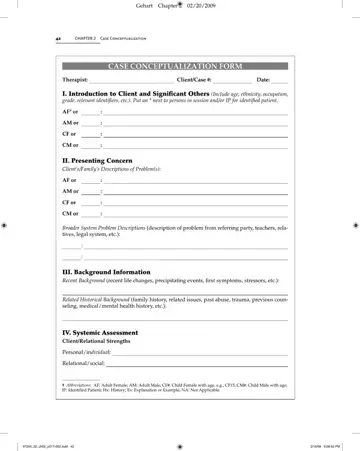
Use the online PDF editor to fill out the case conceptualization form directly in your browser without any software download. The editor supports text entry, field highlighting, and saving a completed copy. Follow the steps below to complete your case conceptualization template.
Step 1: Open the form in the PDF editor
Click the orange "Get Form Now" button to load the case conceptualization form in the online editor. The form opens directly in your browser, ready for you to enter client information section by section.
Step 2: Complete the broader system and background sections
Use the editor toolbar to add, remove, modify, or highlight content within the form. Fill in the following fields in this section:
- Broader System Problem
- Background Information (Recent and Historical)
- Systemic Assessment (Personal and Relational dimensions)
Step 3: Enter family structure and interaction details
Record the key details in the family and couple sections:
- Spiritual and Family Structure fields
- Couple Boundaries (Clear or Enmeshed)
- Rules for closeness and distance
- Couple Problem Interaction Pattern (tension start, conflict escalation, return to homeostasis)
- Couple Complementary Patterns
- Emotional and logical roles (good or bad parent)
Step 4: Record assessment tool findings
Enter your observations from the clinical assessment tools included in the Gehart case conceptualization form:
- Satir's Communication Stances for each family member
- Gottman's Divorce Indicators: Criticism, Defensiveness, Contempt, Stonewalling, Failed repair attempts, Harsh startup
- Parental Subsystem and family membership data
- Sibling subsystem notes
Step 5: Finalize the systemic assessment and save
Complete the remaining Systemic Assessment (Family) fields, including Hierarchy Between Child and Parents, Emotional Boundaries with Children, and any other relevant fields. Once all sections are filled, press "Done" to finalize and download the completed case conceptualization form.
Save at least two copies of the completed form: one for the client file and one as a backup. The case conceptualization form is typically reviewed and updated as therapy progresses and new information comes to light.
Frequently Asked Questions About the Case Conceptualization Form
What is a case conceptualization form?
A case conceptualization form is a structured clinical document that organizes a therapist's understanding of a client's presenting problems, relevant history, relational dynamics, and working hypotheses about the factors maintaining the client's difficulties. It serves as a foundation for treatment planning in both individual and family therapy.
Who developed the Gehart case conceptualization format?
Dr. Diane R. Gehart, a licensed marriage and family therapist and university professor, developed this format. It is widely used in marriage and family therapy training programs and clinical supervision settings across the United States.
How long does it take to complete the form?
Completing a thorough case conceptualization typically takes 30 to 60 minutes of focused work after gathering initial assessment information. Therapists often draft a first version after the first two or three sessions and refine it as new clinical information emerges over time.
Can this form be used for individual therapy?
Yes. While the Gehart format was designed with family and systemic therapy in mind, most sections apply equally to individual therapy. Therapists can complete the relevant sections and leave couple- or family-specific areas blank where not applicable to the case.
For additional clinical documentation tools, see the client intake form for gathering initial client data and the case management assessment template for ongoing case tracking.