
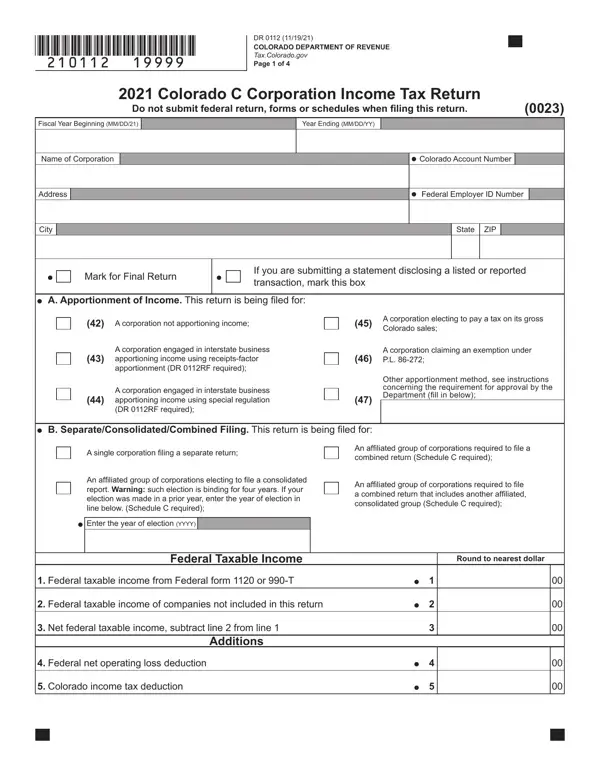
The DR 0112 is the state C Corporation Income Tax Return every qualifying C corporation must file with the Department of Revenue each year. The return covers five main parts: corporation identification, state adjustments to federal taxable income, state taxable income and gross tax, nonrefundable credits, and payments with the final balance due or refund. Open FormsPal's free PDF editor by clicking the orange "Get Form" button above, fill in the required fields, then download your completed return and submit it by mail or through the Revenue Online portal.
How to Fill Out the DR 0112
Step 1: Complete the corporation identification section. Enter the corporation name, state account number, and the tax year covered by the return. Indicate the type of return filed: separate, consolidated, or combined. An affiliated group of corporations may file a consolidated return under qualifying conditions. Mark the correct box so the Department processes the return at the correct apportionment level. Also check the applicable-year boxes and any extension payment credit that was submitted with the DR 0158-C before the original due date.
Step 2: Enter the starting figure and apply state adjustments. The DR 0112 begins with the federal taxable income reported on IRS Form 1120. Transfer this IRS figure to line 1 of the state return. Then add required state additions, including the disallowed federal net operating loss. Next, subtract allowed state deductions: the state capital gain subtraction, exempt federal interest, excluded foreign-source income, the state marijuana business deduction if applicable, and any other subtractions approved by statute. The resulting figure is modified federal taxable income, which the state uses as its starting point for computing the corporation's state taxable income and tax.
Step 3: Compute state taxable income and gross state tax. From modified federal taxable income, subtract any state net operating loss carryforward from prior years to arrive at the corporation's state taxable income. Multiply that amount by the flat state income tax rate in effect for the filing year. The product is the gross state tax before any credits are applied. Each corporation should verify the current rate on the Department of Revenue website before completing this line, because the legislature may adjust the rate between filing years.
Step 4: Claim available state tax credits on the return. Attach the DR 0112CR credit schedule to total all available nonrefundable credits: enterprise zone credits, renewable energy credits, strategic capital credits, innovative motor vehicle credits, gross conservation easement credits, and business personal property credits. Nonrefundable credits reduce the gross tax dollar-for-dollar but cannot bring the balance below zero. A corporation with multiple credits should complete the DR 0112CR carefully before entering the totals on the main return. The IRS allows analogous federal credits on Form 1120; the DR 0112CR gives the equivalent state benefit to the corporation's return.
Step 5: Record payments and calculate the balance due or refund. Enter all estimated tax payments made during the year on the DR 0112EP, any extension payment submitted with the DR 0158-C, and any withholding credits. Subtract total payments and nonrefundable credits from the gross state tax. A positive balance means the corporation owes additional tax with the return. A negative balance results in a refund from the state. Click "Done" when finished to download your completed DR 0112 return, then mail it to the address on the return or file electronically.
Who Must File the DR 0112 Return
Any C corporation incorporated in the state, doing business here, or deriving income from sources here must file an annual DR 0112 return with the Department of Revenue. This obligation applies even when no net tax is owed, unless a specific statutory exemption applies. An affiliated group of C corporations that operates primarily in the state may elect to file a consolidated return rather than separate returns for each entity. S corporations, limited partnerships, and single-member LLCs taxed as disregarded entities file different state tax forms and do not use the DR 0112. The IRS classification of an entity as a C corporation for federal purposes generally determines the state filing obligation as well. Corporations that become subject to state tax part-way through the year must still file a return for the full period the state had jurisdiction.
Estimated Tax Payments and Underpayment Penalty
Corporations expecting to owe state income tax must make quarterly estimated payments using the Form DR 0112EP. Each quarterly payment is due by the 15th day of the 4th, 6th, 9th, and 12th months of the tax year. Underpaying during the year can trigger an underpayment interest penalty calculated on the shortfall for each quarter. Use the DR 0204 form to calculate whether a penalty applies and to compute the amount owed on the final return. The IRS imposes a parallel estimated tax requirement at the federal level under IRC Section 6655; the state mirrors this structure for corporation filers. Corporations that underpay both federal and state estimated taxes in the same year face separate penalties on each return.
Filing Deadlines and Extensions for the DR 0112
Calendar-year C corporations must file the DR 0112 return by April 15. Fiscal-year filers must file by the 15th day of the fourth month after their tax year closes. File the DR 0158-C extension form and pay at least 90 percent of the tax due by the original deadline to receive an automatic six-month extension. The extension moves the return deadline to October 15 for calendar-year filers but does not postpone the payment deadline. A corporation that misses the payment deadline still owes interest on the unpaid balance from the original due date, even if the extension was properly filed and granted. Corporations that need additional time to gather records should nevertheless estimate and pay their liability by April 15.
Key Sections of the DR 0112 Return
- Part 1 - Corporation identification: Name, account number, tax year, and type of return (separate, consolidated, or combined).
- Part 2 - Additions to federal taxable income: Required state additions, including the disallowed federal net operating loss deduction and other items mandated by statute.
- Part 3 - Subtractions and state taxable income: Allowed state deductions leading to state taxable income, then gross state tax at the applicable rate.
- Part 4 - Nonrefundable credits: Tax credits from the DR 0112CR schedule, including enterprise zone and renewable energy credits, applied against the gross tax.
- Part 5 - Payments and balance: Estimated payments, extension payments, withholding credits, and the final balance due or refund on the return.
Frequently Asked Questions
How is state taxable income calculated on the DR 0112?
Start with the federal taxable income from IRS Form 1120. Add the required state additions (such as the disallowed federal net operating loss), then subtract allowed state deductions (such as the capital gain subtraction and exempt federal interest) to reach modified federal taxable income. Deduct any state net operating loss carryforward to get final state taxable income. Multiply by the flat state rate to determine the gross tax on the return.
Can the DR 0112 return be filed electronically?
Yes. The Department of Revenue accepts e-filing of the DR 0112 C corporation return through Revenue Online. E-filing confirms receipt immediately, speeds processing, and reduces the chance of errors. Many tax professionals transmit the state return to the Department at the same time they file IRS Form 1120 with the IRS, which reduces data entry and errors.
What forms must be attached to the DR 0112 return?
Common attachments include the DR 0112CR credits schedule, the DR 0112RF receipts factor apportionment schedule, and Schedule C for corporation affiliations. The DR 0158-C is used when an extension is needed. Find all companion state forms in the Colorado Tax Form collection on FormsPal.
What is the state corporate income tax rate?
The state applies a flat rate to C corporation state taxable income. The legislature may adjust the rate from year to year, so verify the current rate on the Department of Revenue website before completing the return for each tax year.
How does the DR 0112 differ from IRS Form 1120?
IRS Form 1120 reports the corporation's federal taxable income and federal tax to the IRS. The DR 0112 starts from that same IRS figure, applies state-specific additions and subtractions, and computes the separate state tax liability owed to the Department of Revenue. Every C corporation that files IRS Form 1120 and has a state filing obligation must also file the DR 0112 return independently.
How does a C corporation handle a state net operating loss?
When a C corporation generates a net operating loss in a tax year, that loss can be carried forward to reduce state taxable income in future years. The loss carryforward amount is entered on the DR 0112 as a subtraction from modified federal taxable income. The amount of the carryforward, the number of years it may be carried, and any limitations differ from the IRS rules for federal net operating losses on Form 1120.
