

Form DE-147 at a glance
What it is: DE-147, Duties and Liabilities of Personal Representative (Probate): when the court appoints you as personal representative of an estate, you become an officer of the court and assume certain duties and obligations.
Who signs: The petitioner signs on the (SIGNATURE OF PETITIONER) line under ACKNOWLEDGMENT OF RECEIPT.
I have petitioned the court to be appointed as a personal representative.
What to bring and attach to Form DE-147
If required to do so by local court rule, you must provide your date of birth and driver's license number on supplemental Form DE-147S.
A filled-in Form DE-147 example: a petitioner without an attorney
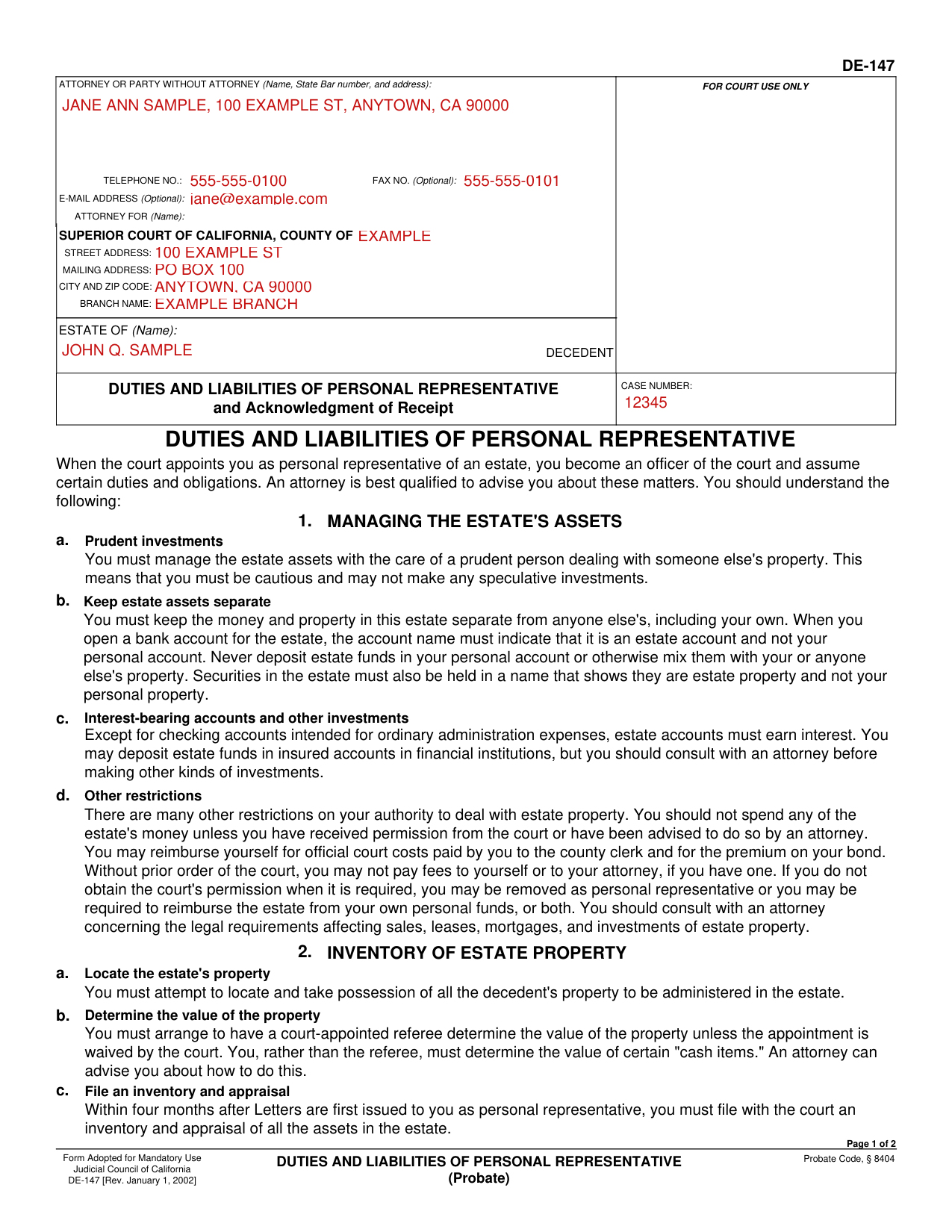
How to fill out Form DE-147, box by box
Superior Court of California, County of

Enter the county after Superior Court of California, County of, and the street address, mailing address, city and zip code and branch name.
Estate of and case number
Enter ESTATE OF (Name), the DECEDENT, and the CASE NUMBER.
Attorney or party without attorney
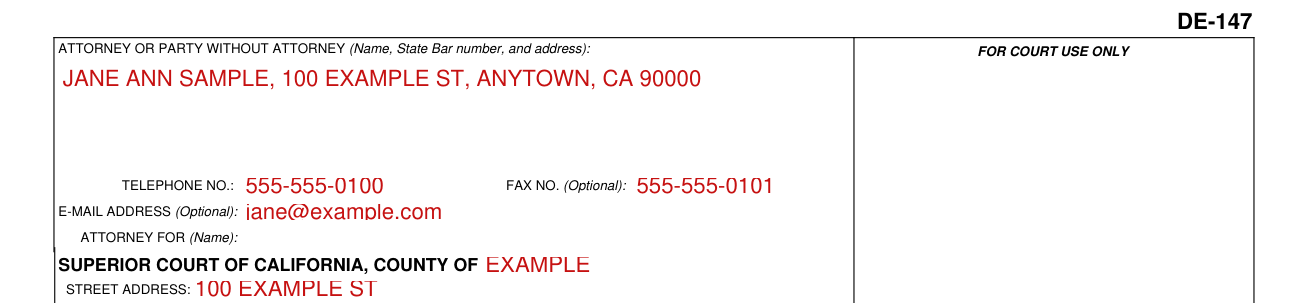
Under ATTORNEY OR PARTY WITHOUT ATTORNEY, enter Name, State Bar number, and address, then TELEPHONE NO., FAX NO. (Optional), E-MAIL ADDRESS (Optional) and ATTORNEY FOR (Name).
Acknowledgment of receipt
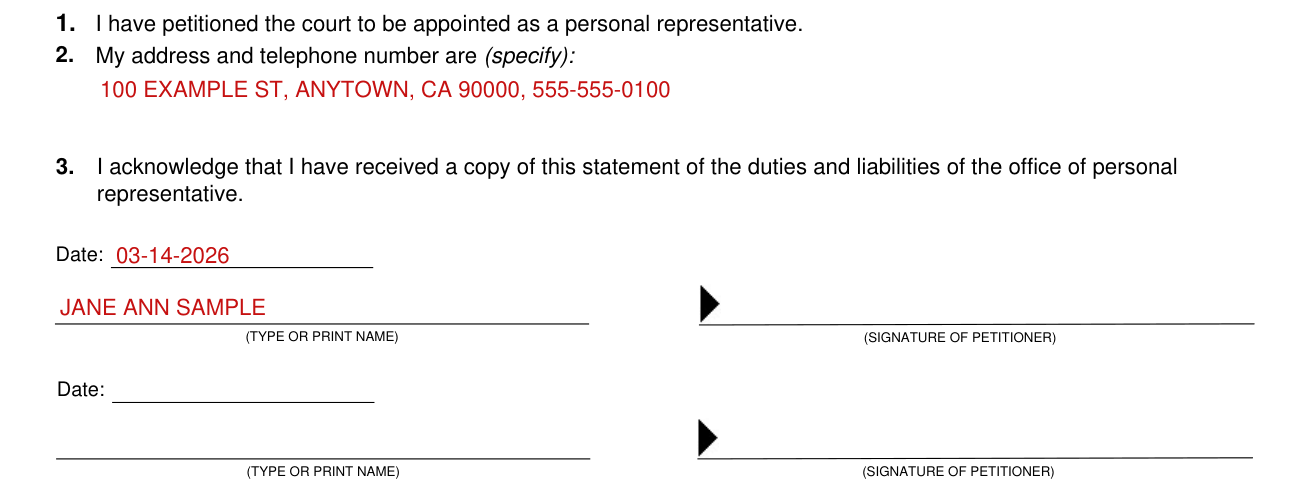
My address and telephone number are (specify):
Acknowledge that you have received a copy of this statement of the duties and liabilities of the office of personal representative: enter the Date and (TYPE OR PRINT NAME) and sign on (SIGNATURE OF PETITIONER).
More rules for Form DE-147
You must manage the estate assets with the care of a prudent person dealing with someone else's property. This means that you must be cautious and may not make any speculative investments.
You must keep the money and property in this estate separate from anyone else's, including your own. When you open a bank account for the estate, the account name must indicate that it is an estate account and not your personal account. Never deposit estate funds in your personal account or otherwise mix them with your or anyone else's property. Securities in the estate must also be held in a name that shows they are estate property and not your personal property.
Except for checking accounts intended for ordinary administration expenses, estate accounts must earn interest. You may deposit estate funds in insured accounts in financial institutions, but you should consult with an attorney before making other kinds of investments.
You should not spend any of the estate's money unless you have received permission from the court or have been advised by an attorney to do so. You may reimburse yourself for official court costs paid by you to the county clerk and for the premium on your bond. Without prior order of the court, you may not pay fees to yourself or to your attorney, if you have one. If you do not obtain the court's permission when it is required, you may be removed as personal representative or you may be required to reimburse the estate from your own personal funds, or both.
You must attempt to locate and take possession of all the decedent's property to be administered in the estate.
You must mail a notice of administration to each known creditor of the decedent within four months after your appointment as personal representative.
You should determine that there is appropriate and adequate insurance covering the assets and risks of the estate. Maintain the insurance in force during the entire period of the administration.
You must keep complete and accurate records of each financial transaction affecting the estate. You will have to prepare an account of all money and property you have received, what you have spent, and the date of each transaction. You must describe in detail what you have left after the payment of expenses.
Your account will be reviewed by the court. Save your receipts because the court may ask to review them.
If you do not file your accounts as required, the court will order you to do so. You may be removed as personal representative if you fail to comply.
This statement of duties and liabilities is a summary and is not a complete statement of the law. Your conduct as a personal representative is governed by the law itself and not by this summary.
Other situations
You file the inventory and appraisal
Within four months after Letters are first issued to you as personal representative, you must file with the court an inventory and appraisal of all the assets in the estate. You must arrange to have a court-appointed referee determine the value of the property unless the appointment is waived by the court. You, rather than the referee, must determine the value of certain "cash items."
You fail to perform your duties or to meet the deadlines
If you fail to perform your duties or to meet the deadlines, the court may reduce your compensation, remove you from office, and impose other sanctions.
The decedent received Medi-Cal assistance
If the decedent received Medi-Cal assistance, you must notify the State Director of Health Services within 90 days after appointment.
The decedent owned real property at the time of death
At the time you file the inventory and appraisal, you must also file a change of ownership statement with the county recorder or assessor in each county where the decedent owned real property at the time of death, as provided in section 480 of the California Revenue and Taxation Code.
You have an attorney
If you have an attorney, you should cooperate with the attorney at all times. You and your attorney are responsible for completing the estate administration as promptly as possible. When in doubt, contact your attorney.
Sources
[1] Form DE-147 (Rev. January 1, 2002), Duties and Liabilities of Personal Representative (Probate), Judicial Council of California (the Official source link on this page).
