
Form 2220 at a glance
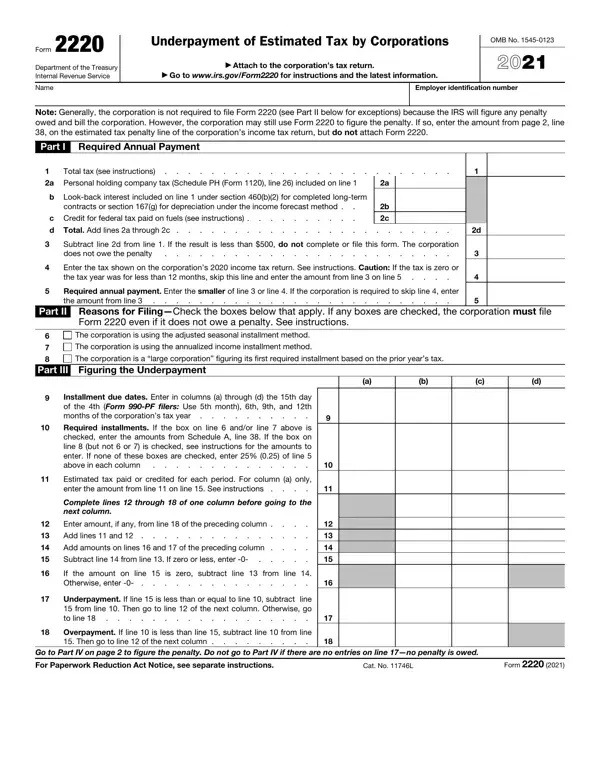
What it is: Form 2220, Underpayment of Estimated Tax by Corporations, is a form of the Department of the Treasury Internal Revenue Service.
Where and when to file: Attach Form 2220 to the corporation's tax return.
Corporations (including S corporations), tax-exempt organizations subject to the unrelated business income tax, and private foundations use Form 2220 to determine: whether they are subject to the penalty for underpayment of estimated tax and, if so, the amount of the underpayment penalty for the period that applies.[2]
Generally, the corporation does not have to file this form with its income tax return because the IRS will figure the amount of any penalty and notify the corporation of any amount due.[2]
However, even if the corporation does not owe a penalty, complete and attach this form to the corporation's tax return if the Part I, line 3, amount is $500 or more and any of the following apply. The adjusted seasonal installment method is used. The annualized income installment method is used. The corporation is a large corporation (as defined in the instructions for Part II, line 8) figuring its first required installment based on the prior year's tax (checked November 8, 2026).[2]
Generally, the corporation is not required to file Form 2220 (see Part II below for exceptions) because the IRS will figure any penalty owed and bill the corporation. However, the corporation may still use Form 2220 to figure the penalty. If so, enter the amount from page 2, line 38, on the estimated tax penalty line of the corporation's income tax return, but do not attach Form 2220.
A filled-in Form 2220 example: a corporation that paid every installment
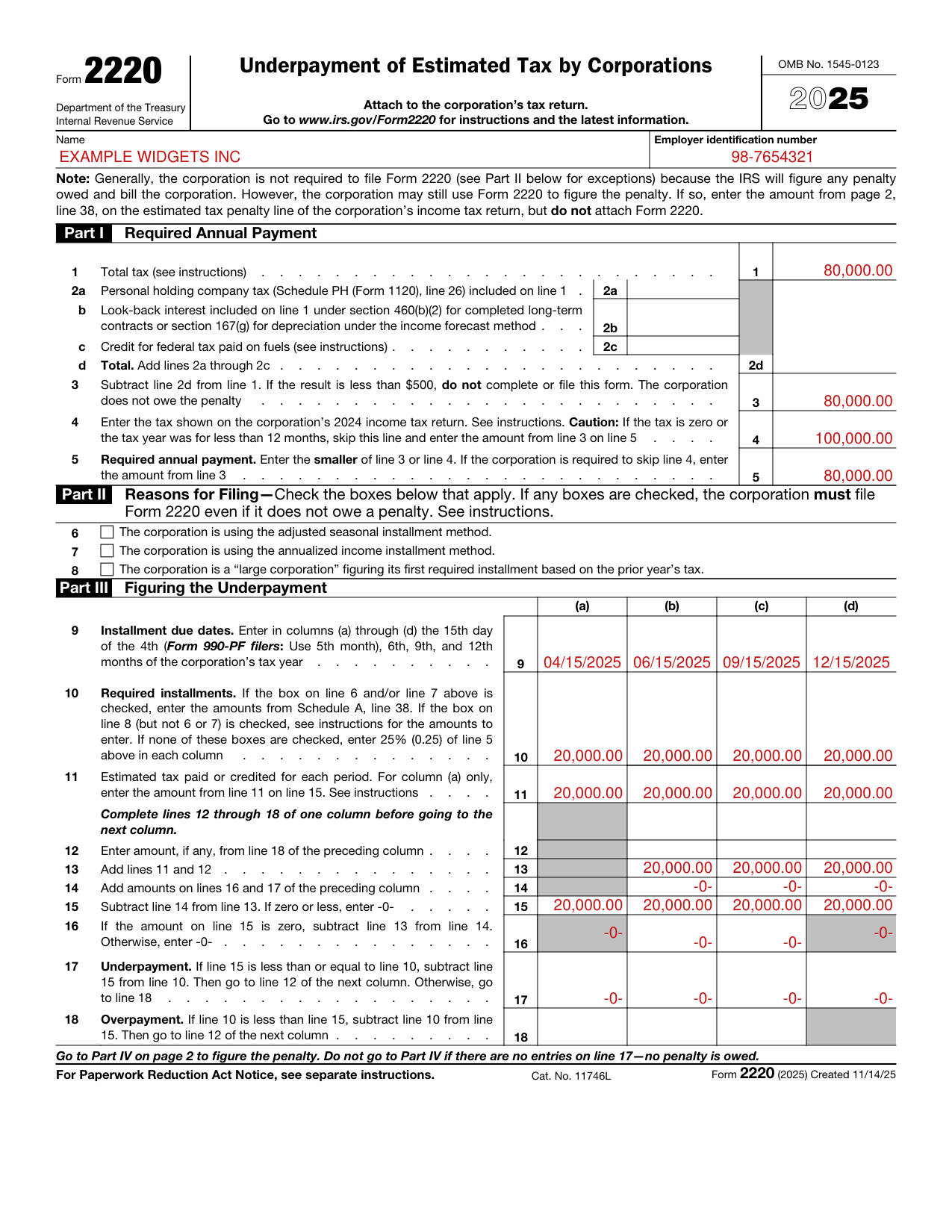
How to fill out Form 2220, box by box
Part I Required Annual Payment
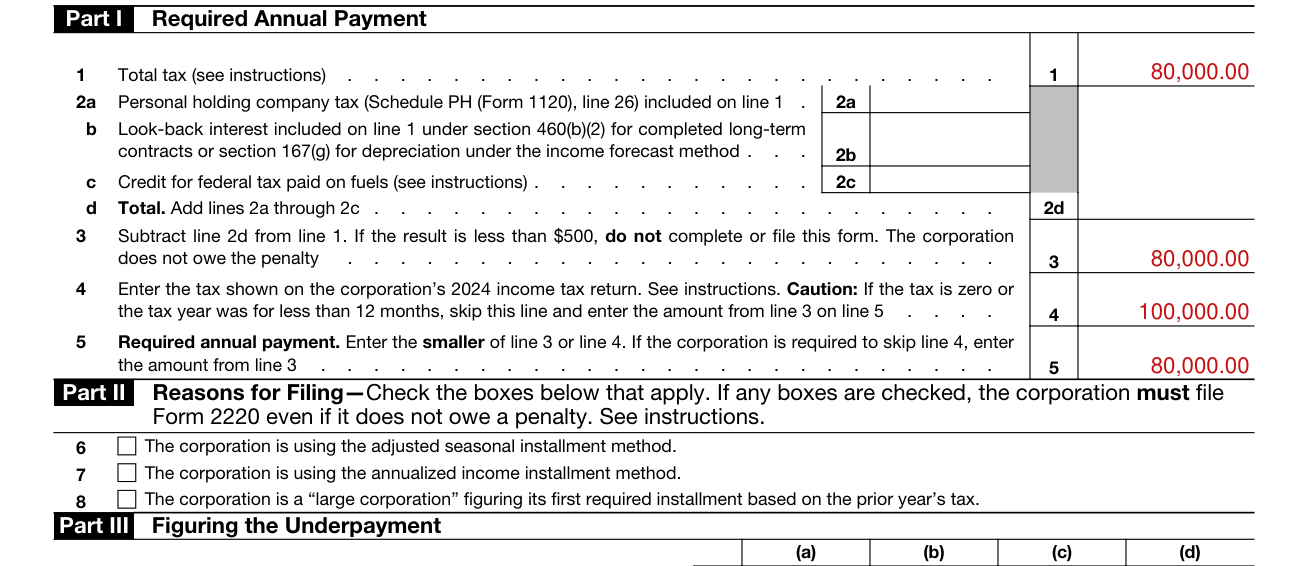
Complete lines 1 through 5 to figure the corporation's required annual payment.
On line 1, enter the Total tax (see instructions). Lines 2a through 2c are for the personal holding company tax (Schedule PH (Form 1120), line 26) included on line 1, the look-back interest included on line 1 under section 460(b)(2) for completed long-term contracts or section 167(g) for depreciation under the income forecast method, and the credit for federal tax paid on fuels (see instructions). On line 2d, add lines 2a through 2c.
On line 3, subtract line 2d from line 1. If the result is less than $500, do not complete or file this form. The corporation does not owe the penalty (checked November 8, 2026).
On line 4, enter the tax shown on the corporation's 2024 income tax return. Caution: If the tax is zero or the tax year was for less than 12 months, skip this line and enter the amount from line 3 on line 5. For all filers other than S corporations, figure the corporation's 2024 tax the same way the amount on line 3 of this form was determined, using the taxes and credits from its 2024 tax return.
On line 5, Required annual payment, enter the smaller of line 3 or line 4. If the corporation is required to skip line 4, enter the amount from line 3. Part II Reasons for Filing: Check the boxes below that apply. If any boxes are checked, the corporation must file Form 2220 even if it does not owe a penalty. See instructions.[2]
Part II Check the boxes below that apply

On line 6, check the box if the corporation is using the adjusted seasonal installment method.
On line 7, check the box if the corporation is using the annualized income installment method.
On line 8, check the box if the corporation is a large corporation figuring its first required installment based on the prior year's tax.
If the corporation checked a box in Part II, attach Form 2220 to the income tax return. Be sure to check the box on Form 1120, page 1, line 34; or the comparable line of any other income tax return the corporation is required to file.
If Schedule A is used for any payment due date, it must be used for all payment due dates.[2]
Part III Figuring the Underpayment
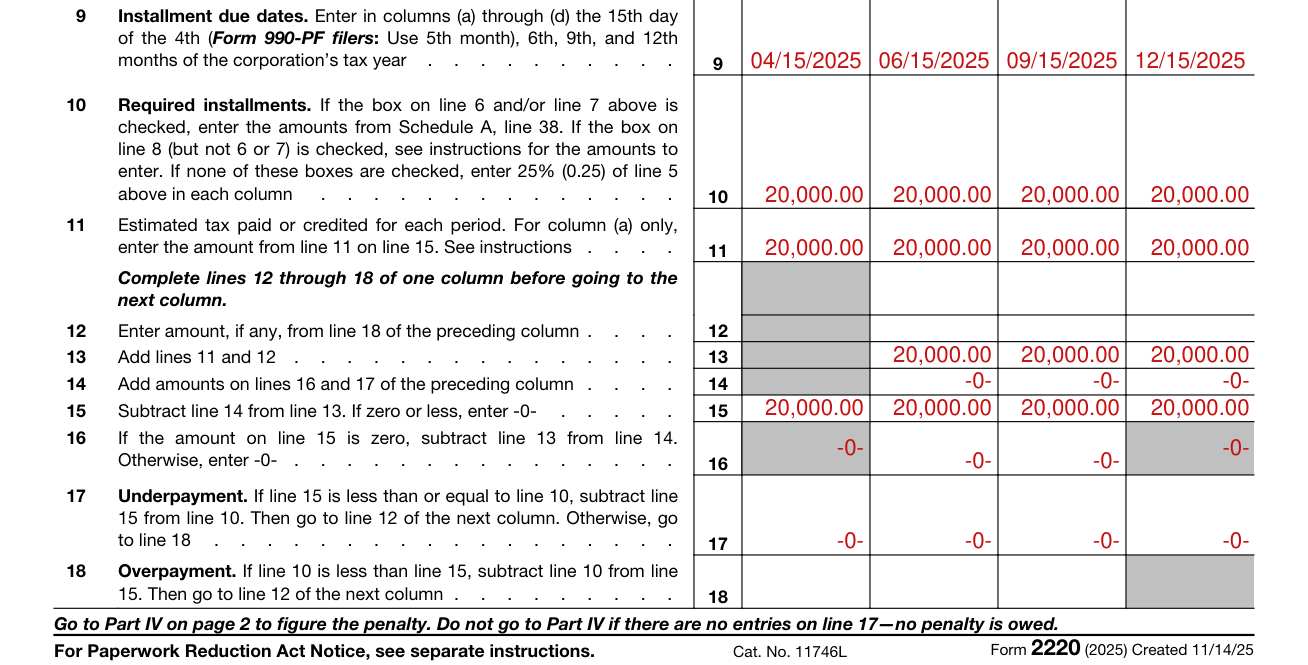
Figuring the Underpayment, line 9: enter in columns (a) through (d) the 15th day of the 4th (Form 990-PF filers: Use 5th month), 6th, 9th, and 12th months of the corporation's tax year.
On line 10, if the box on line 6 and/or line 7 above is checked, enter the amounts from Schedule A, line 38. If the box on line 8 (but not 6 or 7) is checked, see instructions for the amounts to enter. If none of these boxes are checked, enter 25% (0.25) of line 5 above in each column.
On line 11, enter the estimated tax paid or credited for each period. For column (a) only, enter the amount from line 11 on line 15.
Complete lines 12 through 18 of one column before going to the next column.
On line 12, enter the amount, if any, from line 18 of the preceding column. On line 13, add lines 11 and 12. On line 14, add the amounts on lines 16 and 17 of the preceding column. On line 15, subtract line 14 from line 13. If zero or less, enter -0-.
On line 16, if the amount on line 15 is zero, subtract line 13 from line 14. Otherwise, enter -0-.
On line 17, enter the Underpayment. If line 15 is less than or equal to line 10, subtract line 15 from line 10. Then go to line 12 of the next column. Otherwise, go to line 18. On line 18, Overpayment: if line 10 is less than line 15, subtract line 10 from line 15. Then go to line 12 of the next column. Go to Part IV on page 2 to figure the penalty. Do not go to Part IV if there are no entries on line 17-no penalty is owed. For Paperwork Reduction Act Notice, see separate instructions. Cat. No. 11746L Form 2220 (2025) Created 11/14/25.[2]
Part IV Figuring the Penalty
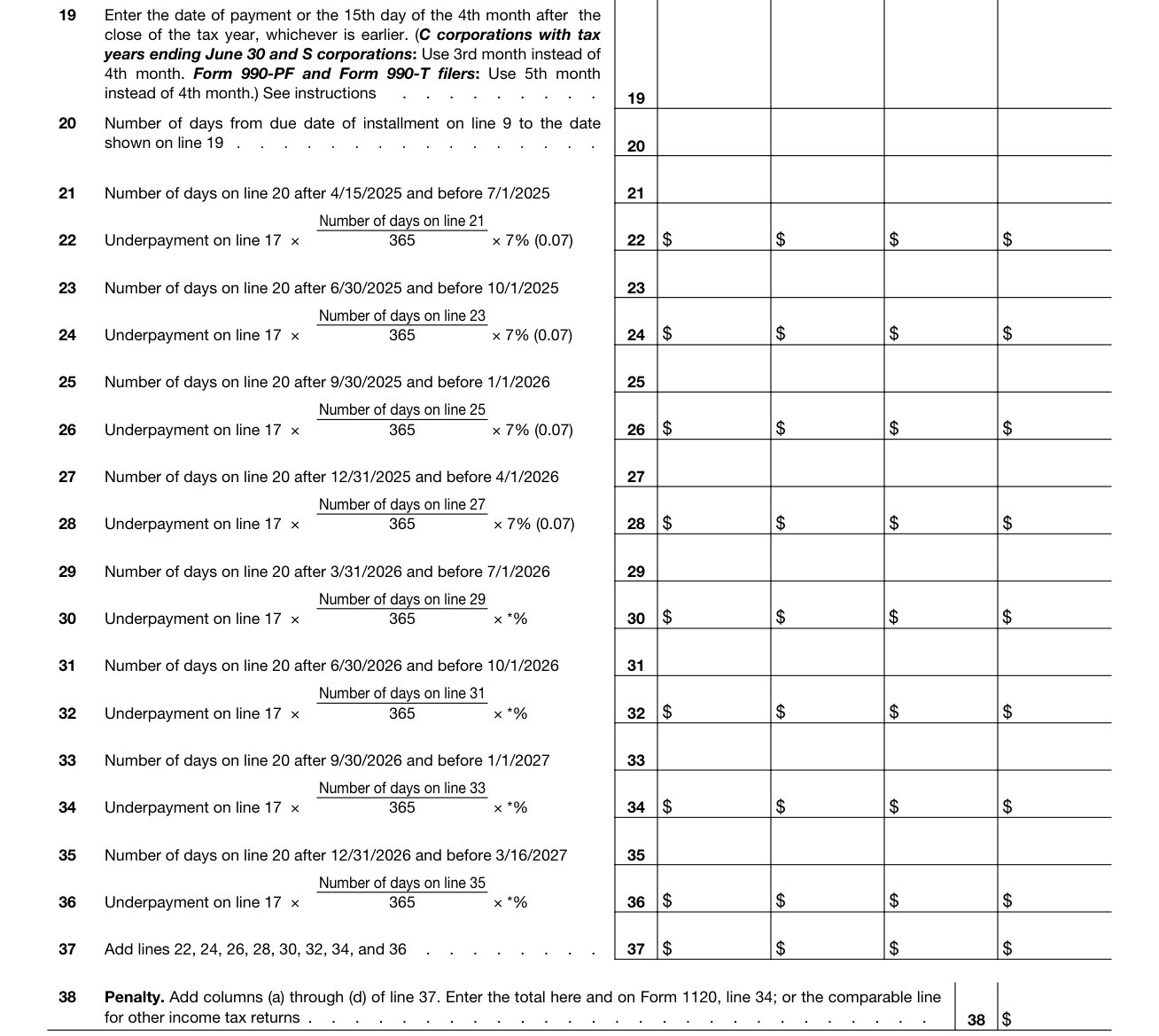
If any of the columns in line 17 shows an underpayment, complete Part IV to figure the penalty.
On line 19, enter the date of payment or the 15th day of the 4th month after the close of the tax year, whichever is earlier. C corporations with tax years ending June 30 and S corporations: Use 3rd month instead of 4th month. Form 990-PF and Form 990-T filers: Use 5th month instead of 4th month.
On line 20, enter the number of days from the due date of the installment on line 9 to the date shown on line 19.
On line 38, enter the Penalty: add columns (a) through (d) of line 37. Enter the total here and on Form 1120, line 34; or the comparable line for other income tax returns.[2]
Common questions about Form 2220
What is IRS form 2220?
Form 2220, Underpayment of Estimated Tax by Corporations, is a form of the Department of the Treasury Internal Revenue Service. The corporation may be able to reduce or eliminate the penalty by using the annualized income installment method or the adjusted seasonal installment method.[2]
What triggers an underpayment penalty from the IRS?
Generally, a corporation is subject to the penalty if it did not timely pay at least the smaller of: 1. The tax shown on its 2025 return, or 2. The tax shown on its 2024 return (if it filed a 2024 return showing at least some amount of tax and the return was for a full 12 months). However, a large corporation can base only its first required installment on the prior year's tax.[2]
Where do I file it?
Attach Form 2220 to the corporation's tax return.
Sources
[1] Form 2220 (2025), Underpayment of Estimated Tax by Corporations, Department of the Treasury, Internal Revenue Service.
[2] Instructions for Form 2220 (2025), Underpayment of Estimated Tax by Corporations, Department of the Treasury, Internal Revenue Service.