
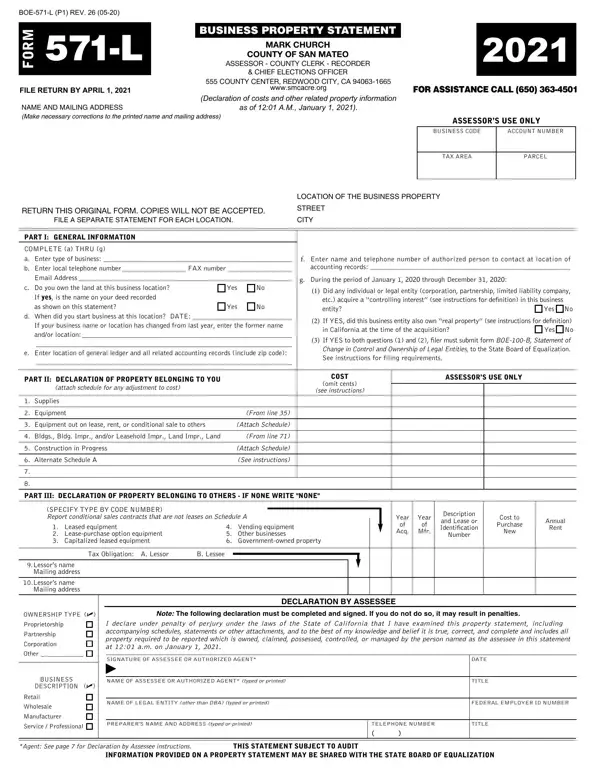

Form 571-L at a glance
What it is: Form 571-L is the Business Property Statement of the County of San Mateo Assessor, a declaration of costs and other related property information as of 12:01 A.M., January 1, 2026.
Where and when to file: File the return by April 1, 2026. For assistance call (650) 363-4501. Return this original form. Copies will not be accepted. File a separate statement for each location.
This form constitutes an official request that you declare all assessable business property situated in this county which you owned, claimed, possessed, controlled, or managed on the tax lien date, and that you sign (under penalty of perjury) and return the statement to the Assessor's Office by the date cited on the face of the form as required by law.
If you own taxable personal property in any other county whose aggregate cost is $100,000 or more for any assessment year, you must file a property statement with the Assessor of that county whether or not you are requested to do so. (checked October 19, 2026)
What to bring and attach to Form 571-L
Except for the "DECLARATION BY ASSESSEE" section, you may furnish attachments in lieu of entering the information on this property statement. However, such attachments must contain all the information requested by the statement and these instructions.
A filled-in Form 571-L example: a consultant with no property fills in page 1
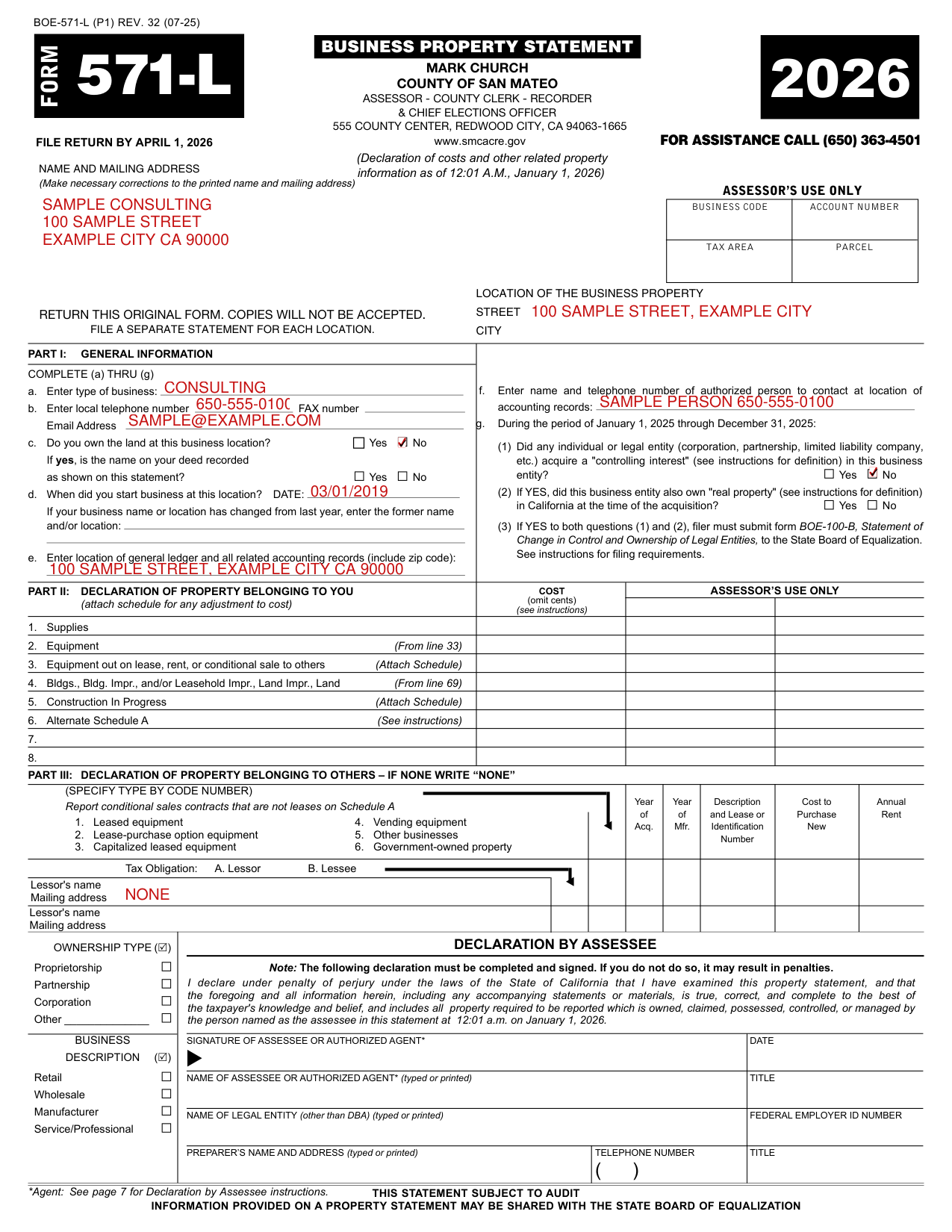
How to fill out Form 571-L, box by box
Name and mailing address

Enter the name and mailing address. If the information has been preprinted by the Assessor, make necessary corrections.
Individuals, enter the last name first, then the first name and middle initial.
Partnerships must enter at least two names, showing last name, first name and middle initial for each partner.
Corporations report the full corporate name.
If the business operates under a DBA (Doing Business As) or FICTITIOUS NAME, enter the DBA (Fictitious) name under which you are operating in this county under the name of the sole owner, partnership, or corporation.
Location of the business property

Enter the complete street address of the business property.
Forms for additional business or warehouse locations will be furnished upon request.
Part I: General Information
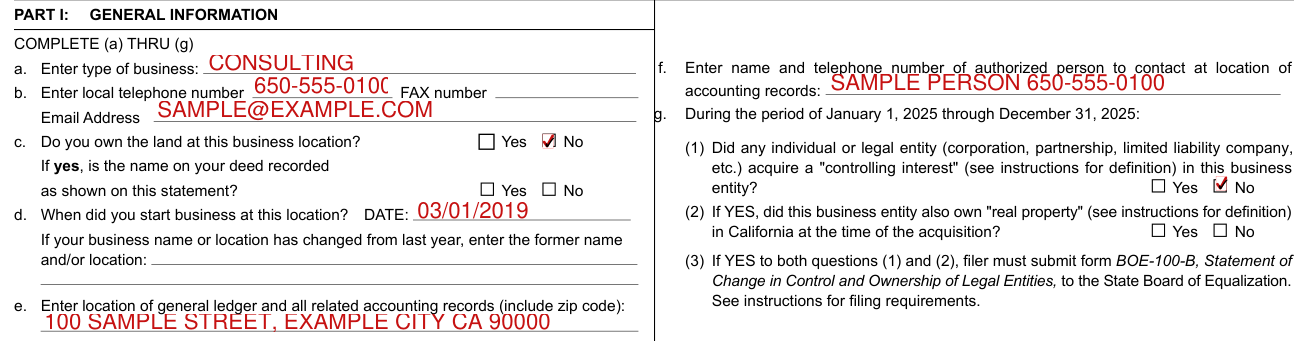
Part I: General Information. Complete (a) thru (g).
Enter type of business. Enter local telephone number, FAX number and Email Address.
Check either the YES or the NO box to indicate whether you own the land at the LOCATION OF THE PROPERTY shown on this statement.
If YES is checked, verify the official RECORDED NAME on your DEED. If it agrees with the name shown on this statement, check the second YES box. If it does not agree, check the second NO box.
Enter the date you started business at this location.
If your business name or location has changed from last year, enter the former name and/or location.
Location of records (e and f)
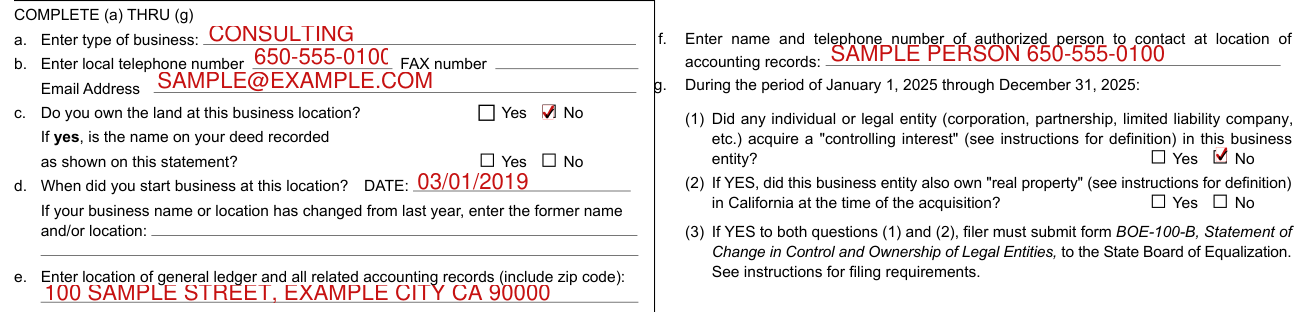
Location of records (e and f). Enter the address or addresses at which your general ledger and all related accounting records are maintained and available for audit.
Enter name and telephone number of authorized person to contact at location of accounting records.
During the period of January 1, 2025 through December 31, 2025

During the period of January 1, 2025 through December 31, 2025: (1) Did any individual or legal entity (corporation, partnership, limited liability company, etc.) acquire a "controlling interest" (see instructions for definition) in this business entity? Yes No (2) If YES, did this business entity also own "real property" (see instructions for definition) in California at the time of the acquisition? Yes No (3) If YES to both questions (1) and (2), filer must submit form BOE-100-B, Statement of Change in Control and Ownership of Legal Entities, to the State Board of Equalization. See instructions for filing requirements.
Part II: Declaration of property belonging to you

Attach schedule for any adjustment to cost. Enter cost (omit cents).
Report full cost (100 percent of actual cost). Include excise, sales, and use taxes, freight-in, installation charges, and all other relevant costs.
Enter total from Schedule A, line 33 (see instructions for Schedule A).
Report cost on line 3 and attach schedules showing the following: equipment actually out on lease or rent, equipment out on a conditional sale agreement, and equipment held for lease or rent which you have used or intend to use must be reported.
Enter total from Schedule B, line 69 (see instructions for Schedule B).
Describe and report the cost of tangible property not reported elsewhere on this form.
Part III: Declaration of property belonging to others
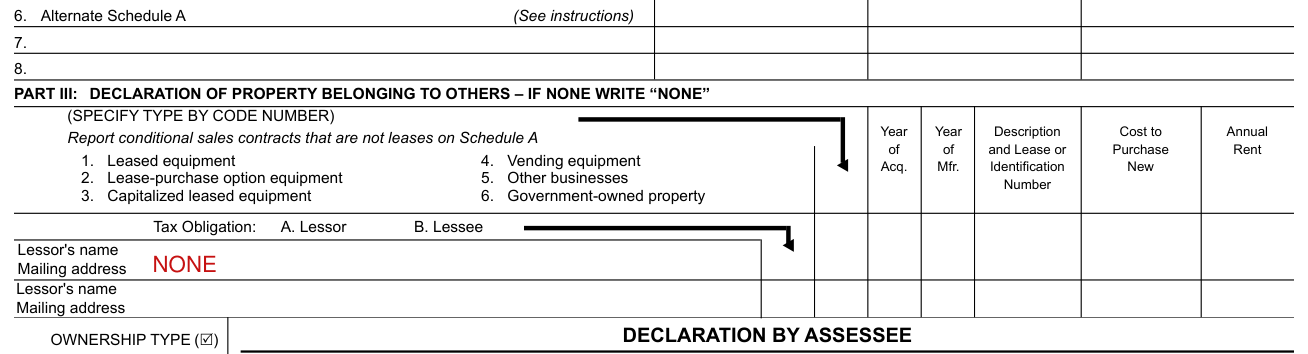
If none write "NONE".
If property belonging to others, or their business entities, is located on your premises, report the owner's name and mailing address.
If it is leased equipment, read your agreement carefully and enter A (Lessor) or B (Lessee), and whether lessor or lessee has the tax obligation. For assessment purposes, the Assessor will consider, but is not bound to, the contractual agreement.
1. Leased equipment: Report the year of acquisition, the year of manufacture, description of the leased property, the lease contract number or other identification number, the total installed cost to purchase (including sales tax), and the annual rent; do not include in Schedule A or B (see No. 3).
2. Lease-purchase option equipment: Report here all equipment acquired on lease-purchase option on which the final payment remains to be made. If final payment has been made, report full cost in Schedule A or B (see No. 3).
3. Capitalized leased equipment: Report here all leased equipment that has been capitalized at the present value of the minimum lease payments on which a final payment remains to be made. Do not include in Schedule A or B unless final payment has been made.
4. Vending equipment: Report the model and description of the equipment; do not include in Schedule A.
5. Other businesses: Report other businesses on your premises.
6. Government-owned property: If you possess or use government-owned land, improvements, or fixed equipment, or government-owned property is located on your premises, report the name and address of the agency which owns the property, and a description of the property.
Schedule A - Cost detail: Equipment
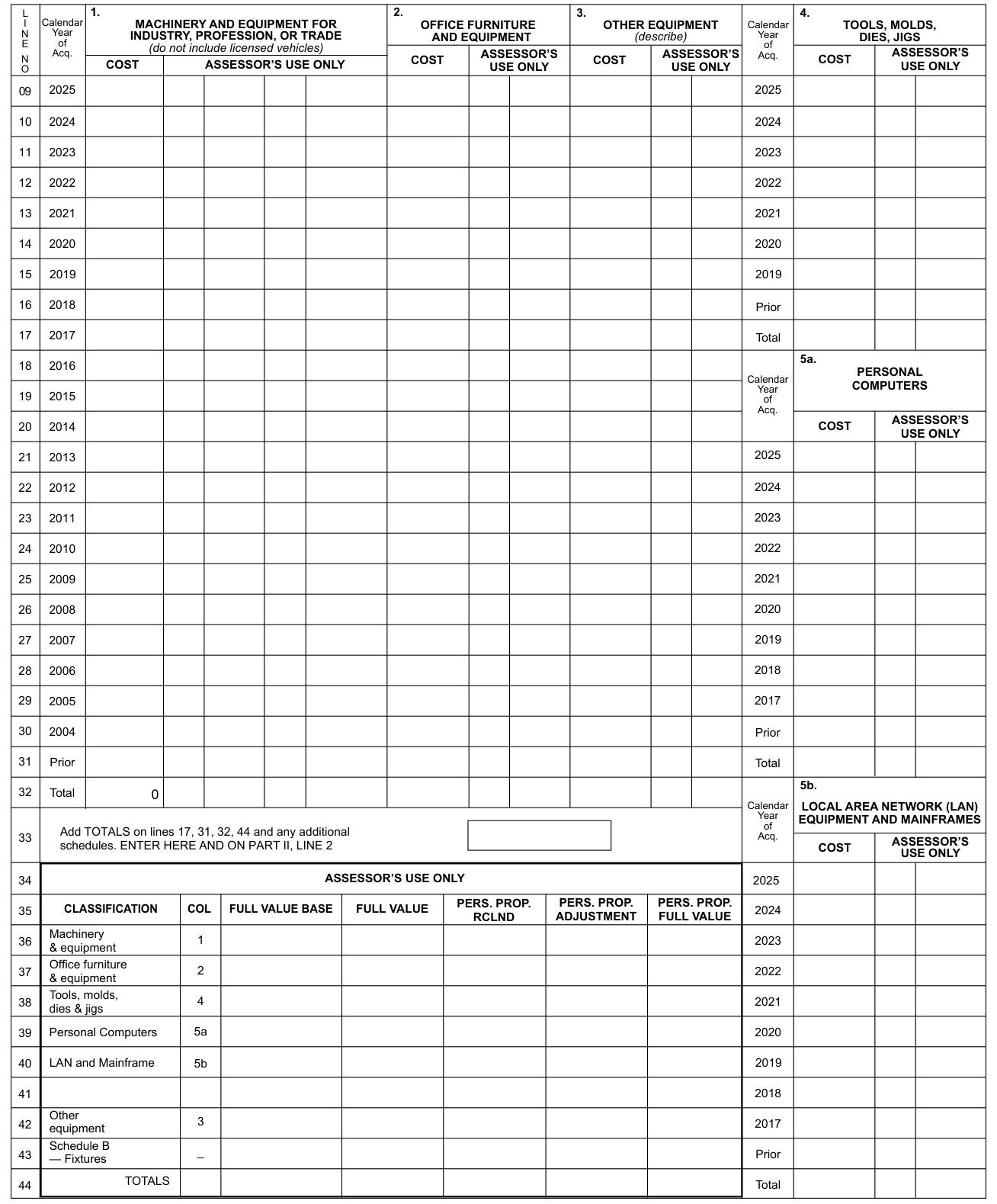
Do not include property reported in Part III. Enter in the appropriate column the cost of your equipment segregated by calendar year of acquisition, include short-lived or expensed equipment. Total each column.
Include sales or use tax (see instructions for important use tax information), freight and installation costs. Report full cost; do not deduct investment credits, trade-in allowances or depreciation.
Businesses must report and pay use tax on items purchased from out-of-state vendors not required to collect California tax on their sales.
Exclude the cost of equipment actually removed from the site. The cost of equipment retired but not removed from the site must be reported.
Line 33. Add totals on lines 17, Column 4; line 31, Column 5a; line 32, Columns 1, 2, 3; line 44, Column 5b; and any additional schedules. Enter the same figure on PART II, line 2, that you entered in the box.
Schedule B
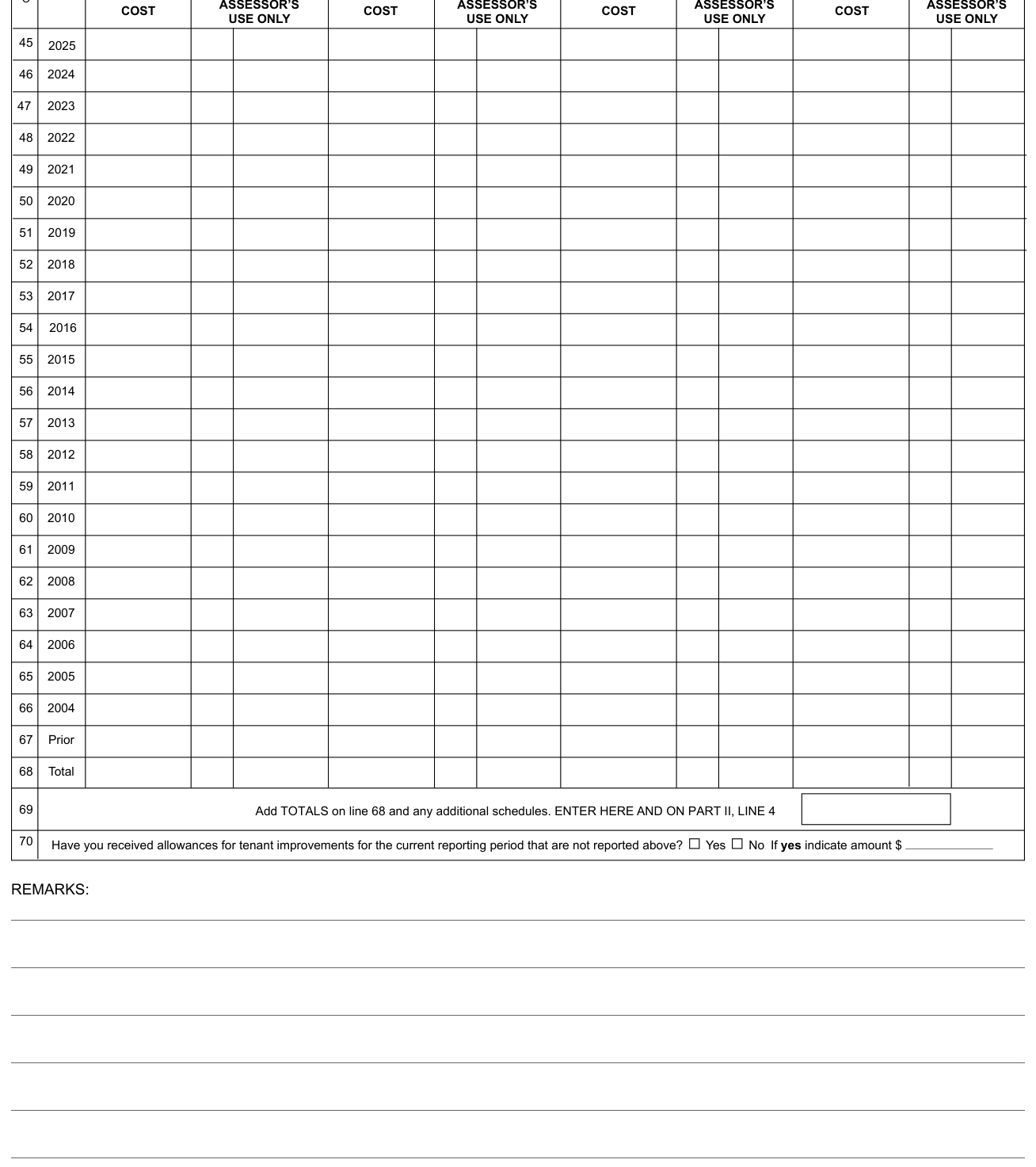
In the appropriate column enter costs, including cost of fully depreciated items, by the calendar year of acquisition and total each column. Do not include items that are reported in Schedule A.
Line 69. Add totals on line 68 and any additional schedules. Enter the same figure on PART II, line 4 that you entered in the box.
Declaration by assessee
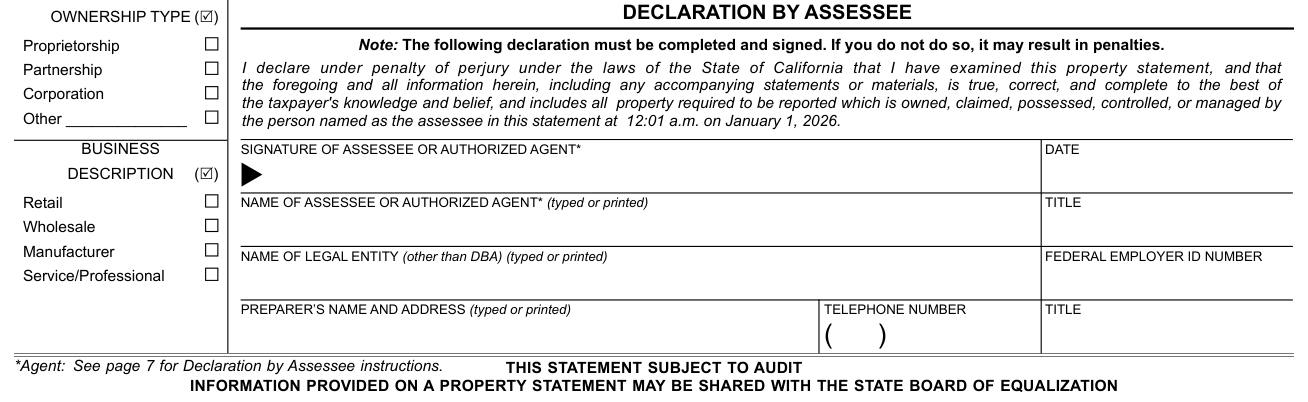
The law requires that this property statement, regardless of where it is executed, shall be declared to be true under penalty of perjury under the laws of the State of California.
The declaration must be signed by the assessee, a duly appointed fiduciary, or a person authorized to sign on behalf of the assessee.
A property statement that is not signed and executed in accordance with these instructions is not validly filed.
Common questions about Form 571-L
Is there a penalty?
Failure to file the statement during the time provided in section 441 of the Revenue and Taxation Code will compel the Assessor to estimate the value of your property from other information in the Assessor's possession and add a penalty of 10 percent of the assessed value as required by section 463 of the Code.
Sources
[1] Form 571-L (07-25), Business Property Statement, County of San Mateo Assessor-County Clerk-Recorder (the Official source link on this page).