

Form 945 at a glance
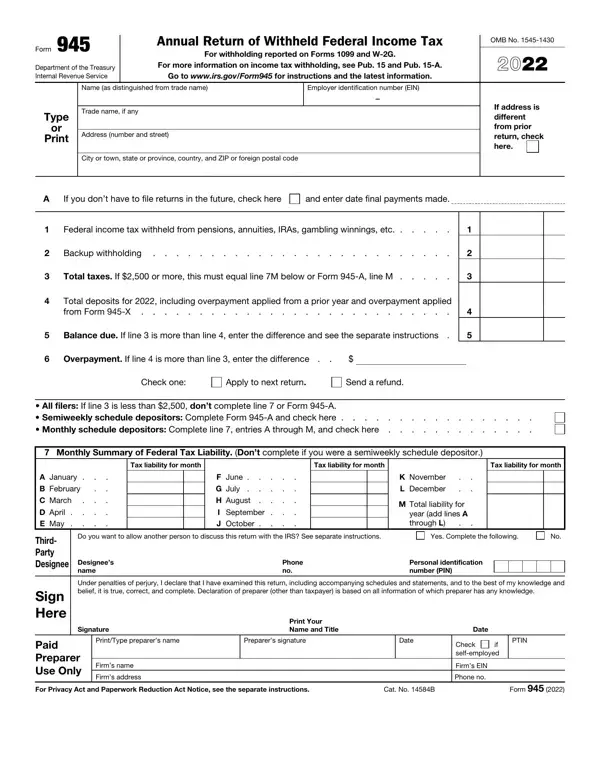
What it is: Form 945, Annual Return of Withheld Federal Income Tax, is for withholding reported on Forms 1099 and W-2G.
Where and when to file: You're encouraged to file Form 945 electronically.[2]
Use Form 945 to report federal income tax withheld (or required to be withheld) from nonpayroll payments.[2]
If you withhold or are required to withhold federal income tax (including backup withholding) from nonpayroll payments, you must file Form 945.[2]
You don't have to file Form 945 for those years in which you don't have a nonpayroll tax liability.[2]
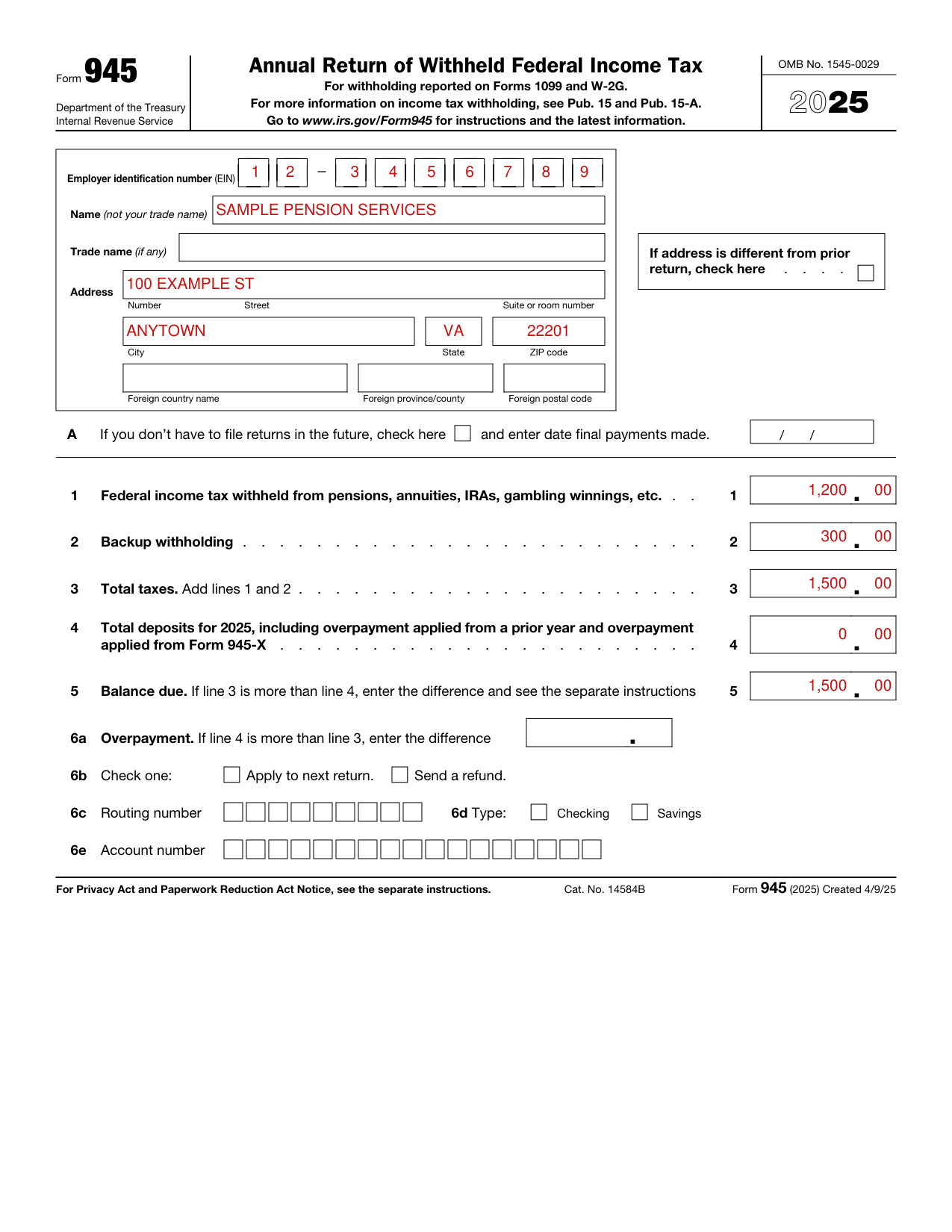
A filled-in Form 945 example: a pension payer with a balance due
How to fill out Form 945, box by box
EIN and address
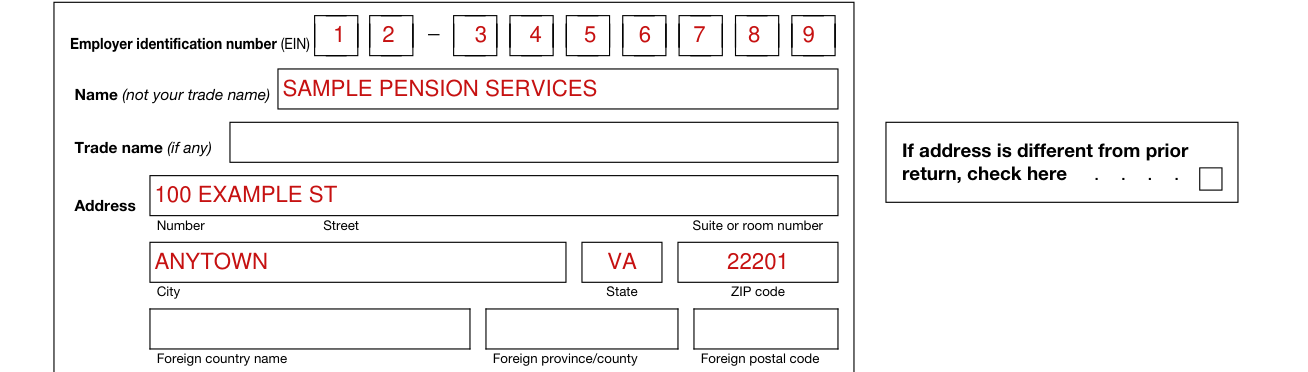
If you don't have an EIN, you may apply for one online by going to www.irs.gov/EIN. You may also apply for an EIN by faxing or mailing Form SS-4 to the IRS.
If you have applied for an EIN but don't have your EIN by the due date of Form 945, file a paper return and write “Applied For” and the date you applied in this entry space.
If address is different from prior return, check here.[2]
Line A, final return

If you go out of business or end operations and you won't have to file Form 945 in the future, file a final return. Be sure to check the box on line A and enter the date that final nonpayroll payments were made.[2]
Lines 1 to 3, the tax withheld

Completing Form 945: Enter dollars to the left of the preprinted decimal point and cents to the right of it. Don't round entries to whole dollars. Always show an amount for cents, even if it is zero.
Instructions for Form 945 (2026): Enter the federal income tax that you withheld (or were required to withhold) from pensions (including distributions from tax-favored retirement plans, for example, section 401(k), section 403(b), and governmental section 457(b) plans), annuities, IRA distributions, military retirement, Indian gaming profits, and gambling winnings (regular gambling withholding only; backup withholding on gambling winnings is reported on line 2).
Enter any backup withholding that you withheld (or were required to withhold), including backup withholding on gambling winnings.
Add lines 1 and 2.[2]
Lines 4 to 6a, balance due and overpayment

If line 3 is more than line 4, enter the difference on line 5.
Never make an entry on both lines 5 and 6a.
If line 4 is more than line 3, enter the difference on line 6a.[2]
Line 6b, apply to next return or refund

Choose to have your overpayment applied to your next return or refunded.
Check only one box on line 6b.[2]
Lines 6c to 6e, routing number and account type

The routing number must be 9 digits. The first 2 digits must be 01 through 12 or 21 through 32.
Check the appropriate box for the type of account. Don't check more than one box. You must check the correct box to ensure your deposit is accepted.[2]
Line 7, Monthly Summary of Federal Tax Liability
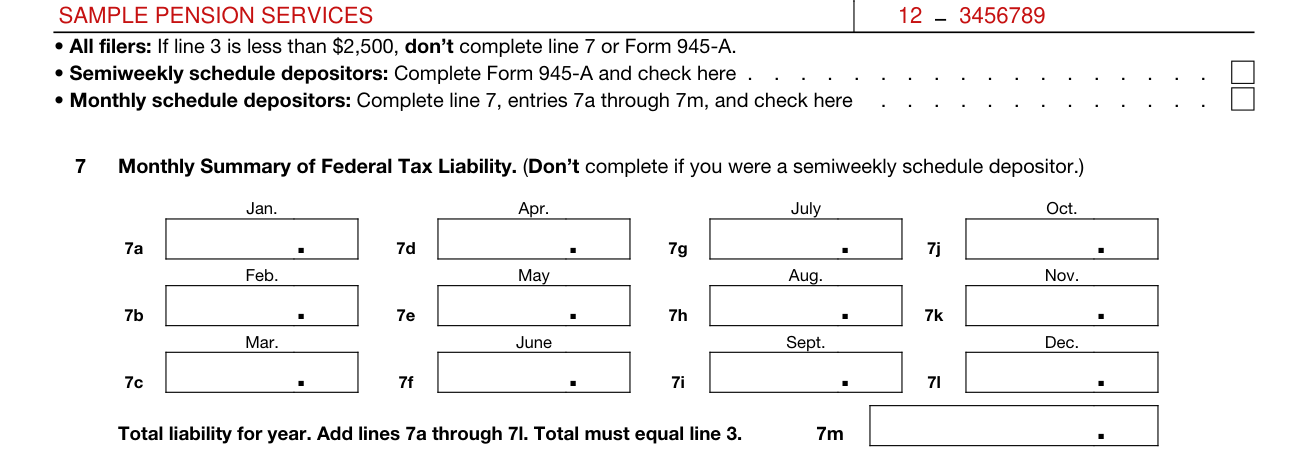
All filers: If line 3 is less than $2,500, don't complete line 7 or Form 945-A (checked November 8, 2026).
Monthly schedule depositors: Complete line 7, entries 7a through 7m, and check here.
Semiweekly schedule depositors: Complete Form 945-A and check here.
Monthly Summary of Federal Tax Liability. This is a summary of your monthly tax liability, not a summary of deposits made.
The amount entered on line 7m must equal the amount reported on line 3.[2]
Designee to discuss the return with the IRS

Do you want to allow an employee, a paid tax preparer, or another person to discuss this return with the IRS?
Enter the name, phone number, and 5-digit personal identification number (PIN) of the specific person to speak with-not the name of the firm that prepared your tax return.
The designee may choose any 5 numbers as their PIN.[2]
Sign here

Under penalties of perjury, I declare that I have examined this return, including accompanying schedules and statements, and to the best of my knowledge and belief, it is true, correct, and complete.
Paid Preparer Use Only
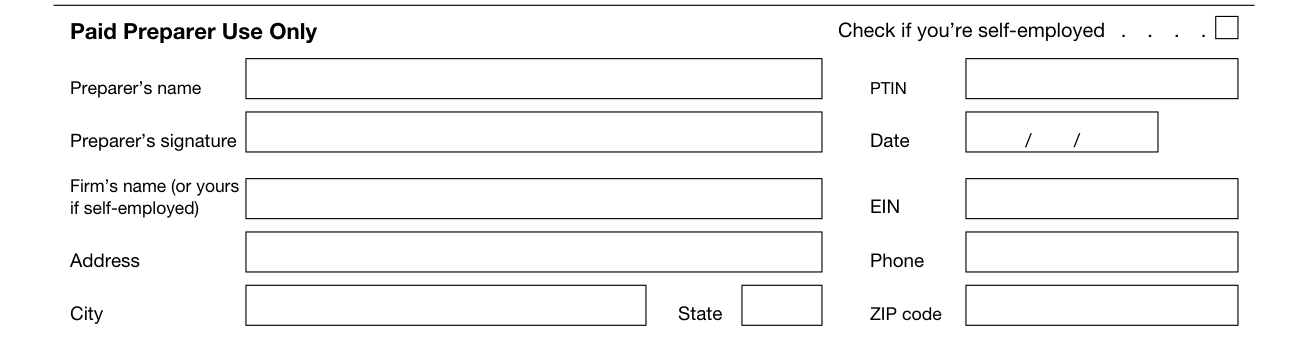
A paid preparer must sign Form 945 and provide the information in the Paid Preparer Use Only section if the preparer was paid to prepare Form 945 and isn't an employee of the filing entity.[2]
More rules for Form 945
Don't file more than one Form 945 for any calendar year.[2]
Pay by check or money order and deposit tax
You pay by check or money order
Complete Form 945-V if you're paying your balance due on Form 945 by check or money order.
If your only option is to pay by check or money order because you don't have access to U.S. banking services or electronic payment systems, make it payable to “United States Treasury.” Enter your EIN, “Form 945,” and the tax year on your check or money order. Complete Form 945-V and enclose with Form 945.[2]
You deposit the withheld tax
Deposit all nonpayroll (Form 945) withheld federal income tax, including backup withholding, by EFT.
Don't use Form 945-V to make federal tax deposits.[2]
Common questions about Form 945
What is a form 945 tax return?
Form 945, Annual Return of Withheld Federal Income Tax, is for withholding reported on Forms 1099 and W-2G. Report all federal income tax withholding from nonpayroll payments or distributions annually on one Form 945.[2]
How do I know if I am a monthly or semiweekly depositor?
For 2027, you're a monthly schedule depositor for Form 945 if the total tax reported on your 2025 Form 945 (line 3) was $50,000 or less (checked November 8, 2026). If the total tax reported for 2025 was more than $50,000, you're a semiweekly schedule depositor (checked November 8, 2026).[2]
Who signs it?
The following persons are authorized to sign the return for each type of business entity. Sole proprietorship-the individual who owns the business. Corporation (including a limited liability company (LLC) treated as a corporation)-the president, the vice president, or another principal officer duly authorized to sign. Partnership (including an LLC treated as a partnership) or unincorporated organization-a responsible and duly authorized partner, member, or officer having knowledge of its affairs. Single-member LLC treated as a disregarded entity for federal income tax purposes-the owner of the LLC or a principal officer duly authorized to sign. Trust or estate-the fiduciary. Form 945 may also be signed by a duly authorized agent of the taxpayer if a valid power of attorney has been filed.[2]
Is there a deadline?
For 2026, file Form 945 by February 1, 2027. However, if you made deposits on time in full payment of the taxes due for the year, you may file the return by February 10, 2027.[2]
Where do I file it?
You're encouraged to file Form 945 electronically. Go to IRS.gov/EmploymentEfile for more information on electronic filing.[2]
Are there fees?
EFTPS is a free service provided by the Department of the Treasury. Payments made using IRS Direct Pay or through your IRS business tax account are also free.[2]
Is there a penalty?
There are penalties for filing Form 945 late and for paying or depositing taxes late, unless filing and/or paying late are due to reasonable cause and not due to willful neglect. If taxes that must be withheld (that is, trust fund taxes) aren't withheld or aren't deposited or paid to the U.S. Treasury, the trust fund recovery penalty may apply. The penalty is 100% of the unpaid trust fund taxes.[2]
When is this form not the right one?
Do not report federal income tax withholding from wages on Form 945. Do not report on Form 945 withholding that is required to be reported on Form 1042, Annual Withholding Tax Return for U.S. Source Income of Foreign Persons.[2]
Sources
[1] Form 945 (2025), Annual Return of Withheld Federal Income Tax, Department of the Treasury Internal Revenue Service (the Official source link on this page).
[2] Instructions for Form 945 (2026), Department of the Treasury Internal Revenue Service.