

Health Care Practitioner Physical Assessment Form at a glance
What it is: The Health Care Practitioner Physical Assessment Form is to be completed by a primary physician, certified nurse practitioner, registered nurse, certified nurse-midwife or physician assistant.
Who signs: The health care practitioner enters Print Name and Date, and signs on the Signature of Health Care Practitioner line, after marking independently without assistance, can do so with physical assistance, reminders, or supervision only, or need to have medications administered by someone else. The prescriber signs on the Prescriber's Signature line, and enters Date, Office Address and Phone.
A filled-in Health Care Practitioner Physical Assessment Form example: a practitioner completes page 1 for one resident
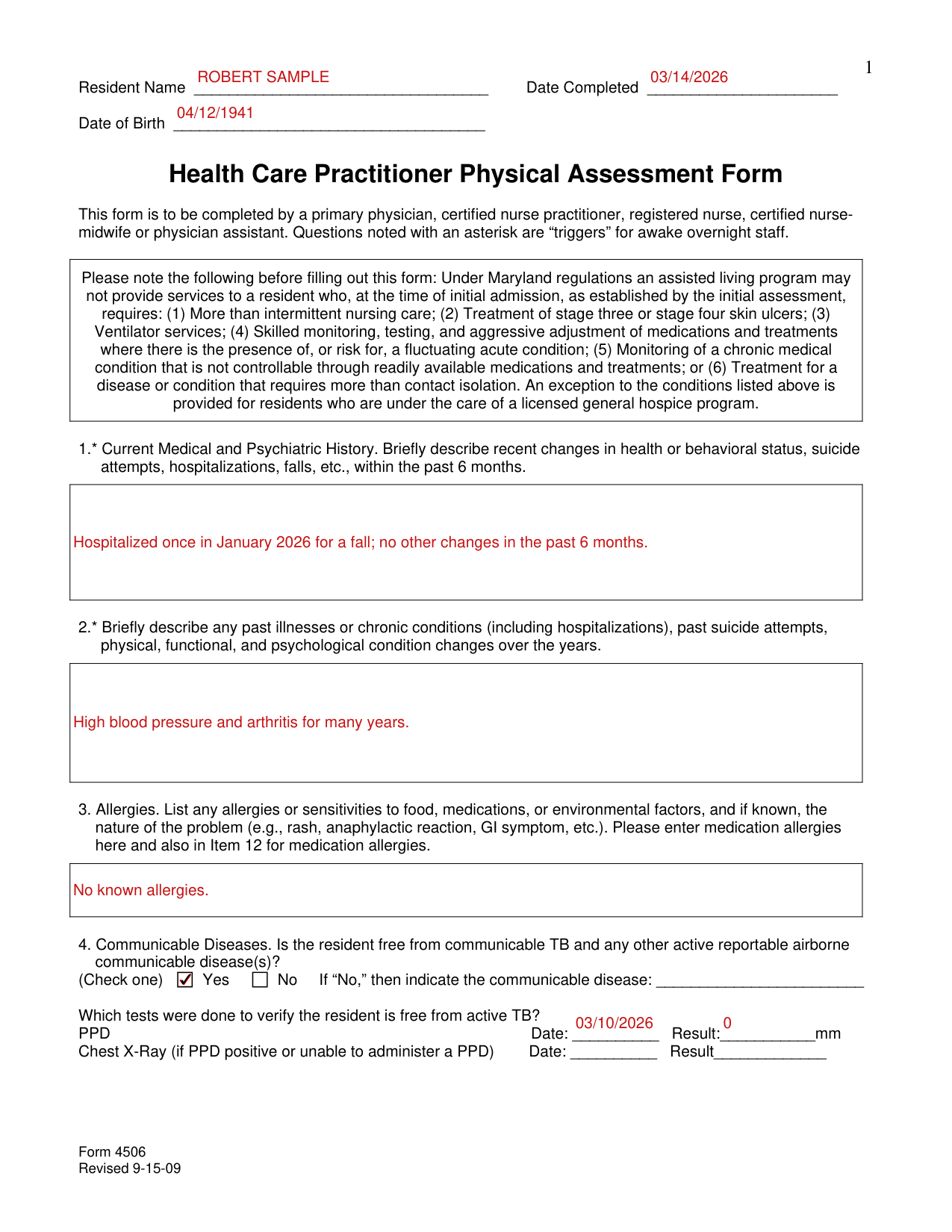
How to fill out Health Care Practitioner Physical Assessment Form, box by box
Resident name, date completed and date of birth

Fill in Resident Name, Date Completed and Date of Birth on pages 1, 2, 3 and 4.
History and allergies
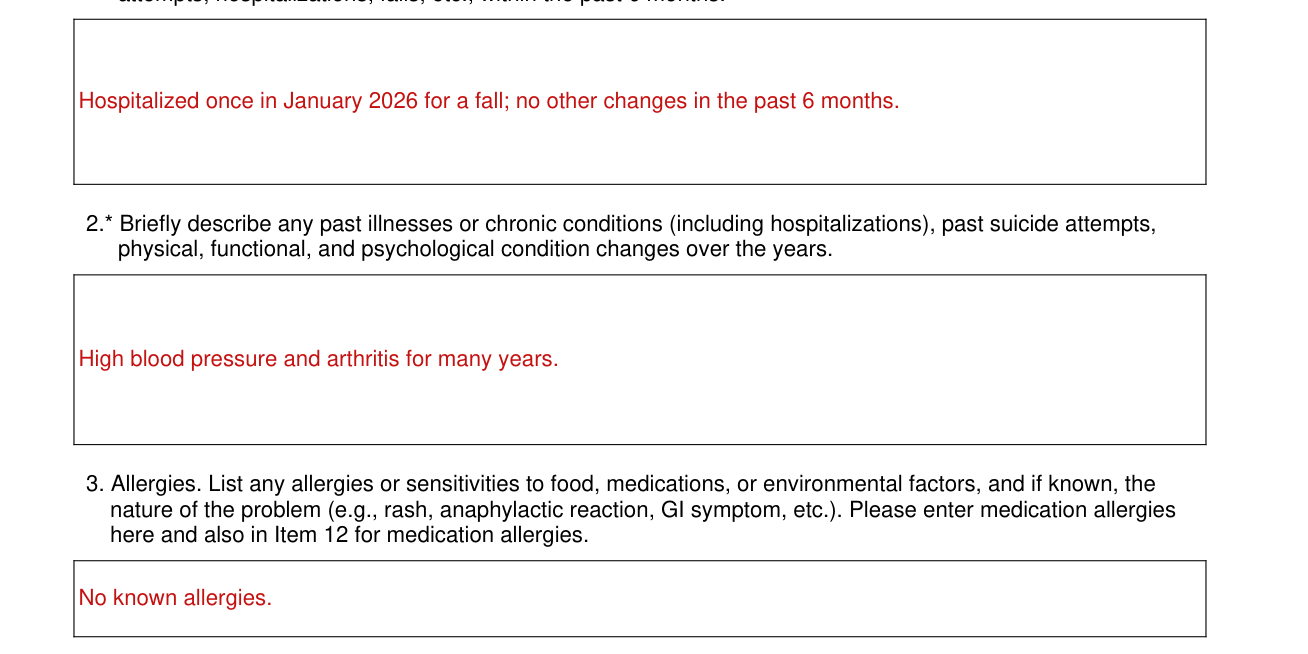
1.* Current Medical and Psychiatric History: briefly describe recent changes in health or behavioral status, suicide attempts, hospitalizations, falls, etc., within the past 6 months.
2.* Briefly describe any past illnesses or chronic conditions (including hospitalizations), past suicide attempts, physical, functional, and psychological condition changes over the years.
3. Allergies: list any allergies or sensitivities to food, medications, or environmental factors, and if known, the nature of the problem. Enter medication allergies here and also in Item 12 for medication allergies.
Communicable diseases

4. Communicable Diseases: is the resident free from communicable TB and any other active reportable airborne communicable disease(s)? (Check one) Yes or No. If “No,” then indicate the communicable disease.
Tests done to verify the resident is free from active TB: PPD, with Date and Result in mm; Chest X-Ray (if PPD positive or unable to administer a PPD), with Date and Result.
Page 2, history of abuse or misuse
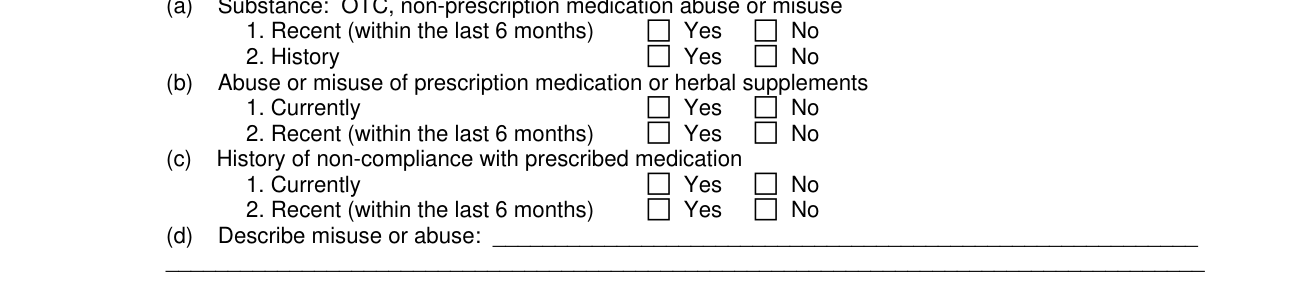
5. History: does the resident have a history or current problem related to abuse of prescription, non-prescription, over-the-counter (OTC), illegal drugs, alcohol, inhalants, etc.?
(a) Substance: OTC, non-prescription medication abuse or misuse: mark Yes or No for Recent (within the last 6 months) and for History.
(b) Abuse or misuse of prescription medication or herbal supplements: mark Yes or No for Currently and for Recent (within the last 6 months).
(c) History of non-compliance with prescribed medication: mark Yes or No for Currently and for Recent (within the last 6 months). (d) Describe misuse or abuse.
Page 2, risk factors for falls and skin condition

6.* Risk factors for falls and injury: identify any conditions about this resident that increase his/her risk of falling or injury (check all that apply): orthostatic hypotension, osteoporosis, gait problem, impaired balance, confusion, Parkinsonism, foot deformity, pain, assistive devices, other (explain).
7.* Skin condition(s): identify any history of or current ulcers, rashes, or skin tears with any standing treatment orders.
Page 2, sensory impairments

8.* Sensory impairments affecting functioning (check all that apply): (a) Hearing, Left ear and Right ear: Adequate, Poor, Deaf, Uses corrective aid; (b) Vision: Adequate, Poor, Uses corrective lenses, Blind (check all that apply) R or L; (c) Temperature Sensitivity: Normal or Decreased sensation to Heat or Cold.
Page 2, current nutritional status
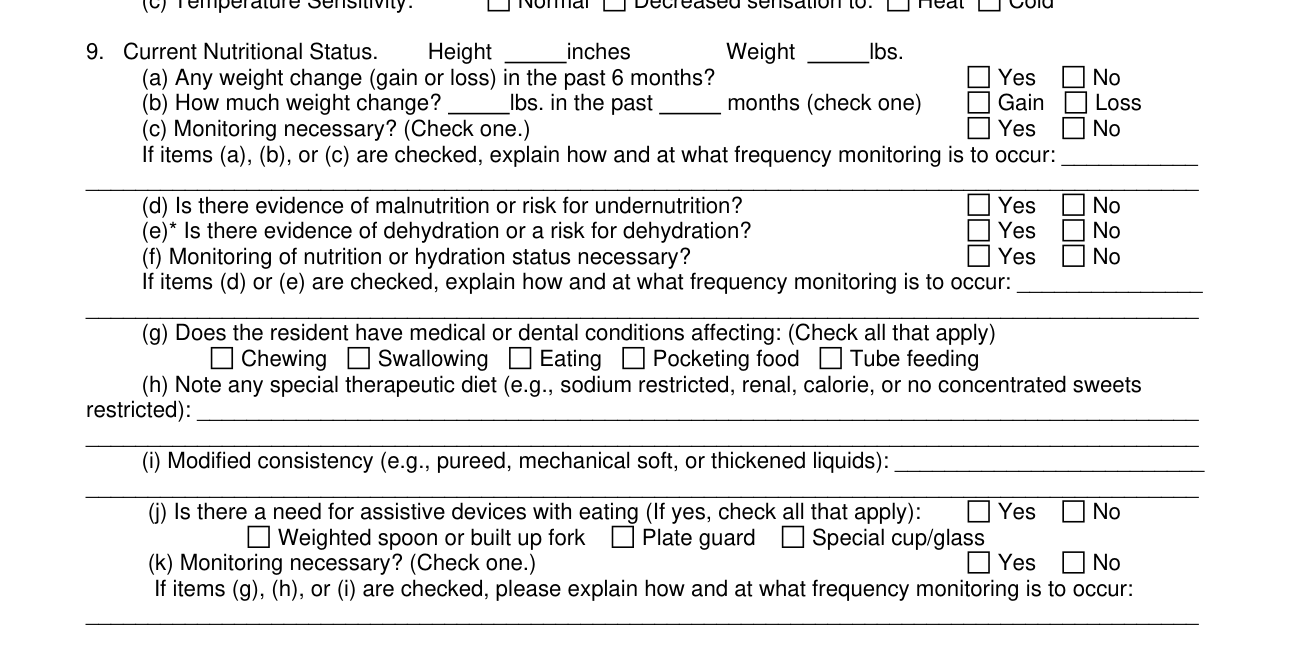
9. Current Nutritional Status: enter Height in inches and Weight in lbs. (a) Any weight change (gain or loss) in the past 6 months? (b) How much weight change, in lbs. in the past months (check one) Gain or Loss? (c) Monitoring necessary? (Check one.) Yes or No. If items (a), (b), or (c) are checked, explain how and at what frequency monitoring is to occur.
(d) Is there evidence of malnutrition or risk for undernutrition? (e)* Is there evidence of dehydration or a risk for dehydration? (f) Monitoring of nutrition or hydration status necessary? Yes or No. If items (d) or (e) are checked, explain how and at what frequency monitoring is to occur.
(g) Does the resident have medical or dental conditions affecting: (Check all that apply) Chewing, Swallowing, Eating, Pocketing food, Tube feeding. (h) Note any special therapeutic diet (e.g., sodium restricted, renal, calorie, or no concentrated sweets restricted). (i) Modified consistency (e.g., pureed, mechanical soft, or thickened liquids). (j) Is there a need for assistive devices with eating (If yes, check all that apply): Weighted spoon or built up fork, Plate guard, Special cup/glass. (k) Monitoring necessary? (Check one.) Yes or No. If items (g), (h), or (i) are checked, please explain how and at what frequency monitoring is to occur.
Page 3, cognitive and behavioral status

10.* Cognitive/Behavioral Status: (a)* Is there evidence of dementia? (Check one.) Yes or No. (b) Has the resident undergone an evaluation for dementia? Yes or No.
(c)* Diagnosis (cause(s) of dementia): Alzheimer's Disease, Multi-infarct/Vascular, Parkinson's Disease, Other. (d) Mini-Mental Status Exam (if tested): enter Date and Score.
Page 3, item 10(e) frequency and intensity
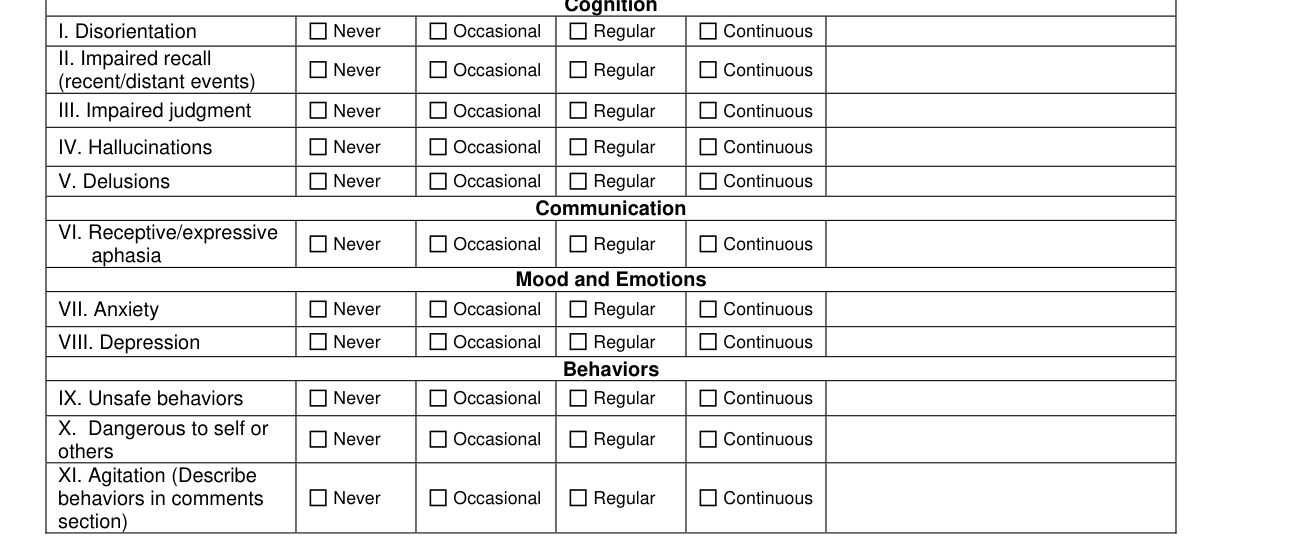
10(e)* Instructions for the following items: for each item, circle the appropriate level of frequency or intensity, depending on the item. Use the “Comments” column to provide any relevant details.
Item 10(e), A, B*, C*, D* and Comments: Never, Occasional, Regular or Continuous for I. Disorientation, II. Impaired recall (recent/distant events), III. Impaired judgment, IV. Hallucinations, V. Delusions, VI. Receptive/expressive aphasia, VII. Anxiety, VIII. Depression, IX. Unsafe behaviors, X. Dangerous to self or others and XI. Agitation (describe behaviors in the comments section).
Page 3, decision-making, self-administering medications and signing
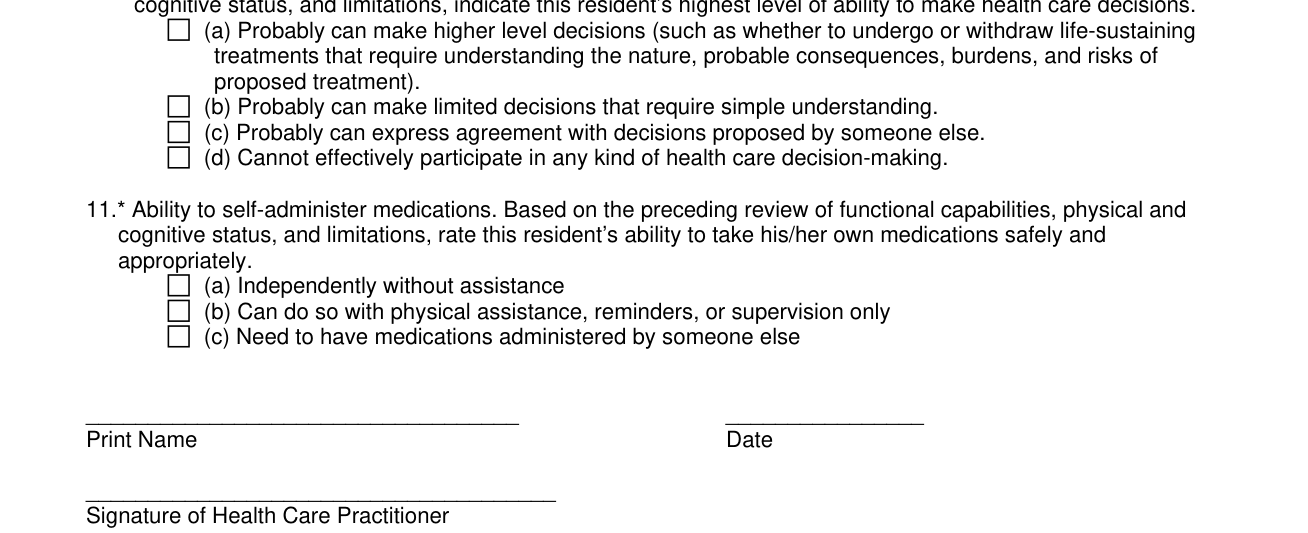
10(f) Health care decision-making capacity: based on the preceding review of functional capabilities, physical and cognitive status, and limitations, indicate this resident's highest level of ability to make health care decisions.
(a) Probably can make higher level decisions (such as whether to undergo or withdraw life-sustaining treatments that require understanding the nature, probable consequences, burdens, and risks of proposed treatment).
(b) Probably can make limited decisions that require simple understanding; (c) Probably can express agreement with decisions proposed by someone else; (d) Cannot effectively participate in any kind of health care decision-making.
11.* Ability to self-administer medications: based on the preceding review of functional capabilities, physical and cognitive status, and limitations, rate this resident's ability to take his/her own medications safely and appropriately.
(a) Independently without assistance, (b) Can do so with physical assistance, reminders, or supervision only, or (c) Need to have medications administered by someone else. Enter Print Name and Date, and sign on the Signature of Health Care Practitioner line.
Page 4, prescriber's medication and treatment orders
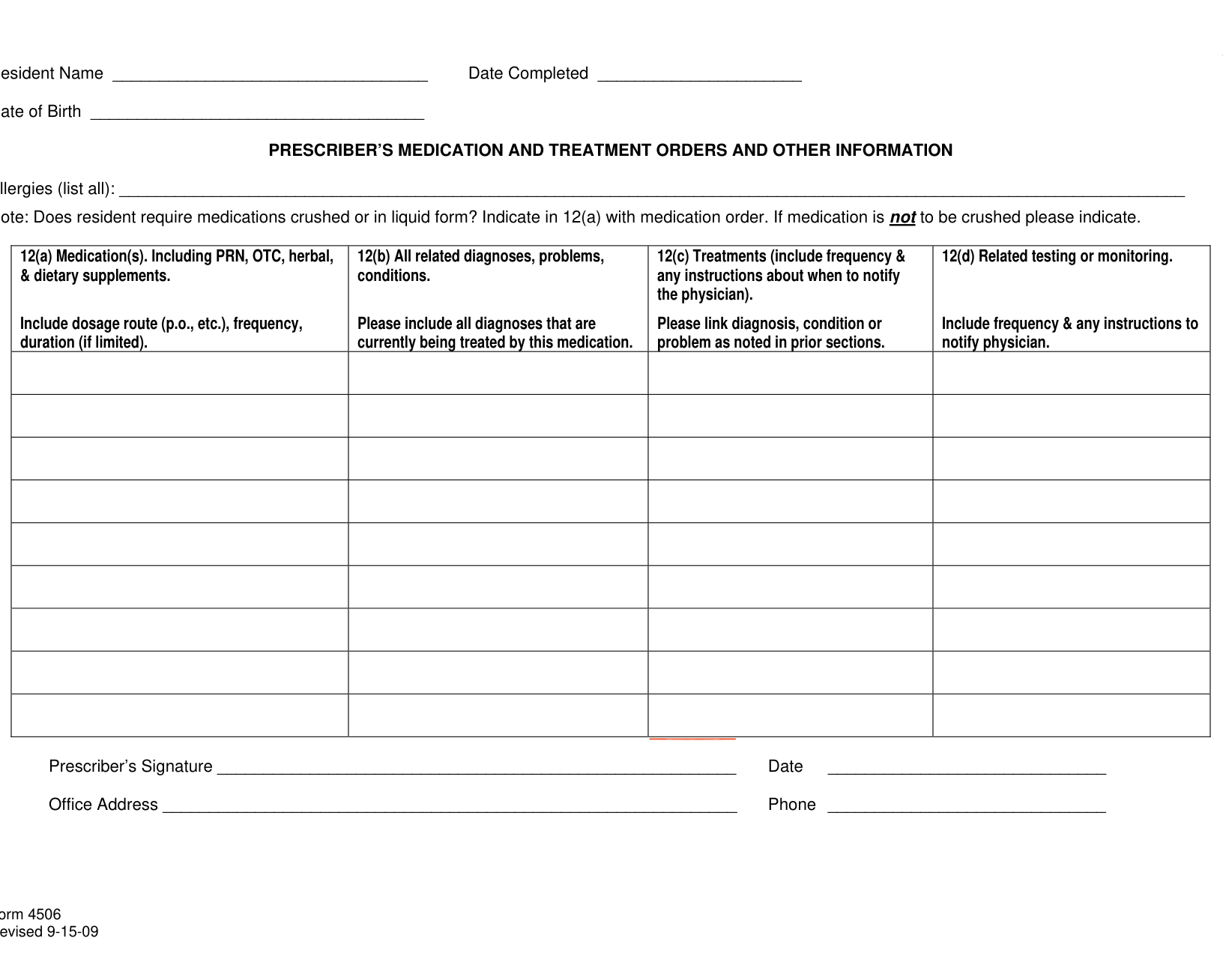
Prescriber's medication and treatment orders and other information: list all Allergies. Does the resident require medications crushed or in liquid form? Indicate in 12(a) with the medication order. If a medication is not to be crushed, please indicate.
12(a) Medication(s): include PRN, OTC, herbal, & dietary supplements. Include dosage route (p.o., etc.), frequency, duration (if limited).
12(b) All related diagnoses, problems, conditions: include all diagnoses that are currently being treated by this medication.
12(c) Treatments (include frequency & any instructions about when to notify the physician): link diagnosis, condition or problem as noted in prior sections.
12(d) Related testing or monitoring: include frequency & any instructions to notify physician.
The prescriber signs on the Prescriber's Signature line, and enters Date, Office Address and Phone.
More rules for Health Care Practitioner Physical Assessment Form
Questions noted with an asterisk are “triggers” for awake overnight staff.
If your situation is different
The resident requires a service an assisted living program may not provide in Maryland
Under Maryland regulations an assisted living program may not provide services to a resident who, at the time of initial admission, as established by the initial assessment, requires: (1) More than intermittent nursing care; (2) Treatment of stage three or stage four skin ulcers; (3) Ventilator services; (4) Skilled monitoring, testing, and aggressive adjustment of medications and treatments where there is the presence of, or risk for, a fluctuating acute condition; (5) Monitoring of a chronic medical condition that is not controllable through readily available medications and treatments; or (6) Treatment for a disease or condition that requires more than contact isolation.
An exception to these conditions is provided for residents who are under the care of a licensed general hospice program.
Sources
[1] Health Care Practitioner Physical Assessment Form (Form 4506, Revised 9-15-09) (the Official source link on this page).
