

Form HUD-NPMA-99-A at a glance
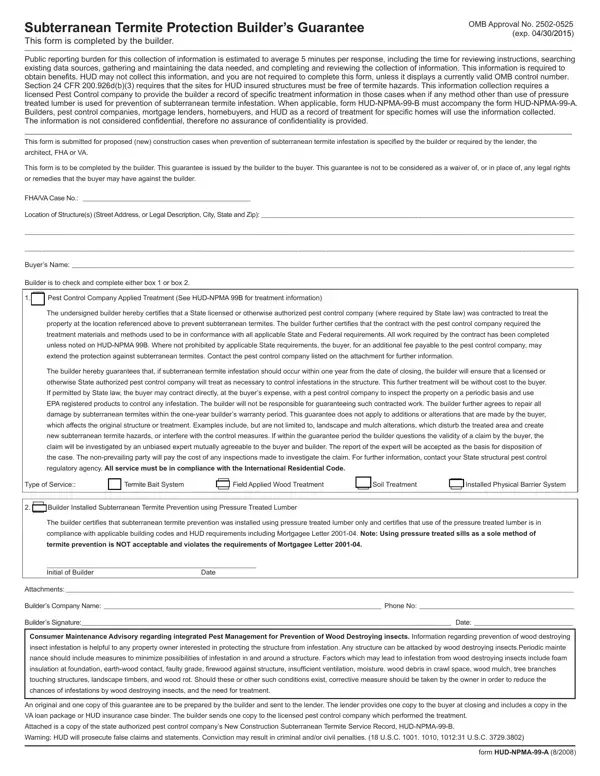
What it is: This form is the Subterranean Termite Protection Builder's Guarantee, completed by the builder.
Who signs: Builder's Signature and Date.
This form is submitted for proposed (new) construction cases when prevention of subterranean termite infestation is specified by the builder or required by the lender, the architect, FHA, or the Department of Veterans Affairs (VA).
This form is to be completed by the builder. This guarantee is issued by the builder to the buyer.
What to bring and attach to Form HUD-NPMA-99-A
When applicable, form HUD-NPMA-99-B, New Construction Subterranean Termite Service Record, must accompany form HUD-NPMA-99-A.
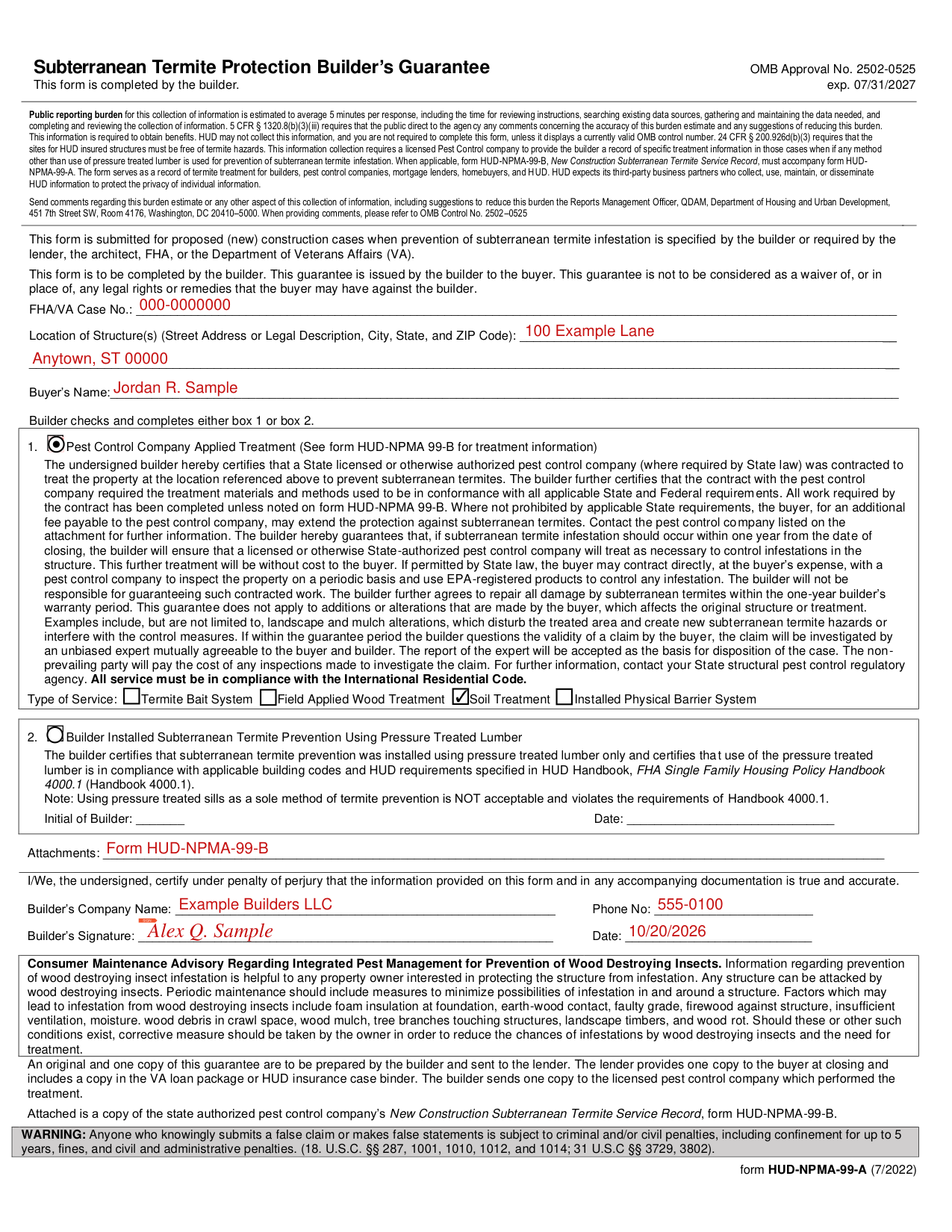
A filled-in Form HUD-NPMA-99-A example: a builder completes a termite guarantee
How to fill out Form HUD-NPMA-99-A, box by box
FHA/VA Case No., Location of Structure(s) and Buyer's Name

Enter the FHA/VA Case No., the Location of Structure(s) (Street Address or Legal Description, City, State, and ZIP Code), and the Buyer's Name.
Box 1 or box 2
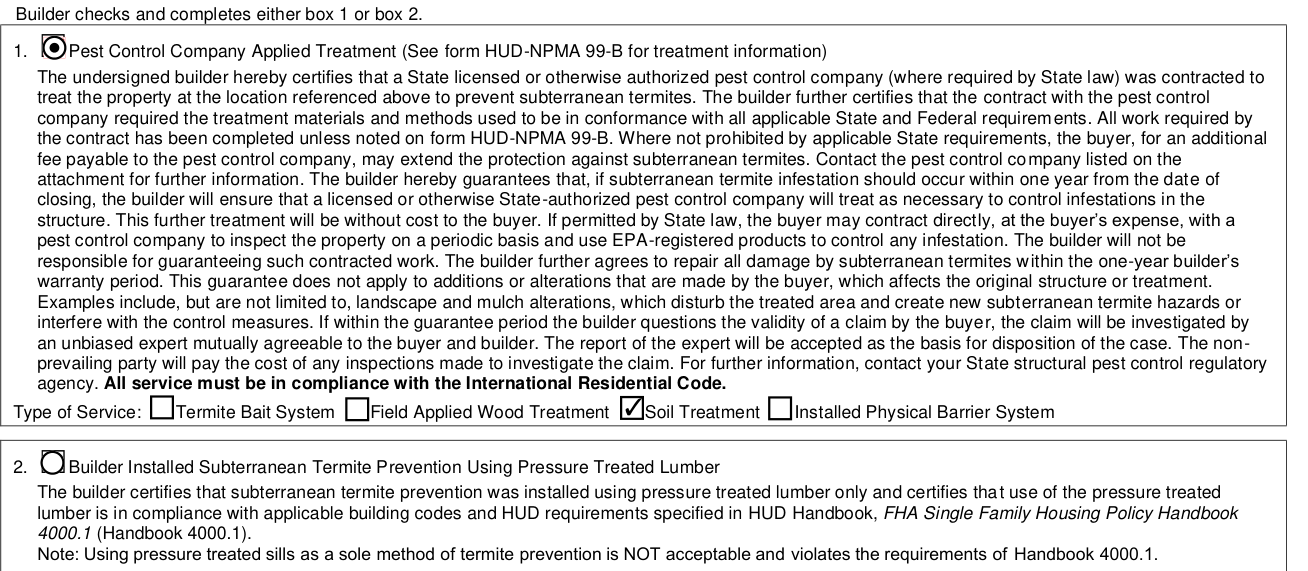
Builder checks and completes either box 1 or box 2.
Pest Control Company Applied Treatment
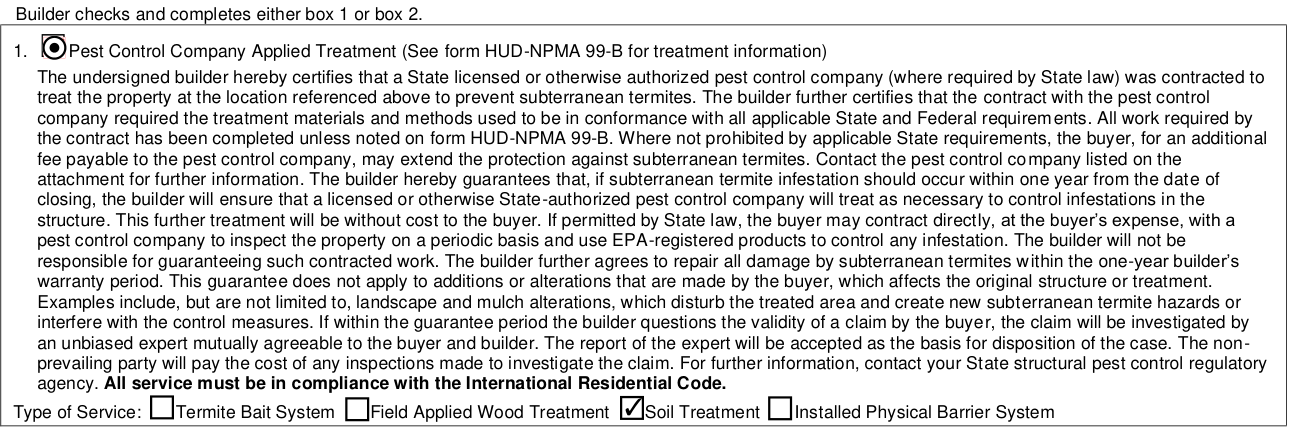
Box 1 is Pest Control Company Applied Treatment (See form HUD-NPMA 99-B for treatment information).
Type of Service: Termite Bait System, Field Applied Wood Treatment, Soil Treatment, Installed Physical Barrier System.
The builder certifies that a State licensed or otherwise authorized pest control company (where required by State law) was contracted to treat the property to prevent subterranean termites.
The builder further certifies that the contract with the pest control company required the treatment materials and methods used to be in conformance with all applicable State and Federal requirements. All work required by the contract has been completed unless noted on form HUD-NPMA 99-B.
The builder guarantees that, if subterranean termite infestation should occur within one year from the date of closing, the builder will ensure that a licensed or otherwise State-authorized pest control company will treat as necessary to control infestations in the structure. This further treatment will be without cost to the buyer.
The builder further agrees to repair all damage by subterranean termites within the one-year builder's warranty period.
Where not prohibited by applicable State requirements, the buyer, for an additional fee payable to the pest control company, may extend the protection against subterranean termites.
If permitted by State law, the buyer may contract directly, at the buyer's expense, with a pest control company to inspect the property on a periodic basis and use EPA-registered products to control any infestation. The builder will not be responsible for guaranteeing such contracted work.
This guarantee does not apply to additions or alterations that are made by the buyer, which affects the original structure or treatment. Examples include, but are not limited to, landscape and mulch alterations, which disturb the treated area and create new subterranean termite hazards or interfere with the control measures.
If within the guarantee period the builder questions the validity of a claim by the buyer, the claim will be investigated by an unbiased expert mutually agreeable to the buyer and builder. The report of the expert will be accepted as the basis for disposition of the case. The non-prevailing party will pay the cost of any inspections made to investigate the claim.
All service must be in compliance with the International Residential Code.
Builder Installed Subterranean Termite Prevention Using Pressure Treated Lumber

Builder Installed Subterranean Termite Prevention Using Pressure Treated Lumber: The builder certifies that subterranean termite prevention was installed using pressure treated lumber only and certifies that use of the pressure treated lumber is in compliance with applicable building codes and HUD requirements specified in HUD Handbook, FHA Single Family Housing Policy Handbook 4000.1 (Handbook 4000.1).
Note: Using pressure treated sills as a sole method of termite prevention is NOT acceptable and violates the requirements of Handbook 4000.1.
Initial of Builder and Date.
Attachments

Attached is a copy of the state authorized pest control company's New Construction Subterranean Termite Service Record, form HUD-NPMA-99-B.
Builder's Company Name and Phone No

Builder's Company Name and Phone No.
Signing the form

The undersigned certifies under penalty of perjury that the information provided on this form and in any accompanying documentation is true and accurate.
Builder's Signature and Date.
WARNING: Anyone who knowingly submits a false claim or makes false statements is subject to criminal and/or civil penalties, including confinement for up to 5 years, fines, and civil and administrative penalties. (18. U.S.C. §§ 287, 1001, 1010, 1012, and 1014; 31 U.S.C §§ 3729, 3802).
More rules for Form HUD-NPMA-99-A
This guarantee is not to be considered as a waiver of, or in place of, any legal rights or remedies that the buyer may have against the builder.
If your situation is different
Copies of the guarantee
An original and one copy of this guarantee are to be prepared by the builder and sent to the lender. The lender provides one copy to the buyer at closing and includes a copy in the VA loan package or HUD insurance case binder. The builder sends one copy to the licensed pest control company which performed the treatment.
Common questions about Form HUD-NPMA-99-A
What is a NPMA 99A form?
This form is the Subterranean Termite Protection Builder's Guarantee, completed by the builder. The form serves as a record of termite treatment for builders, pest control companies, mortgage lenders, homebuyers, and HUD.
Sources
[1] Form HUD-NPMA-99-A (7/2022), Subterranean Termite Protection Builder's Guarantee, U.S. Department of Housing and Urban Development (the Official source link on this page).