

Form 851 at a glance
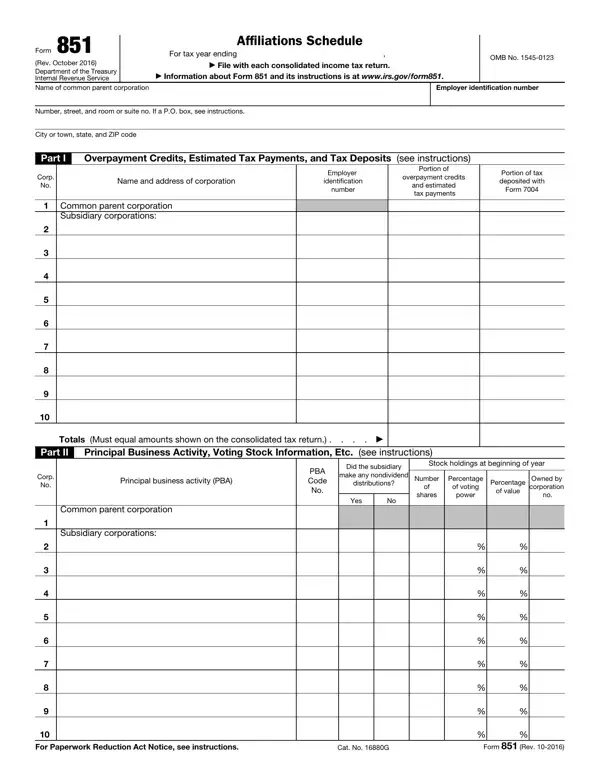
What it is: Form 851 is the Affiliations Schedule to file with each consolidated income tax return.
Where and when to file: File Form 851 by attaching it to the consolidated tax return for the group.
Use Form 851 to identify the common parent corporation and each member of the affiliated group; report the amount of overpayment credits, estimated tax payments, and tax deposits attributable to each corporation; and determine that each subsidiary corporation qualifies as a member of the affiliated group.
The parent corporation must file Form 851 for itself and for corporations in the affiliated group.
The common parent must be an includible corporation and the following requirements must be met. 1. The common parent must own directly stock that represents at least 80% of the total voting power and at least 80% of the total value of the stock of at least one of the other includible corporations.
2. Stock that represents at least 80% of the total voting power, and at least 80% of the total value of the stock of each of the other corporations (except for the common parent) must be owned directly by one or more of the other includible corporations.
For this purpose, the term "stock" generally doesn't include any stock that: Is nonvoting, Is nonconvertible, Is limited and preferred as to dividends and doesn't participate significantly in corporate growth, and Has redemption and liquidation rights that don't exceed the issue price of the stock (except for a reasonable redemption or liquidation premium).
A filled-in Form 851 example: a parent corporation lists its one subsidiary
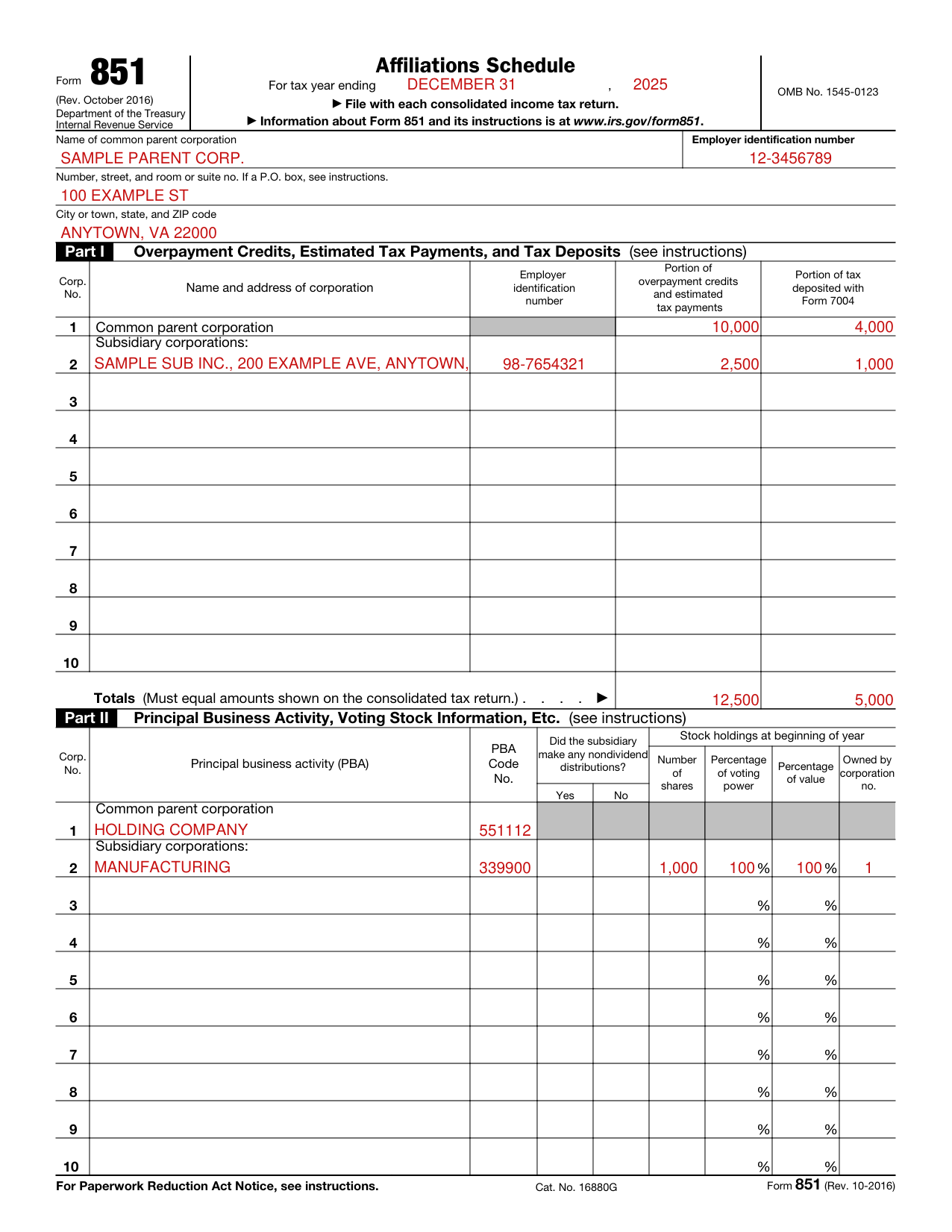
How to fill out Form 851, box by box
Name of common parent corporation and address
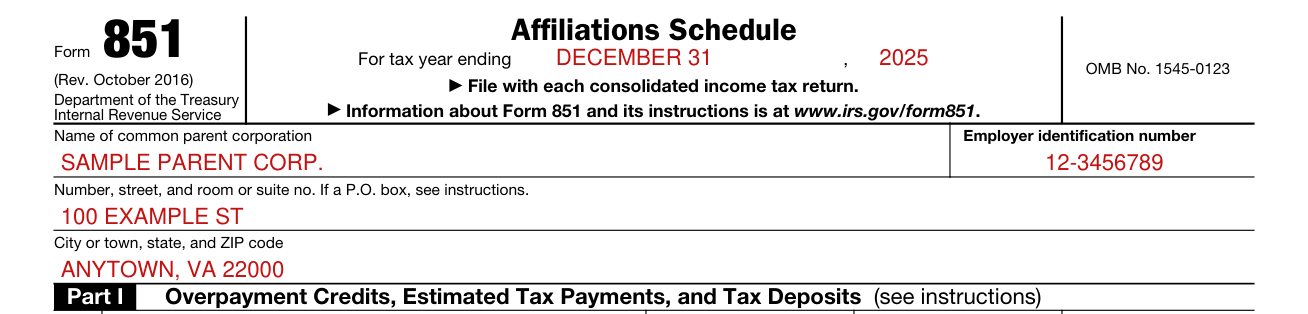
Next to For tax year ending, enter the tax year, and enter the Name of common parent corporation, its Employer identification number, the Number, street, and room or suite no., and the City or town, state, and ZIP code.
Include the suite, room, or other unit number after the street address. If the post office does not deliver mail to the street address and the corporation has a P.O. box, show the box number instead.
Part I Overpayment Credits, Estimated Tax Payments, and Tax Deposits
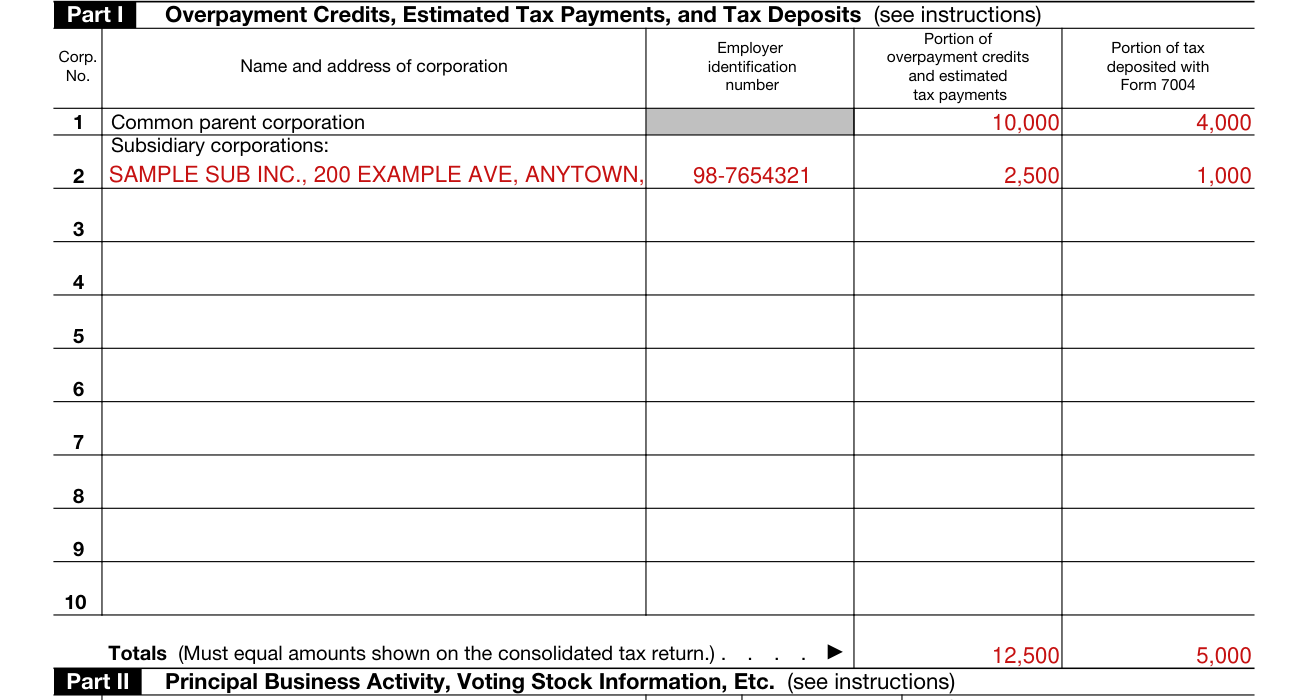
Under Portion of overpayment credits and estimated tax payments, enter for the common parent corporation and for each subsidiary corporation the amount of: Overpayments of tax from the prior tax year that each corporation elected to credit to the current year's tax, and Estimated tax payments made by each corporation.
The total must be the same as the amounts entered on the lines for overpayments and estimated tax payments on the consolidated income tax return.
Under Portion of tax deposited with Form 7004, enter for the common parent the tax deposited with Form 7004, Application for Automatic Extension of Time To File Certain Business Income Tax, Information, and Other Returns, that is attributable to each corporation.
The total must be the same as the amount entered on the "Tax deposited with Form 7004" line on the consolidated income tax return.
Part II Principal Business Activity, Voting Stock Information, Etc.
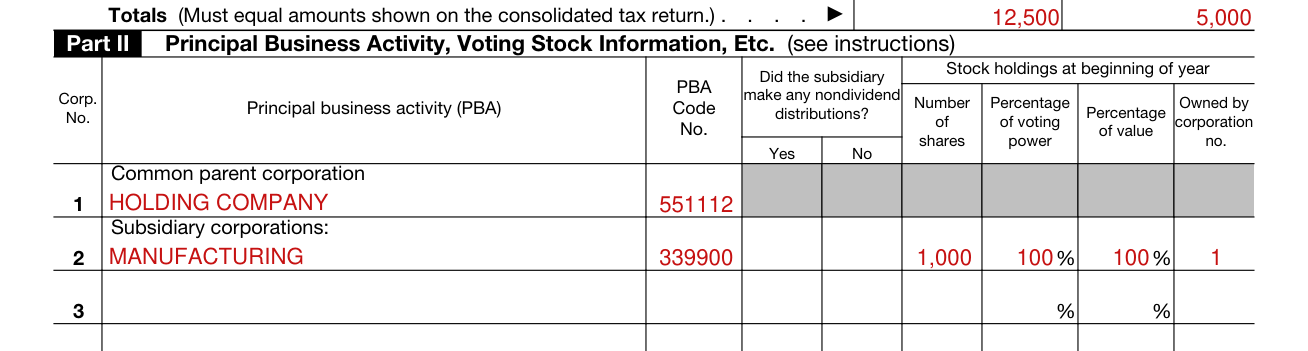
Under Principal business activity (PBA) and PBA Code No., enter the PBA and the PBA code number for the common parent corporation and for each subsidiary corporation. Use the activity for the specific industry group from which the largest percentage of each corporation's total receipts is based. A list of the PBAs and code numbers is located in the Instructions for Form 1120.
Did the subsidiary make any nondividend distributions? Nondividend distributions are any distributions (other than stock dividends and distributions in exchange for stock) made to shareholders during the tax year for which the consolidated tax return is filed that were in excess of the corporation's current and accumulated earnings and profits. See sections 301 and 316 and Form 5452, Corporate Report of Nondividend Distributions.
Under Stock holdings at beginning of year, enter the Owned by corporation no., Number of shares, Percentage of voting power and Percentage of value. When listing information in Parts II, III, and IV, use the same number for the common parent corporation and for each subsidiary corporation as the number listed in Part I.
Part III Changes in Stock Holdings During the Tax Year
For each change, enter the Corp. No. and Name of corporation, the Share-holder of Corporation No., and under (a) Changes the Date of transaction, Number of shares acquired and Number of shares disposed of, and under (b) Shares held after changes described in column (a) the Percentage of voting power and Percentage of value.
(c) If any transaction listed in Part III caused a transfer of a share of subsidiary stock (defined to include dispositions and deconsolidations), did the share's basis exceed its value at the time of the transfer? See instructions. Yes No
Part III Question (c). For this purpose, the term "transfer" includes transactions in which (1) a shareholder-member ceases to own a share of subsidiary stock in a transaction in which the shareholder-member recognizes income, gain, deduction, or loss on the stock; (2) a shareholder-member and the subsidiary cease to be members of the same consolidated group; and (3) a nonmember acquires the share from a member.
If any type of transfer occurs and the share's basis would otherwise exceed its value at the time of the transfer, certain adjustments to members' bases in shares of the subsidiary's stock and to the subsidiary's attributes may be required. See Regulations section 1.1502-36.
Did any share of subsidiary stock become worthless within the meaning of section 165 (taking into account the provisions of Regulations section 1.1502-80(c)) during the taxable year? See instructions. Yes No. Question (d). If a share of subsidiary stock becomes worthless within the meaning of section 165 (taking into account the provisions of Regulations section 1.1502-80(c)) during the group's taxable year, certain adjustments to shareholder-members' bases in shares of the subsidiary's stock and/or to the subsidiary's attributes may be required.
(e) If the equitable owners of any capital stock shown in Part III were other than the holders of record, provide details of the changes. The term "equitable owners" of stock means those that essentially have all the rights to enjoy the benefits of stock ownership without actually holding the stock, for example, beneficiaries of a trust.
(f) If additional stock was issued, or if any stock was retired during the year, list the dates and amounts of these transactions.
Part IV Additional Stock Information
Part IV Additional Stock Information (see instructions), page 3 of Form 851 (Rev. 10-2016), question 1: During the tax year, did the corporation have more than one class of stock outstanding? Yes No If "Yes," enter the name of the corporation and list and describe each class of stock. For purposes of question 1 only, disregard certain preferred stock as described in section 1504(a)(4).
2 During the tax year, was there any member of the consolidated group that reaffiliated within 60 months of disaffiliation? Yes No If "Yes," enter the name of the corporation(s) and explain the circumstances.
3 During the tax year, was there any arrangement in existence by which one or more persons that were not members of the affiliated group could acquire any stock, or acquire any voting power without acquiring stock, in the corporation, other than a de minimis amount, from the corporation or another member of the affiliated group? Yes No If "Yes," enter the name of the corporation and see the instructions for the percentages to enter in columns (a), (b), and (c). The term "arrangement" includes, but is not limited to, phantom stock, stock appreciation rights, an option, warrant, conversion feature, or similar arrangements.
Item 3a. Show the percentage of the value of the outstanding stock that the person(s) could acquire.
Item 3b. If the arrangement was associated with voting stock, show the percentage of outstanding voting stock that the person(s) could acquire.
Item 3c. If the arrangement was associated with the acquisition of voting power without the acquisition of the related stock, show the percentage of voting power that the person(s) could acquire.
(d) Provide a description of any arrangement. Item 3d. Give a brief description of any arrangement (defined in question 3) by which a person that is not a member of the affiliated group could acquire any stock, or acquire any voting power without acquiring stock, in the corporation.
Common questions about Form 851
What is form 851 affiliations schedule?
Form 851 is the Affiliations Schedule to file with each consolidated income tax return. An affiliated group is one or more chains of includible corporations connected through stock ownership with a common parent corporation. See sections 1504(a) and (b).
Where do I file it?
File Form 851 by attaching it to the consolidated tax return for the group.
Sources
[1] Form 851 (Rev. October 2016), Affiliations Schedule, Internal Revenue Service (the Official source link on this page).