
How to Fill Out JDF 206

JDF 206 at a glance

What it is: JDF 206 is the Order re Court Fees.

Who signs: Under So Ordered, a Judge or Magistrate signs on the Signature line, marks Judge or Magistrate, enters the Dated date.

A filled-in JDF 206 example: installments for a party who is not indigent
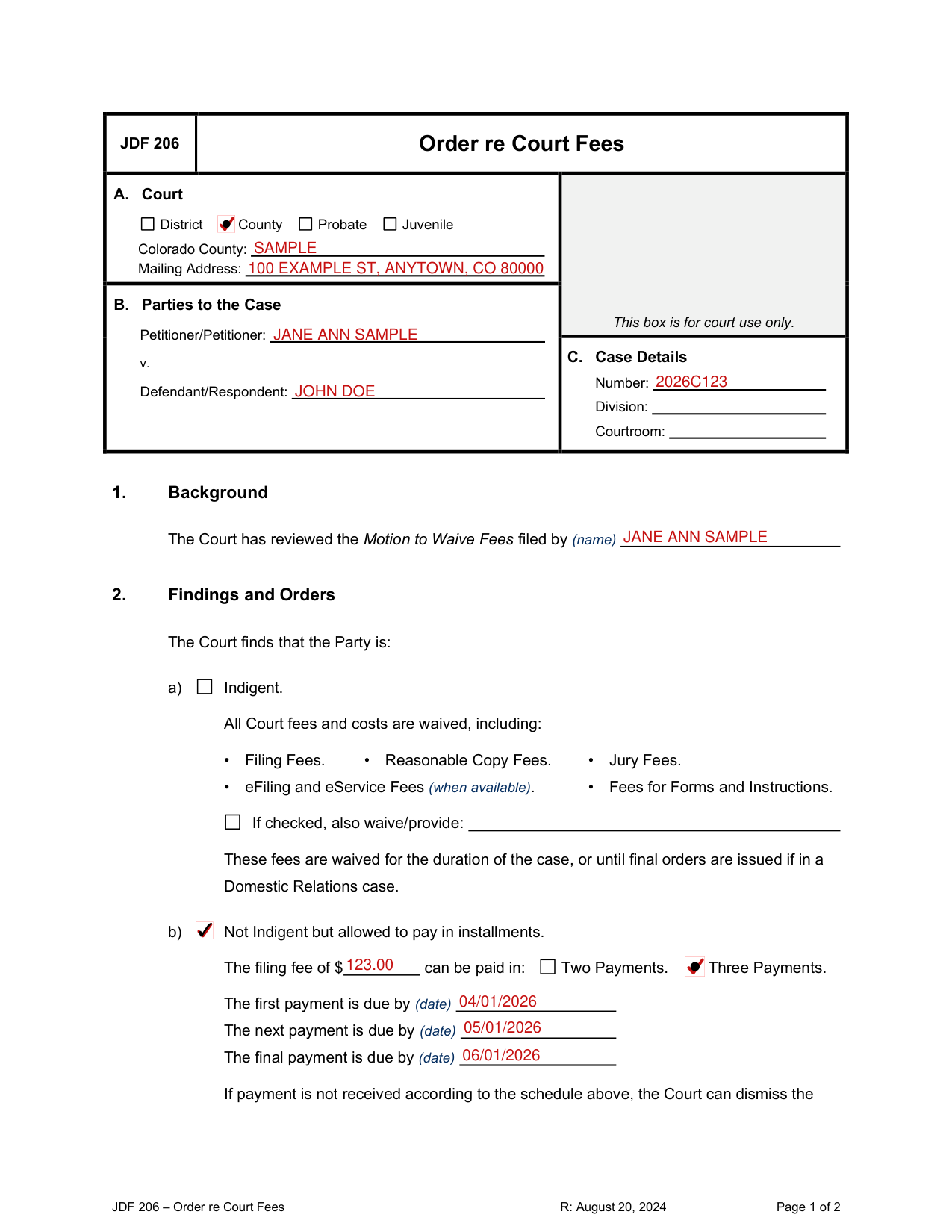
JDF 206 example filled out, example: installments for a party who is not indigent
A County Court judge orders a party to pay fees in installments. Nothing goes in a) Indigent or c) Not Indigent because the party may pay in three payments. The picture shows the ticked boxes, and its names and figures are sample values. Division and Courtroom are left blank because this case has not been assigned either yet.

How to fill out JDF 206, box by box

A. Court

JDF 206 example filled out, a. Court

Under A. Court, mark District, County, Probate or Juvenile.

Fill in Colorado County and Mailing Address.

B. Parties to the Case

JDF 206 example filled out, b. Parties to the Case

Under B. Parties to the Case, fill in Petitioner/Petitioner and Defendant/Respondent. Do not fill in the box marked for court use only.

C. Case Details

JDF 206 example filled out, c. Case Details

Under C. Case Details, enter the Number, and enter the Division and Courtroom if the case has them.

1. Background

JDF 206 example filled out, 1. Background

Under 1. Background, enter the (name) in The Court has reviewed the Motion to Waive Fees filed by (name).

a) Indigent
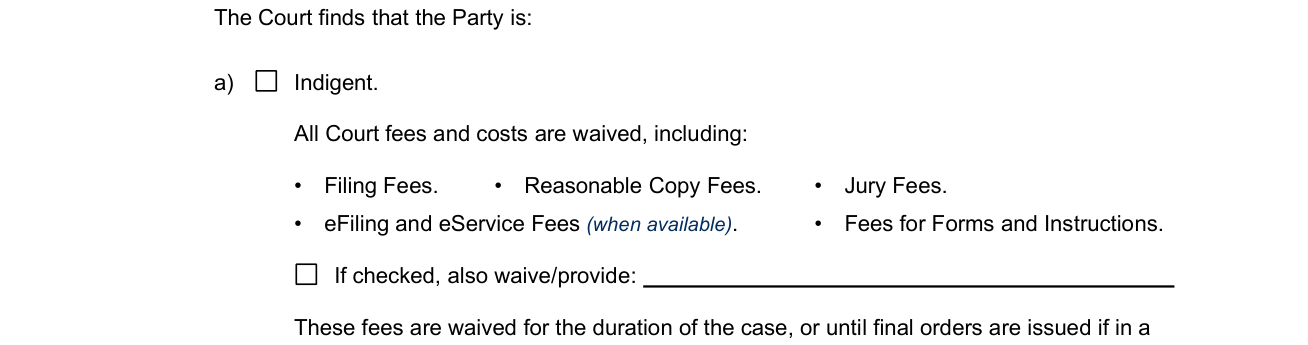
JDF 206 example filled out, a) Indigent

Under 2. Findings and Orders, mark a) Indigent when the Court finds that the Party is Indigent.

All Court fees and costs are waived, including Filing Fees, Reasonable Copy Fees, Jury Fees, eFiling and eService Fees (when available) and Fees for Forms and Instructions.

Mark If checked and write what to also waive/provide on the line.

These fees are waived for the duration of the case, or until final orders are issued if in a Domestic Relations case.

b) Not Indigent but allowed to pay in installments

JDF 206 example filled out, b) Not Indigent but allowed to pay in installments

Mark b) Not Indigent but allowed to pay in installments when the Court finds that the Party is Not Indigent but allowed to pay in installments.

Enter the filing fee and mark Two Payments or Three Payments.

Enter the date the first payment is due by, the date the next payment is due by and the date the final payment is due by.

If payment is not received according to the schedule, the Court can dismiss the party's claims, or the entire case, without further notice (C.J.D. 98-01 Section (VI)).

c) Not Indigent

JDF 206 example filled out, c) Not Indigent

Mark c) Not Indigent when the party is responsible for payment of any court fees and costs.

Mark If checked when the party must pay the filing fee, then enter the filing fee and the date.

3. Findings Made by

JDF 206 example filled out, 3. Findings Made by

Under 3. Findings Made by, enter the Name, mark Judicial Officer or Court Staff and enter the On (date).

So Ordered

JDF 206 example filled out, so Ordered

Under So Ordered, a Judge or Magistrate signs on the Signature line, marks Judge or Magistrate, enters the Dated date.

Sources

[1] JDF 206 Order re Court Fees (R: August 20, 2024), Colorado Judicial Branch (the Official source link on this page).

Jdf 206 Form PDF Details

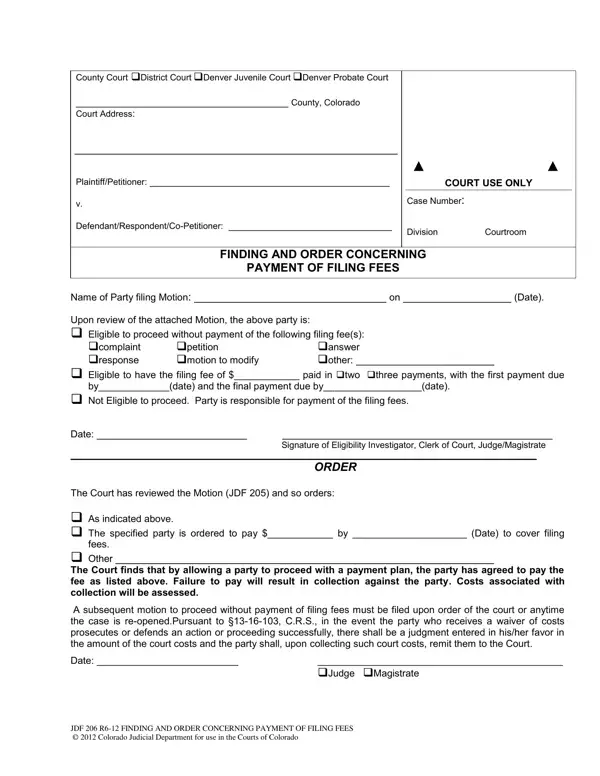
In the legal landscape, the JDF 206 form serves as a crucial instrument for individuals facing financial constraints, enabling them to engage with the judicial system in Colorado without the upfront burden of filing fees. This document is utilized across various court divisions including County, District, Denver Juvenile, and Denver Probate Courts. Essentially, the JDF 206 facilitates a review process where a party's eligibility to bypass or defer these costs is assessed. Upon submitting a motion, indicated within this framework is the possibility for a party to either be exempt from paying fees for specific legal actions like complaints, petitions, and responses, or to arrange a staggered payment schedule over two or three installments. Conversely, a denial indicates the party's obligation to cover these expenses. The presiding officer, whether a clerk, judge, or magistrate, endorses these determinations. Importantly, the form outlines potential consequences for non-compliance with ordered payments, including collection efforts and additional charges. Moreover, it articulates a provision for the reimbursement of waived costs should the party favorably conclude their legal matter. Through this structured mechanism, the form endeavors to uphold the principle that access to justice should not hinge on one’s financial status, thereby reinforcing the foundational values of equity and fairness within the Colorado judicial system.

QuestionAnswer
Form NameJdf 206 Form
Form Length2 pages
Fillable?Yes
Fillable fields27
Avg. time to fill out15 sec
Other namesfinding order filing online, defender form public, finding order payment latest, colorado jdf 206