
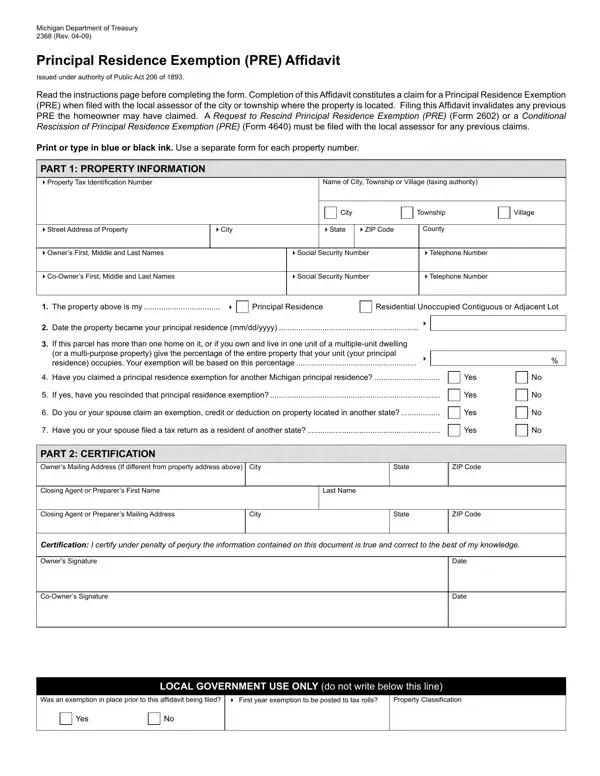
Form 2368 at a glance
What it is: Form 2368 is the Michigan Department of Treasury Principal Residence Exemption (PRE) Affidavit.
Where and when to file: Issued under authority of Public Act 206 of 1893. Read the instructions before completing the form. This form must be filed with the assessor for the city or township where the property is located. Do not submit this form if the property is not your principal residence and/or any of the disqualifying factors apply as listed in MCL 211.7(cc). For information regarding the PRE, please review the PRE Guidelines at www.michigan.gov/pre.
On page 2, the Instructions for Form 2368 say that the Principal Residence Exemption (PRE) exempts a principal residence from the tax levied by a local school district for operating purposes, up to 18 mills.
Owners are defined in MCL 211.7dd(a). Only the owner listed in MCL 211.7dd(a) is eligible to claim the exemption.
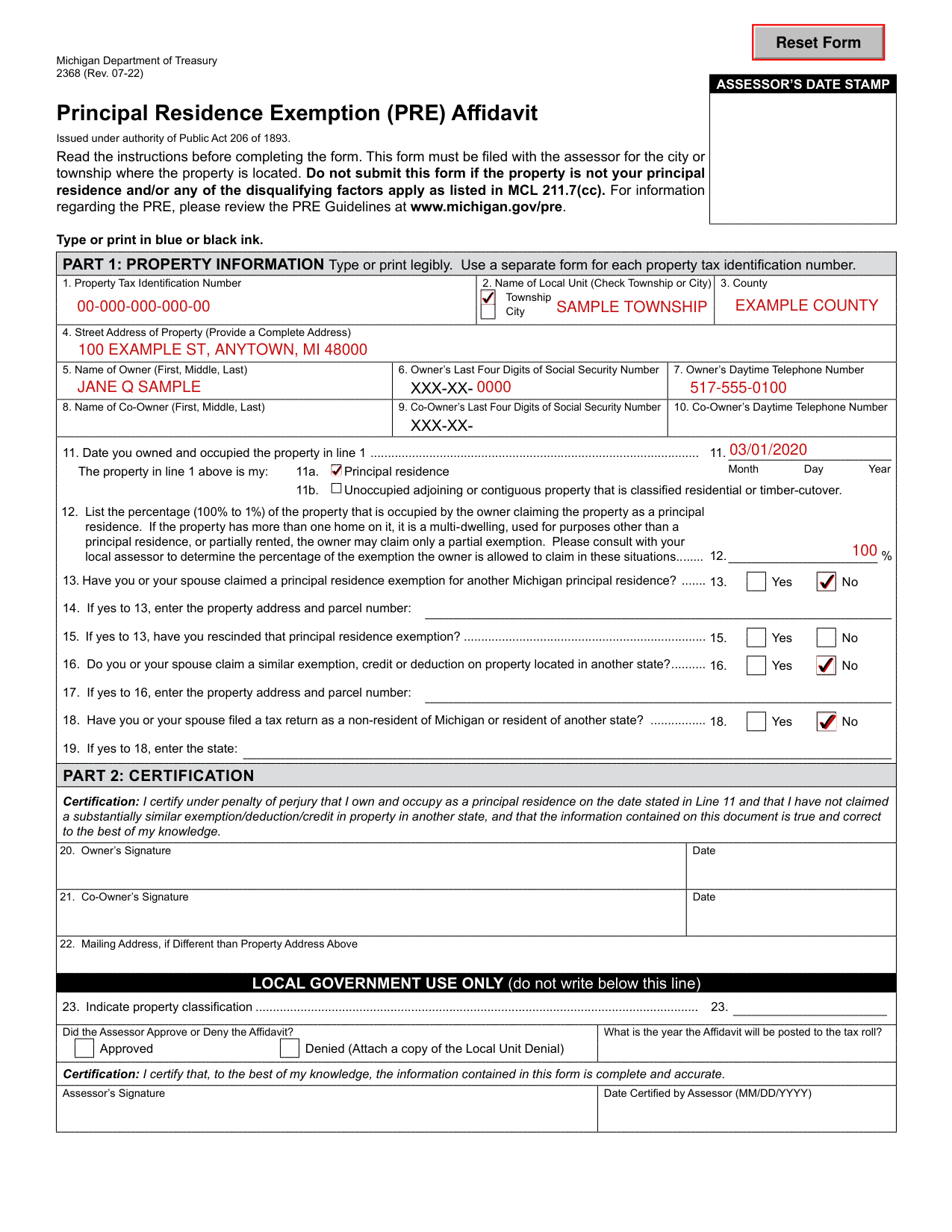
A filled-in Form 2368 example: an owner claims her home
How to fill out Form 2368, box by box
1. Property Tax Identification Number, 2. Name of Local Unit, 3. County and 4. Street Address of Property

In Part 1, use a separate form for each property tax identification number.
In box 1, enter your property tax identification number accurately. You can find this number on your tax bill and on your property tax assessment notice. If you cannot find this number, call your township or city assessor.
In box 2, enter the Name of Local Unit and check Township or City; in box 3, enter the County.
In box 4, enter the Street Address of Property (Provide a Complete Address).
Owner and Co-Owner (boxes 5 to 10)

In box 5, enter the Name of Owner (First, Middle, Last).
In box 6, list the last four digits of your Social Security Number (SSN).
In box 7, enter the Owner's Daytime Telephone Number.
If there is a co-owner, enter the Name of Co-Owner (First, Middle, Last) in box 8, the Co-Owner's Last Four Digits of Social Security Number in box 9 and the Co-Owner's Daytime Telephone Number in box 10. Do not include information for a co-owner who does not occupy the property as a principal residence.
11. Date you owned and occupied the property

In box 11, enter the Date you owned and occupied the property in line 1 (Month Day Year).
Mark 11a Principal residence or 11b Unoccupied adjoining or contiguous property that is classified residential or timber-cutover, after "The property in line 1 above is my".
12. Percentage of the property occupied by the owner

In box 12, list the percentage (100% to 1%) of the property that is occupied by the owner claiming the property as a principal residence. If the property has more than one home on it, it is a multi-dwelling, used for purposes other than a principal residence, or partially rented, the owner may claim only a partial exemption.
For Line 12: if you own and occupy the entire property as a principal residence, you may claim a 100 percent exemption.
If you own and live in a multi-unit or multi-purpose property (e.g., a duplex or apartment building, or a storefront with an upstairs flat), you can only claim a partial exemption based on that portion that you use as a principal residence.
If the parcel of property you are claiming has more than one home on it, you must determine the percentage that you own and occupy as your principal residence. A second residence on the same property (e.g., a mobile home or second house) is not part of your principal residence, even if it is not rented to another person.
Please consult your local assessor to determine the percentage of the exemption the owner is allowed to claim in these situations. Your local assessor can tell you the assessed value of each residence to help you determine the percentage that is your principal residence.
Lines 13 to 19: other exemptions and tax returns
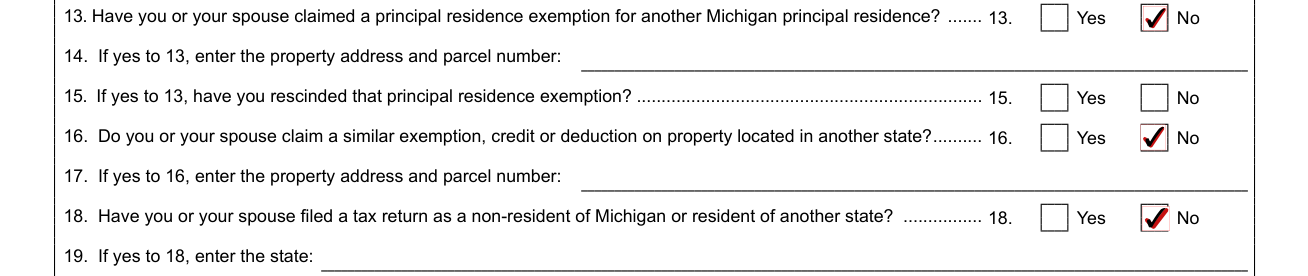
In box 13, mark Yes or No for: Have you or your spouse claimed a principal residence exemption for another Michigan principal residence?
If yes to 13, enter the property address and parcel number in box 14.
If yes to 13, mark Yes or No in box 15 for: have you rescinded that principal residence exemption?
In box 16, mark Yes or No for: Do you or your spouse claim a similar exemption, credit or deduction on property located in another state?
Line 16: MCL 211.7cc(3)(a) prescribes a penalty of $500 for a person who claims a PRE and a substantially similar exemption, deduction, or credit in another state (checked November 2, 2026).
If yes to 16, enter the property address and parcel number in box 17.
In box 18, mark Yes or No for: Have you or your spouse filed a tax return as a non-resident of Michigan or resident of another state?
If yes to 18, enter the state in box 19.
Part 2: Certification, signatures and mailing address
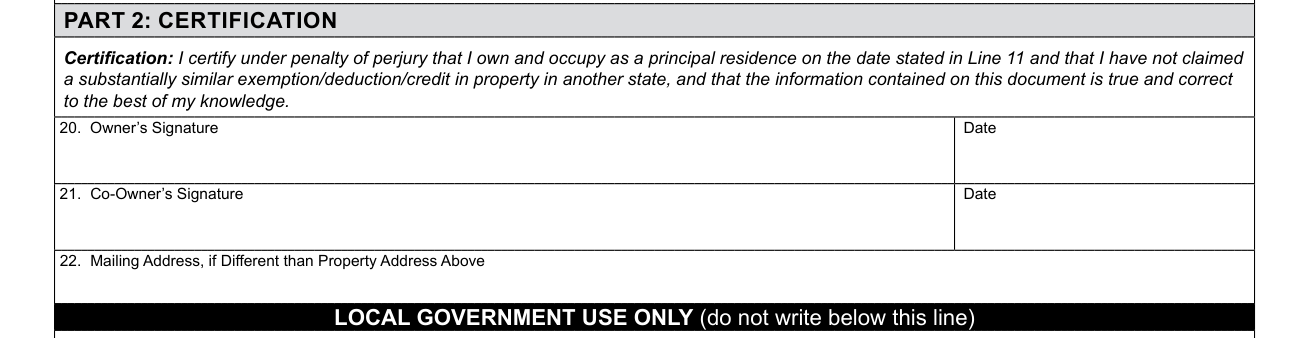
By signing you certify under penalty of perjury that you own and occupy as a principal residence on the date stated in Line 11 and that you have not claimed a substantially similar exemption, deduction or credit in property in another state, and that the information contained on this document is true and correct to the best of your knowledge.
In Part 2, sign and date the form in box 20, Owner's Signature Date.
If there is a co-owner, sign and date in box 21, Co-Owner's Signature Date.
In box 22, enter your mailing address if it is different from the address under Part 1.
More rules for Form 2368
Type or print in blue or black ink.
You must complete each line in its entirety. Failure to complete any of the lines may result in your claim being denied.
Rescinding your exemption
Rescinding your exemption
Within 90 days of when you no longer own or occupy the property as a principal residence, you must complete and file a Request to Rescind Principal Residence Exemption (PRE) (Form 2602) or file a Conditional Rescission (Form 4640) with your township or city assessor.
Failure to do so may subject you to additional tax plus penalties and interest as determined under the General Property Tax Act.
Common questions about Form 2368
What qualifies as a principal residence?
Principal residence means the dwelling that you own and occupy as your permanent home and any unoccupied adjoining or contiguous properties that are classified residential or timber-cut over. Occupying means this is your principal residence, the place that you reside in as your permanent residence and if absent intend to return. It should be the address that appears on your driver's license and voter registration card.
Is there a deadline?
A valid affidavit filed on or before June 1 allows an owner to receive a PRE on the current year summer and winter tax levy and subsequent tax levies so long as it remains the owner's principal residence. If it is filed after June 1 and on or before November 1, the PRE is on the current winter tax levy and subsequent tax levies, so long as it remains the owner's principal residence.
Where do I file it?
To claim a PRE, complete this Affidavit and file it with your township or city assessor of the year of the claim. Mail your completed form to the township or city assessor where the property is located. DO NOT send this form directly to the Department of Treasury.
Is there a penalty?
If it is determined that you claimed property that is not your principal residence, you may be subject to the additional tax plus penalty and interest as determined under the General Property Tax Act.
When is this form not the right one?
MCL 211.7cc(3) Disqualifications: An owner is ineligible to claim a PRE if any of the disqualifying factors apply listed in MCL 211.7cc(3). Vacation homes, seasonal homes, and income property are not occupied as your principal residence and may not be claimed.
Where to get help with Form 2368
If you have any questions contact your local assessor or the PRE Unit of the Michigan Department of Treasury at 517-335-7487, or visit www.michigan.gov/PRE.
Sources
[1] Form 2368 (Rev. 07-22), Principal Residence Exemption (PRE) Affidavit, Michigan Department of Treasury (the Official source link on this page).