

Form REV-1500 at a glance
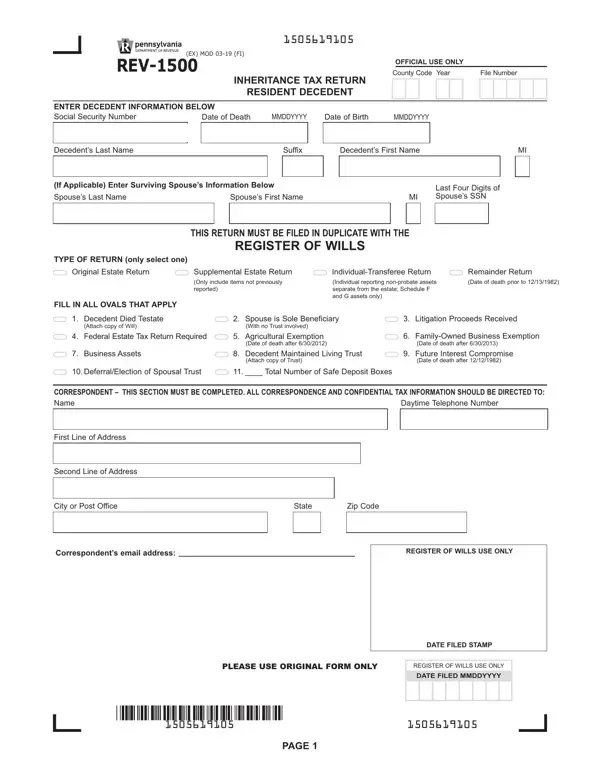
What it is: REV-1500 is the Pennsylvania Inheritance Tax Return for a Resident Decedent.
Where and when to file: The return is to be filed in duplicate with the Register of Wills of the county in which the decedent was a resident at the time of death.
An inheritance tax return must be filed for every decedent who has property which is or may be subject to tax.
The personal representative (executor or administrator appointed by the Register of Wills) of the decedent's estate is the person responsible for filing the return and disclosing property of the decedent that the personal representative has or acquires knowledge of.
The transferee of property should file a return if no personal representative is appointed, if the personal representative does not file a return, or if the personal representative files a return but does not include the subject property.
Inheritance tax is a tax on the right of succession or privilege of receiving property at a death, and it is imposed upon the transfer of taxable property.
What to bring and attach to Form REV-1500
If the decedent died testate or had maintained an inter-vivos (living) trust, a copy of the will and/or trust document must be submitted with the return.
Attach only appropriate schedules based upon the assets and debts and deductions of your particular estate. Do not submit blank schedules.
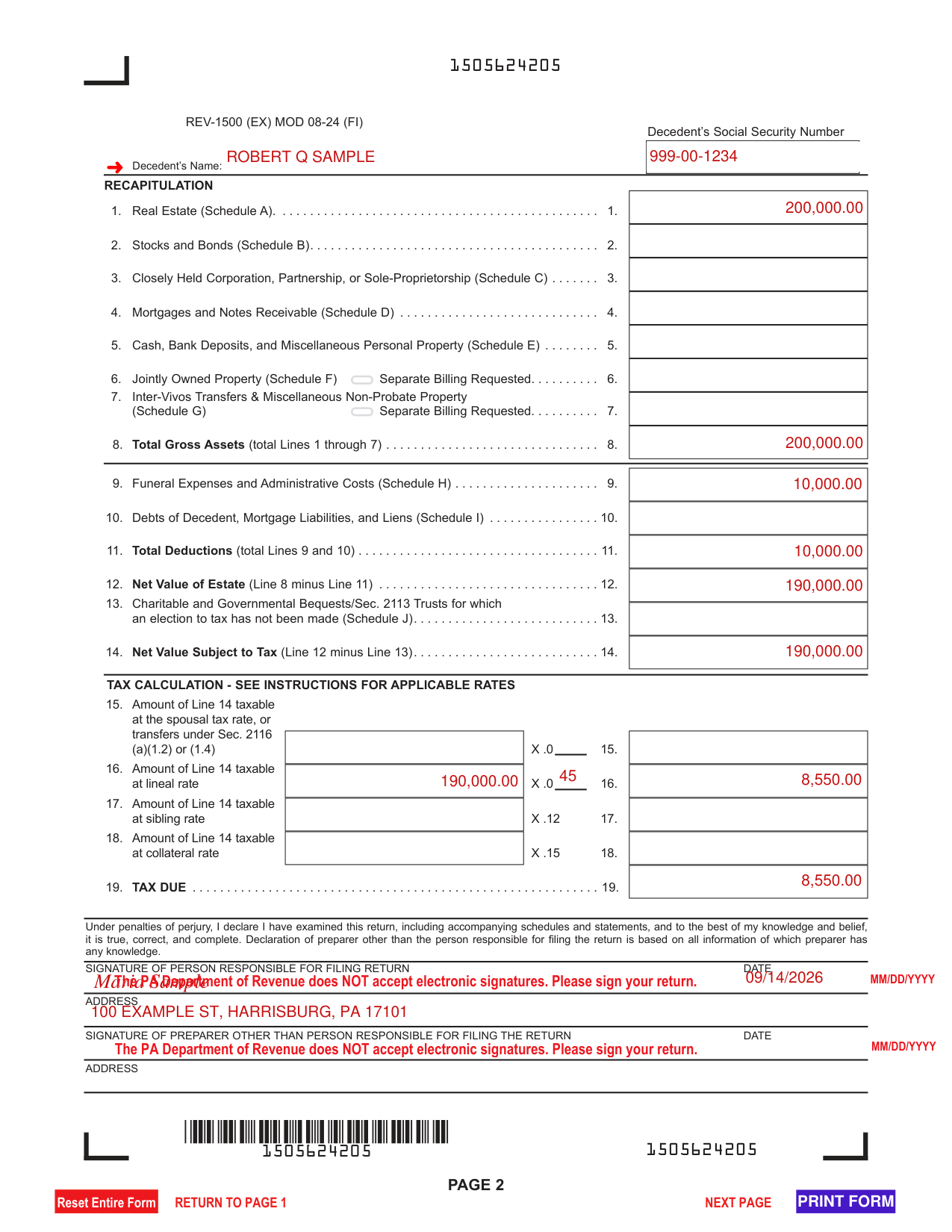
A filled-in Form REV-1500 example: a daughter files for her father's estate
How to fill out Form REV-1500, box by box
Decedent information
Decedent's Social Security Number: enter the nine-digit Social Security number of the decedent. Date of Death: enter the month, day, and year of the decedent's death. Date of Birth: enter the month, day, and year of the decedent's birth. Decedent's Name: enter decedent's last name, first name, and middle initial.
Type of return (only select one)
Only select one oval for the type of return being filed.
Original Estate Return: fill in the oval if this is the first return filed for an estate and no other asset or deduction has previously been submitted.
Supplemental Estate Return: fill in the oval if the return is being filed to report additional assets or deductions not reported on a prior return.
Individual-Transferee Return: fill in the oval if the return is being filed by an individual to report non-probate assets (Schedule F and G) that will not be reported on the estate return.
Fill in all ovals that apply
Decedent Died Testate: fill in the oval if the decedent died having a valid will which has been submitted to the Register of Wills for probate. A copy of the will must be attached to the return.
Lines 1 to 8, Real Estate, Cash and Total Gross Assets
Real Estate (Schedule A): if the estate is required to complete REV-1502 Schedule A, enter the amount from the Total line of REV-1502 Schedule A on Line 1 of the REV-1500. If the estate is not required to complete REV-1502 Schedule A, leave Line 1 of the REV-1500 blank.
Cash, Bank Deposits, and Miscellaneous Personal Property (Schedule E): if the estate is required to complete REV-1508 Schedule E, enter the amount from the Total line of REV-1508 Schedule E on Line 5 of the REV-1500. If the estate is not required to complete REV-1508 Schedule E, leave Line 5 of the REV-1500 blank.
Total Gross Assets: add all assets shown on Lines 1 through 7 together and enter the total value here on Line 8 of the REV-1500.
Lines 9 to 14, deductions and net value subject to tax
Funeral Expenses and Administrative Costs (Schedule H): if the estate is required to complete REV-1511 Schedule H, enter the amount from the Total line of REV-1511 Schedule H on Line 9 of the REV-1500. If the estate is not required to complete REV-1511 Schedule H, leave Line 9 of the REV-1500 blank.
Debts of Decedent, Mortgage Liabilities, and Liens (Schedule I): if the estate is required to complete REV-1512 Schedule I, enter the amount from the Total line of REV-1512 Schedule I on Line 10 of the REV-1500. If the estate is not required to complete REV-1512 Schedule I, leave Line 10 of the REV-1500 blank.
Add all deductions shown on Lines 9 through 10 together and enter the total value here on Line 11 of the REV-1500.
Net Value of Estate: subtract Line 11 total deductions from Line 8 total gross assets and enter total net value of estate here on Line 12 of the REV-1500.
Net Value Subject to Tax: subtract Line 13 Charitable and Governmental Bequests/Sec. 2113 Trusts for which an election to tax has not been made from Line 12 net value of Estate and enter total net value subject to tax on Line 14 of the REV-1500.
Lines 15 to 19, tax calculation
Lineal Tax Rate: 4.5 percent. The lineal tax rate is applicable for transfers to: Grandfather, grandmother, father, mother, children, unremarried wife and husband, or widower of a child, and lineal descendants.
Amount of Line 14 Taxable at the lineal rate: calculate the amount from Line 14 subject to tax at the lineal rate and enter the total value on Line 16 of the REV-1500.
Spousal Tax Rate: 0 percent. Any asset passing to a decedent's spouse is taxed at 0 percent.
Sibling Tax Rate: 12 percent. The sibling tax rate is applicable for transfers to: Brothers or half-brothers, sisters or half-sisters.
Collateral Tax Rate: 15 percent. The collateral tax rate is applicable for transfers to all other beneficiaries.
Tax Due: add the amount from Lines 15 through 18 and enter the total value on Line 19 of the REV-1500.
Signing the return
When the return is complete and contains all necessary schedules, the person(s) responsible for filing must sign, address, and date the return. The PA Department of Revenue does NOT accept electronic signatures.
Under penalties of perjury, I declare I have examined this return, including accompanying schedules and statements, and to the best of my knowledge and belief, it is true, correct, and complete. Declaration of preparer other than the person responsible for filing the return is based on all information of which preparer has any knowledge.
If the estate representative(s) secured help in preparing the return, the preparer must complete their signature, address, and date the return.
Page 3, tax payments and credits
Tax Due: enter the amount from Line 19, Page 2 on Line 1.
Prior Payments: enter the receipt number(s) for prior payments made with the Register of Wills. Enter the total amount paid on Line 2.
If a payment was made within three months of the decedent's date of death, calculate the discount and enter on Line 3 of the REV-1500. A 5 percent discount is allowed on the tax paid within three months of the decedent's death.
Overpayment: if Line 2 + Line 3 is greater than Line 1 + Line 4, enter the difference on Line 5 of the REV-1500. If an overpayment exists, complete the Overpayment Section.
Tax Due: if Line 1 + Line 4 is greater than Line 2 + Line 3, enter the difference on Line 6 of the REV-1500.
Overpayment
If an overpayment exists on Page 3, Line 5 of the REV-1500, fill in the oval that best describes how the overpayment should be issued.
Mark all ovals that apply
If any of the ovals are marked, a REV-1510, Schedule G must be completed and submitted with the REV-1500.
More rules for Form REV-1500
If the return cannot be filed within nine months from the decedent's date of death, an extension to file may be requested from the Department of Revenue. The extension request must be made before the return is due. Granting of an extension to file does not relieve the estate from the payment of tax.
Transfers to exempt charitable organizations, exempt institutions, and government entities are exempt from tax.
Common questions about Form REV-1500
Is there a deadline?
Returns must be filed within nine months after the death of the decedent.
Where do I file it?
This return must be filed in duplicate with the Register of Wills.
Is there a penalty?
Failure to file may subject the estate to a penalty of 25 percent of the tax ultimately found to be due or $1,000, whichever is less (checked November 1, 2026).
Sources
[1] Form REV-1500 (08-24), Pennsylvania Inheritance Tax Return Resident Decedent, Pennsylvania Department of Revenue (the Official source link on this page).