
Standard Form 1174 at a glance
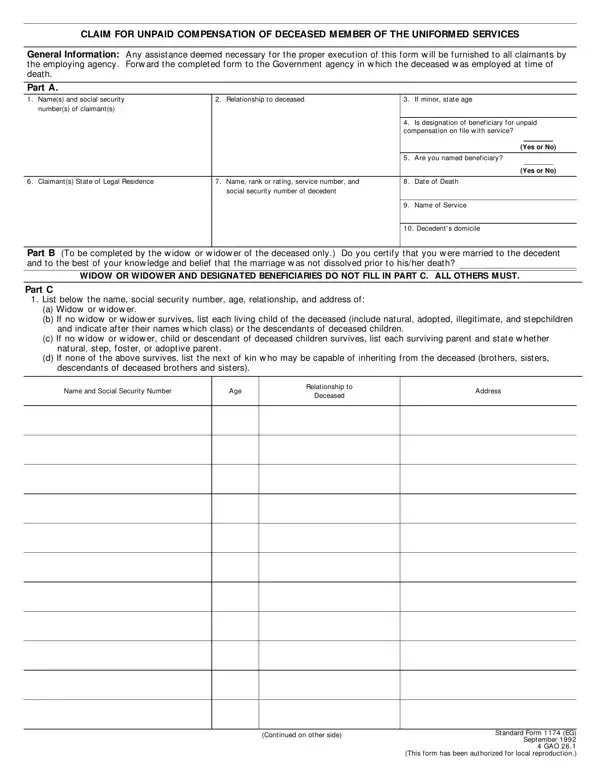
What it is: Standard Form 1174 is the claim for unpaid compensation of a deceased member of the uniformed services.
Where and when to file: Forward the completed form to the Government agency in which the deceased was employed at time of death. Any assistance deemed necessary for the proper execution of this form will be furnished to all claimants by the employing agency.
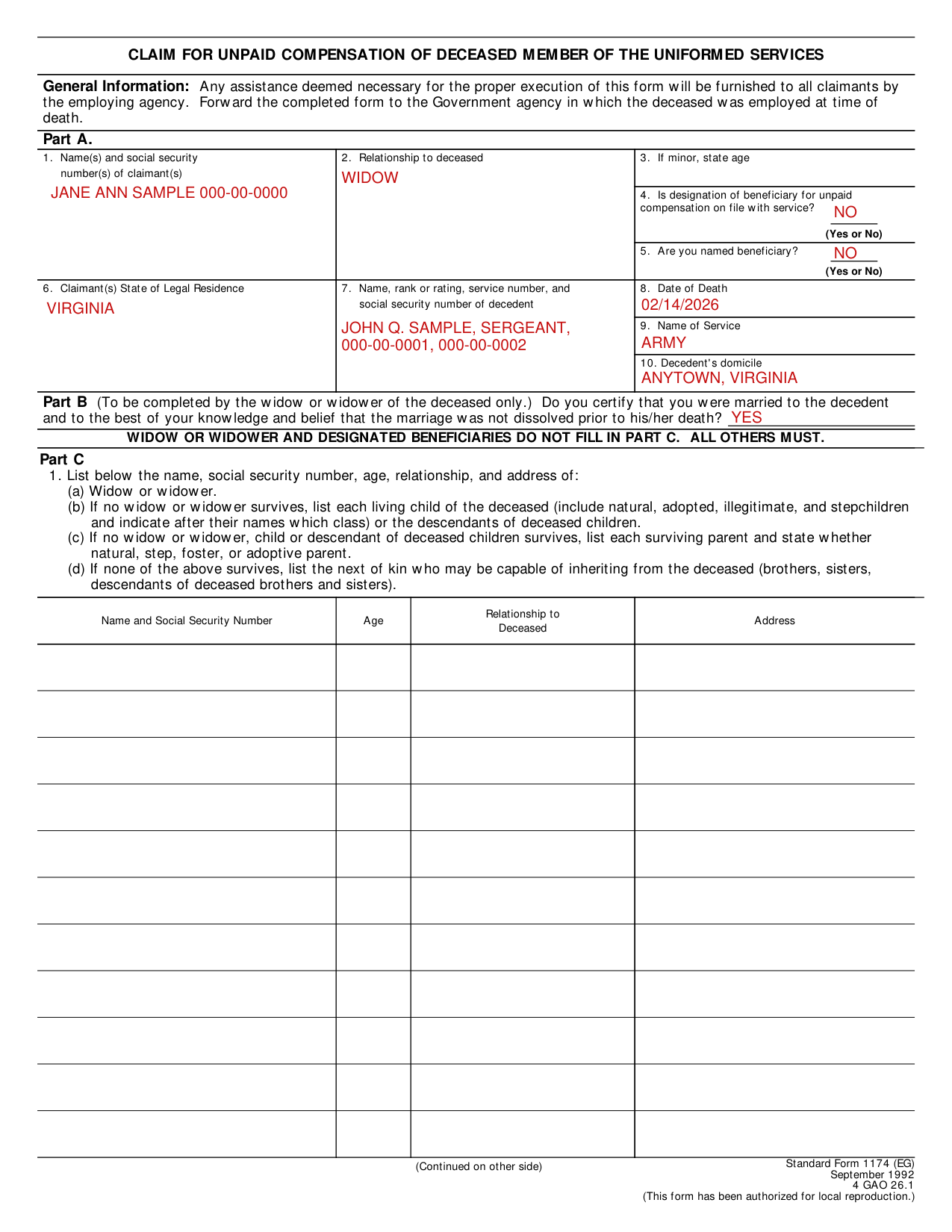
A filled-in Standard Form 1174 example: a widow claims her husband's unpaid pay
How to fill out Standard Form 1174, box by box
Part A: the claimants and the deceased
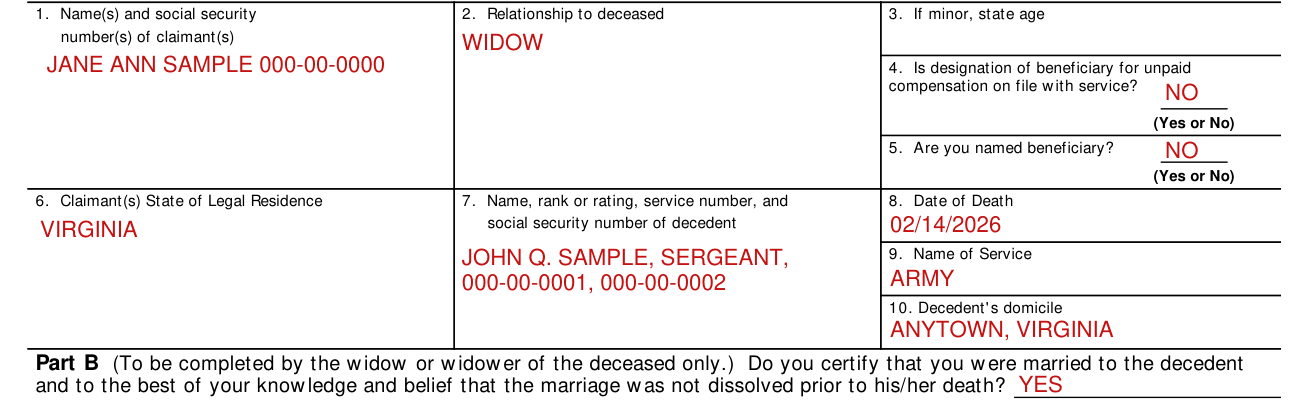
In box 1, enter the name(s) and social security number(s) of claimant(s).
In box 2, enter the relationship to deceased. In box 3, if minor, state age.
In box 4, enter Yes or No: is designation of beneficiary for unpaid compensation on file with service?
In box 5, enter Yes or No: are you named beneficiary?
Box 6 is the claimant(s) State of Legal Residence. Box 7 is the name, rank or rating, service number, and social security number of decedent.
In box 8, enter the date of death.
In box 9, enter the name of service.
In box 10, enter the decedent's domicile.
Part B: the widow or widower

Part B is to be completed by the widow or widower of the deceased only: do you certify that you were married to the decedent and to the best of your knowledge and belief that the marriage was not dissolved prior to his/her death?
Part C: who survives the deceased
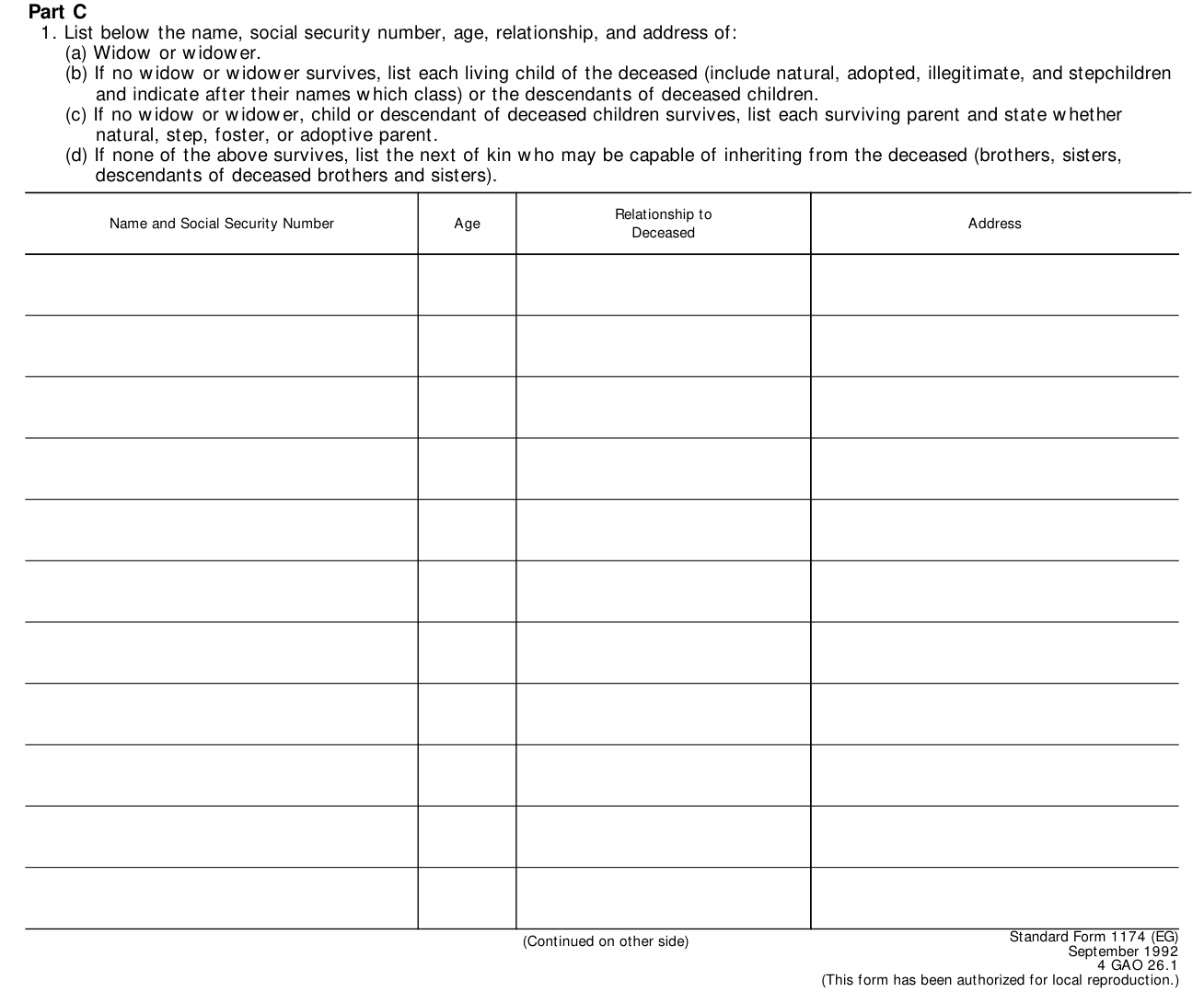
Widow or widower and designated beneficiaries do not fill in Part C. All others must. In Part C, list the name, social security number, age, relationship, and address of: (a) widow or widower. (b) If no widow or widower survives, list each living child of the deceased (include natural, adopted, illegitimate, and stepchildren and indicate after their names which class) or the descendants of deceased children. (c) If no widow or widower, child or descendant of deceased children survives, list each surviving parent and state whether natural, step, foster, or adoptive parent. (d) If none survives, list the next of kin who may be capable of inheriting from the deceased (brothers, sisters, descendants of deceased brothers and sisters).
Part C lists Name and Social Security Number, Age, Relationship to Deceased, and Address.
Part D: executor or administrator
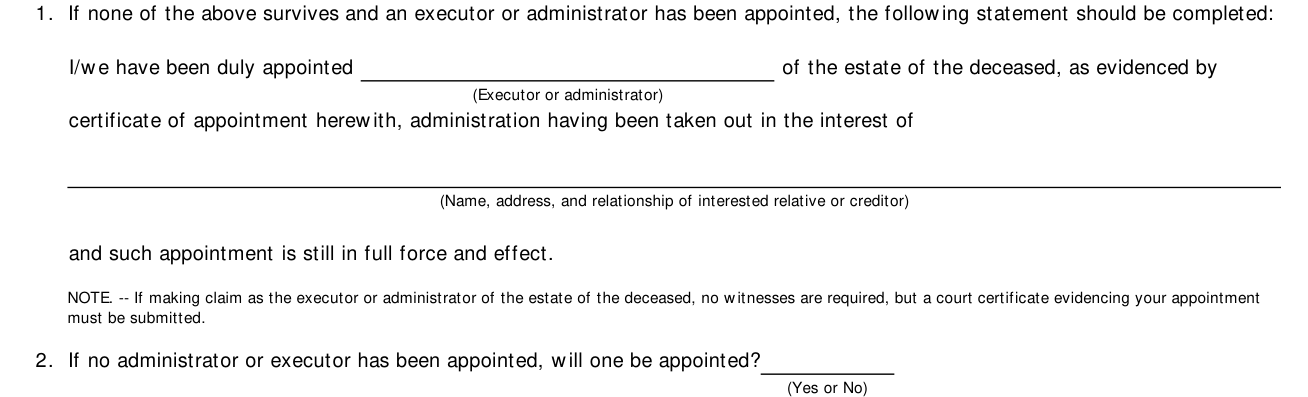
In Part D, if none of Part A, B or C survives and an executor or administrator has been appointed, complete this statement: duly appointed (executor or administrator) of the estate of the deceased, as evidenced by certificate of appointment herewith, administration having been taken out in the interest of (name, address, and relationship of interested relative or creditor), and such appointment is still in full force and effect.
If making claim as the executor or administrator of the estate of the deceased, no witnesses are required, but a court certificate evidencing your appointment must be submitted.
In Part D, enter Yes or No: if no administrator or executor has been appointed, will one be appointed?
Part E: funeral expenses

Designated beneficiary, surviving spouse, children, parents, or legal representatives do not fill in Part E. All other must.
In Part E, enter Yes or No: have the funeral expenses been paid? If paid, receipted bill of the undertaker must be attached hereto.
In Part E, enter whose money was used to pay the funeral expenses.
Signing with two witnesses
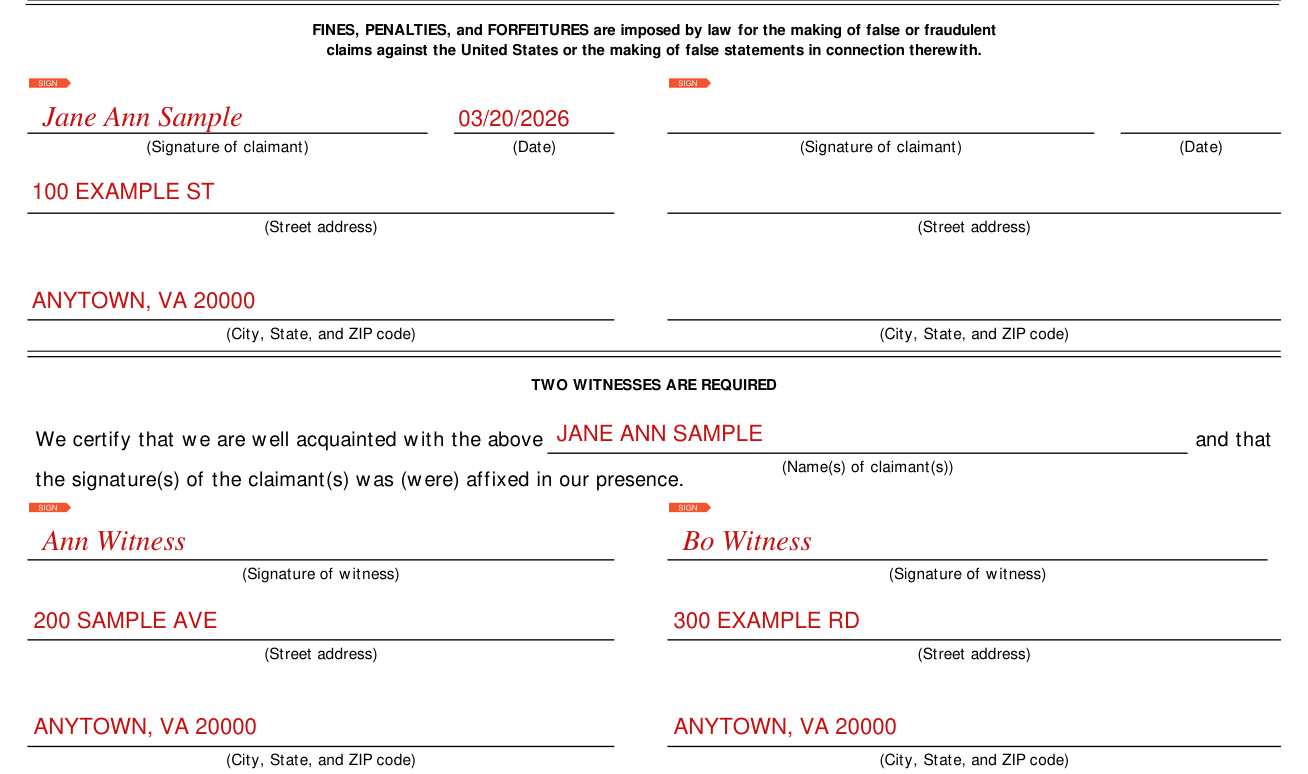
Sign, then enter the date, the street address, and the city, state, and ZIP code.
Two witnesses are required.
Signature of witness, street address, and city, state, and ZIP code.
More rules for Standard Form 1174
All Federal checks in possession of the claimant, drawn to the order of the decedent, in payment of pay and allowances should accompany this claim.
Common questions about Standard Form 1174
Is there a penalty?
Fines, penalties, and forfeitures are imposed by law for the making of false or fraudulent claims against the United States or the making of false statements in connection therewith.
Sources
[1] Standard Form 1174 (September 1992), Claim for Unpaid Compensation of Deceased Member of the Uniformed Services, General Services Administration (the Official source link on this page).