

Teacher Formal Classroom Observation Form at a glance
What it is: The Teacher Formal Classroom Observation Form can be used by the evaluator to document during formal classroom observation.
Who signs: The teacher and the observer each sign and date, on the lines after Evident and Not Evident.
One form should be given to the teacher and one copy should be maintained by the evaluator for the entire evaluation cycle to document growth.
A filled-in Teacher Formal Classroom Observation Form example: an evaluator records one standard
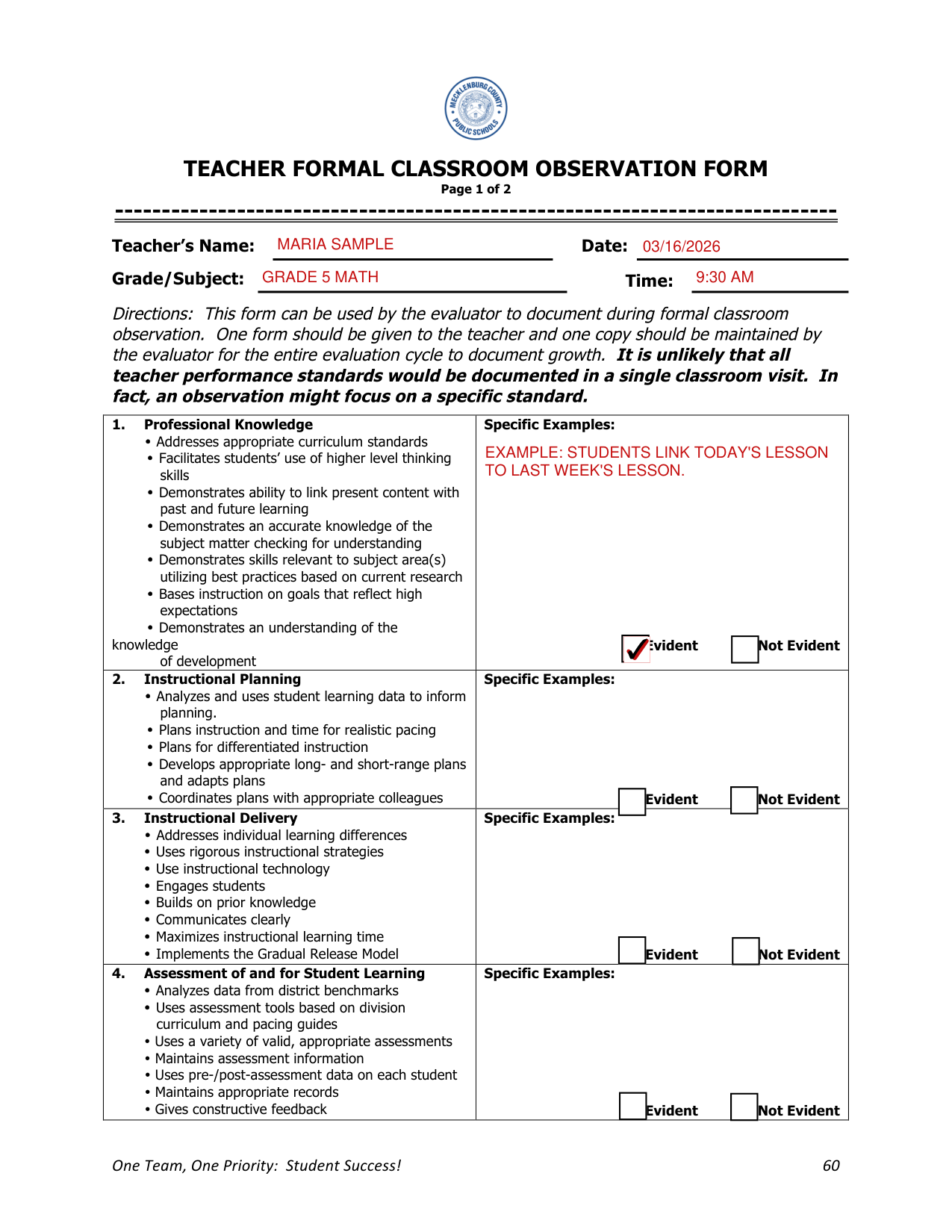
How to fill out Teacher Formal Classroom Observation Form, box by box
Teacher, date, grade and time

Fill in the Teacher's Name, Date, Grade/Subject and Time.
1. Professional Knowledge
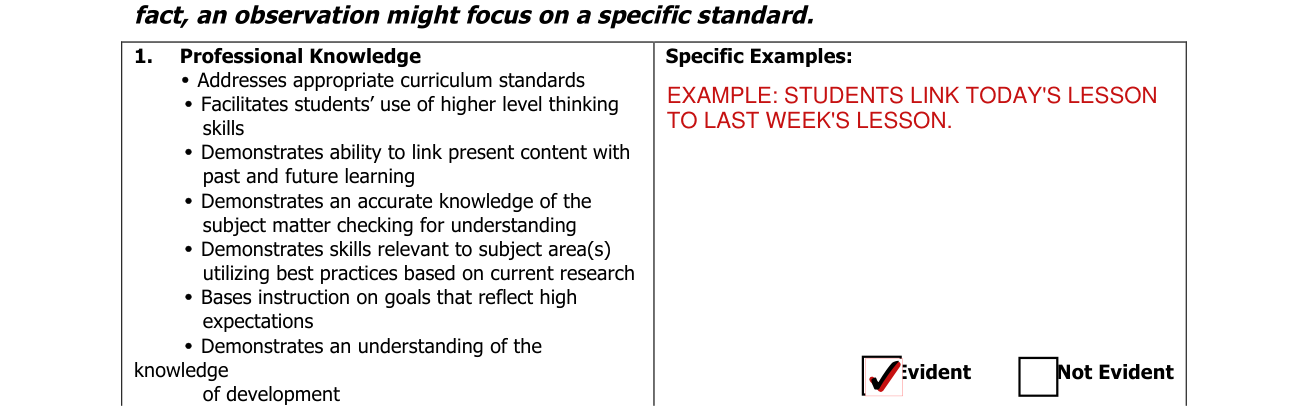
Under 1. Professional Knowledge, write Specific Examples and mark Evident or Not Evident. The form lists: Addresses appropriate curriculum standards; Facilitates students' use of higher level thinking skills; Demonstrates ability to link present content with past and future learning; Demonstrates an accurate knowledge of the subject matter checking for understanding; Demonstrates skills relevant to subject area(s) utilizing best practices based on current research; Bases instruction on goals that reflect high expectations; Demonstrates an understanding of the knowledge of development.
2. Instructional Planning

Under 2. Instructional Planning, write Specific Examples and mark Evident or Not Evident. The form lists: Analyzes and uses student learning data to inform planning; Plans instruction and time for realistic pacing; Plans for differentiated instruction; Develops appropriate long- and short-range plans and adapts plans; Coordinates plans with appropriate colleagues.
3. Instructional Delivery

Under 3. Instructional Delivery, write Specific Examples and mark Evident or Not Evident. The form lists: Addresses individual learning differences; Uses rigorous instructional strategies; Use instructional technology; Engages students; Builds on prior knowledge; Communicates clearly; Maximizes instructional learning time; Implements the Gradual Release Model.
4. Assessment of and for Student Learning

Under 4. Assessment of and for Student Learning, write Specific Examples and mark Evident or Not Evident. The form lists: Analyzes data from district benchmarks; Uses assessment tools based on division curriculum and pacing guides; Uses a variety of valid, appropriate assessments; Maintains assessment information; Uses pre-/post-assessment data on each student; Maintains appropriate records; Gives constructive feedback.
Page 2, 5. Learning Environment
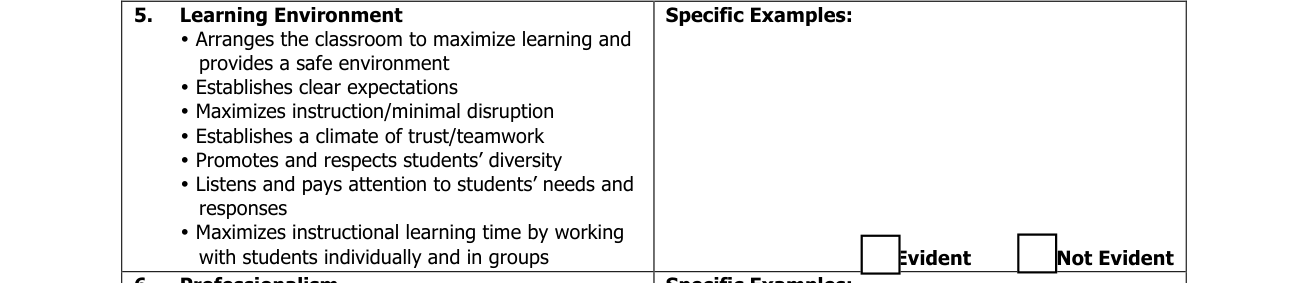
Under 5. Learning Environment, write Specific Examples and mark Evident or Not Evident. The form lists: Arranges the classroom to maximize learning and provides a safe environment; Establishes clear expectations; Maximizes instruction/minimal disruption; Establishes a climate of trust/teamwork; Promotes and respects students' diversity; Listens and pays attention to students' needs and responses; Maximizes instructional learning time by working with students individually and in groups.
Page 2, 6. Professionalism
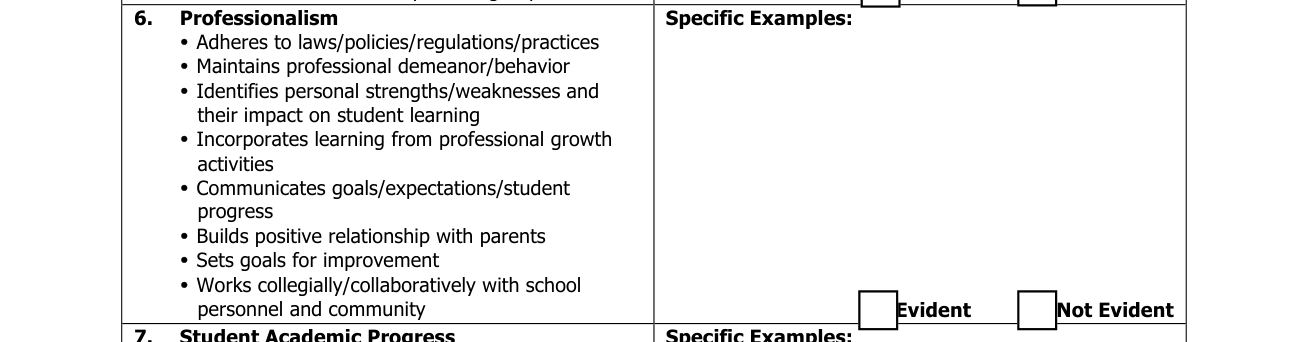
Under 6. Professionalism, write Specific Examples and mark Evident or Not Evident. The form lists: Adheres to laws/policies/regulations/practices; Maintains professional demeanor/behavior; Identifies personal strengths/weaknesses and their impact on student learning; Incorporates learning from professional growth activities; Communicates goals/expectations/student progress; Builds positive relationship with parents; Sets goals for improvement; Works collegially/collaboratively with school personnel and community.
Page 2, 7. Student Academic Progress

Under 7. Student Academic Progress, write Specific Examples and mark Evident or Not Evident. The form lists: Sets student achievement goals; Documents progress; Provides evidence of goal attainment; Provides support to increase student achievement; Develop interim learning targets.
Page 2, Signatures and dates
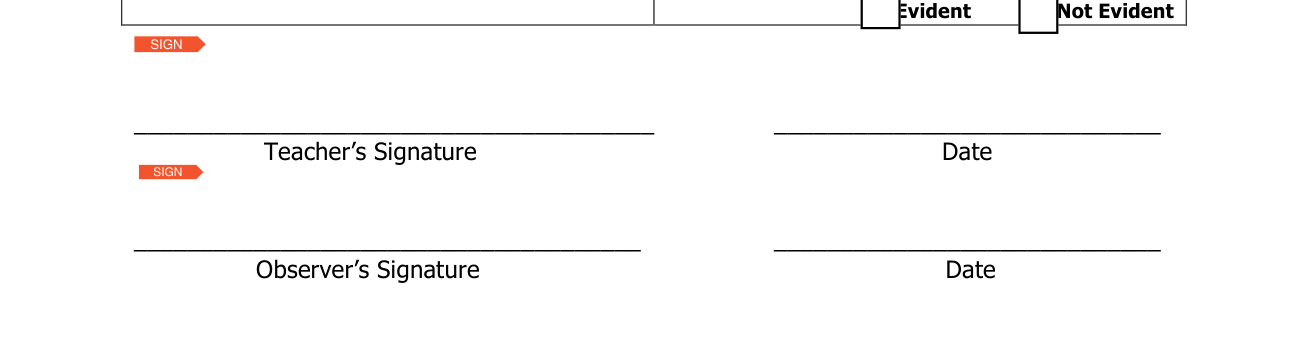
The teacher and the observer each sign and date, on the lines after Evident and Not Evident.
The teacher's signature, on the line after Evident and Not Evident, acknowledges that the teacher has read and received a copy of this classroom observation.
Page 2, Comments attached

The teacher may attach additional professional comments. If the teacher attaches additional professional comments, mark Comments attached.
More rules for Teacher Formal Classroom Observation Form
It is unlikely that all teacher performance standards would be documented in a single classroom visit. In fact, an observation might focus on a specific standard.
Sources
[1] Teacher Formal Classroom Observation Form, a generic template with no single issuer file (the Official source link on this page).