
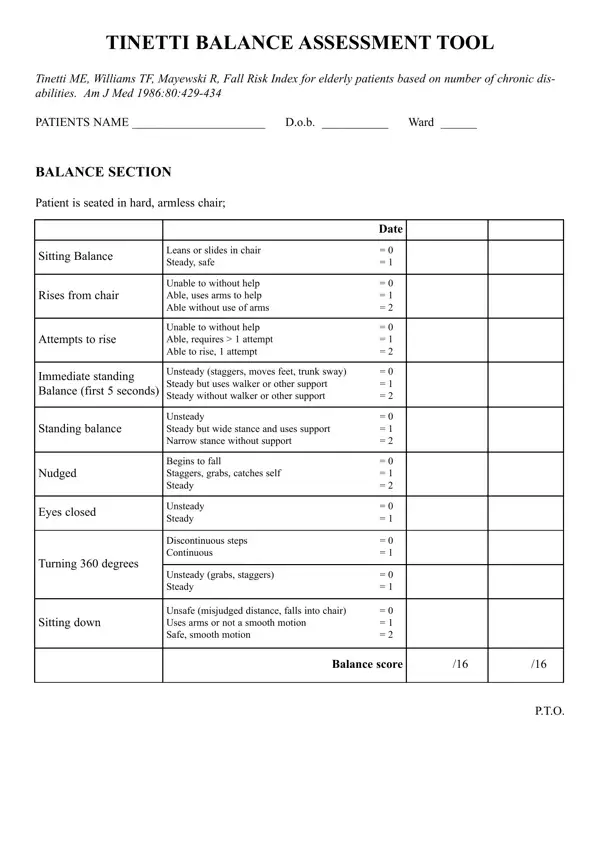
Navigating through the complexities of assessing and managing fall risks among the elderly, the Tinetti Balance Assessment Tool emerges as a beacon of meticulous design and practical utility. Developed by Tinetti ME, Williams TF, and Mayewski R in 1986, this tool has carved its niche in the medical field as an effective instrument for identifying individuals at varying levels of fall risk based on the examination of their balance and gait. It distinguishes itself through a structured examination that unfolds in two main sections: the Balance Section and the Gait Section. Each section meticulously evaluates different components of a patient's mobility; starting with simple tasks like sitting and rising from a chair, to more complex ones such as walking with or without aids and turning 360 degrees. The assessment quantifies performance in these areas, assigning scores that ultimately consolidate into a comprehensive risk indicator—categorizing fall risk as high, moderate, or low. This tailored approach not only highlights the specific areas of weakness in balance and gait but also directs interventions to mitigate these fall risks effectively. Indeed, the Tinetti Balance Assessment Tool serves as a cornerstone for clinicians and healthcare providers in constructing targeted and effective care plans for the elderly population, making fall prevention strategies more nuanced and personalized than ever before.
| Question | Answer |
|---|---|
| Form Name | Tinetti Balance Form |
| Form Length | 2 pages |
| Fillable? | No |
| Fillable fields | 0 |
| Avg. time to fill out | 30 sec |
| Other names | tinetti balance assessment, tinetti balance, tinetti balance test, tinetti balance test calculator |
Tinetti Balance Form isn’t the one you’re looking for?