
An affidavit of identity is a legal document that confirms the identity of a person making a sworn statement. Our free affidavit of identity form is a fillable affidavit form that lets you prove you are who you say you are, so governmental and business entities can rely on more than your word. It serves two main purposes: to authenticate your identity and to verify your signature. It also helps reduce the risk of fraud and identity theft.
Last Updated: October 2026. This guide is reviewed and updated regularly to reflect current law. If you notice an error or outdated information, please contact us.
Build Your Document
Answer a few simple questions to make your document in minutes
Save and Print
Save progress and finish on any device, download and print anytime
Sign and Use
Your valid, lawyer-approved document is ready
If you don’t have this legal document, it might result in governmental bodies or business entities being unconfident about your identity or having your legitimate signature. In some situations, the lack of an affidavit of identity might lead to blocking certain transactions or not reaching the needed results.
Here are some of the situations when the absence of this legal document might result in time and financial expenses.
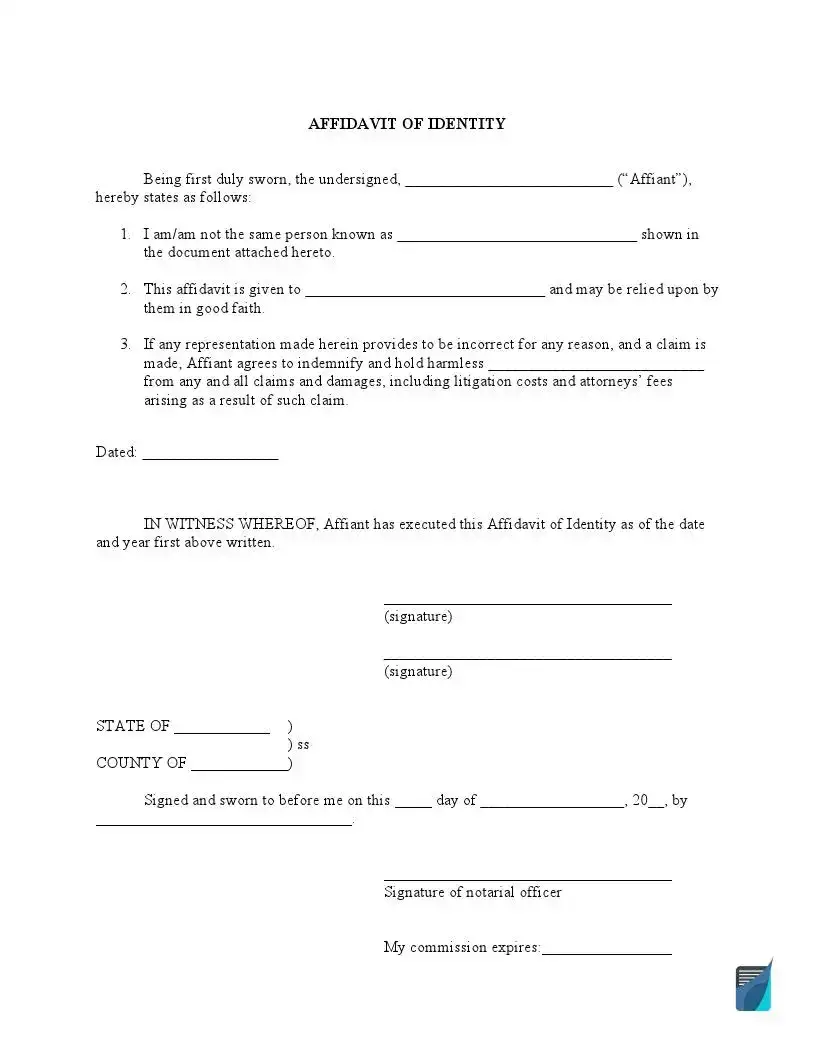
An affidavit of identity is an easy-to-fill legal document. You can use our free affidavit of identity form, which comes in three formats: PDF, DOC, or ODT. Go through the steps below in order and complete the template by entering your details on the matching lines. Download the PDF, fill it in on screen, then print it to be signed.
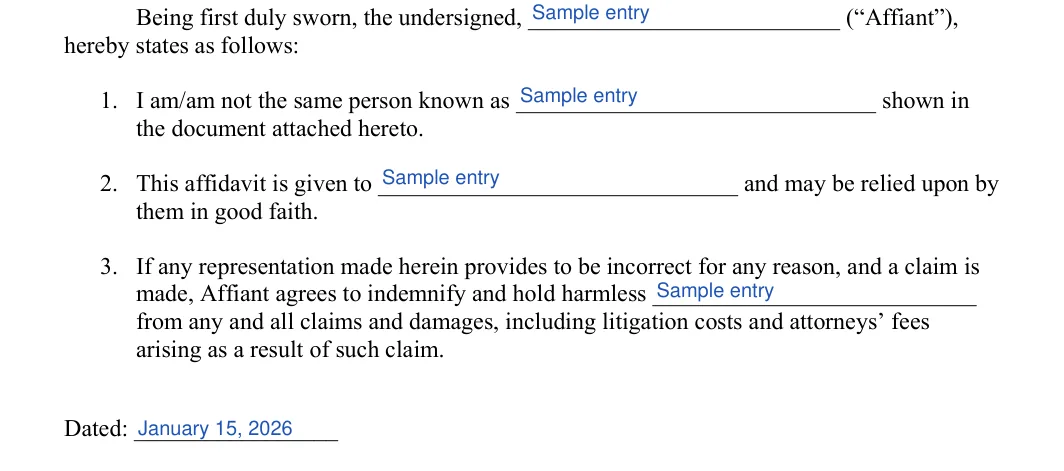
The screenshots under each step show the FormsPal Affidavit of Identity template filled with sample entries in blue, so you can see where each answer goes. The names, addresses, dates and amounts are examples only.
Start with your full name. Write it on the line after “the undersigned” in the opening sentence. The form calls you the Affiant: “Being first duly sworn, the undersigned, [Name of the affiant] (“Affiant”), hereby states as follows.”


Item 1 says who you are. Write the name shown in the attached document and keep the “am” or “am not” that applies to you: “I am/am not the same person known as [Name of the affiant] shown in the document attached hereto.”
Item 2 names the government agency or business entity that will receive the affidavit: “This affidavit is given to [Name of the Recipient] and may be relied upon by them in good faith.”
Item 3 says you will hold the recipient harmless if the information turns out to be wrong. Enter the recipient’s name here. The wording on the form is:
“If any representation made herein provides to be incorrect for any reason, and a claim is made, Affiant agrees to indemnify and hold harmless [Name of the recipient] from any and all claims and damages, including litigation costs and attorneys’ fees arising as a result of such claim.”
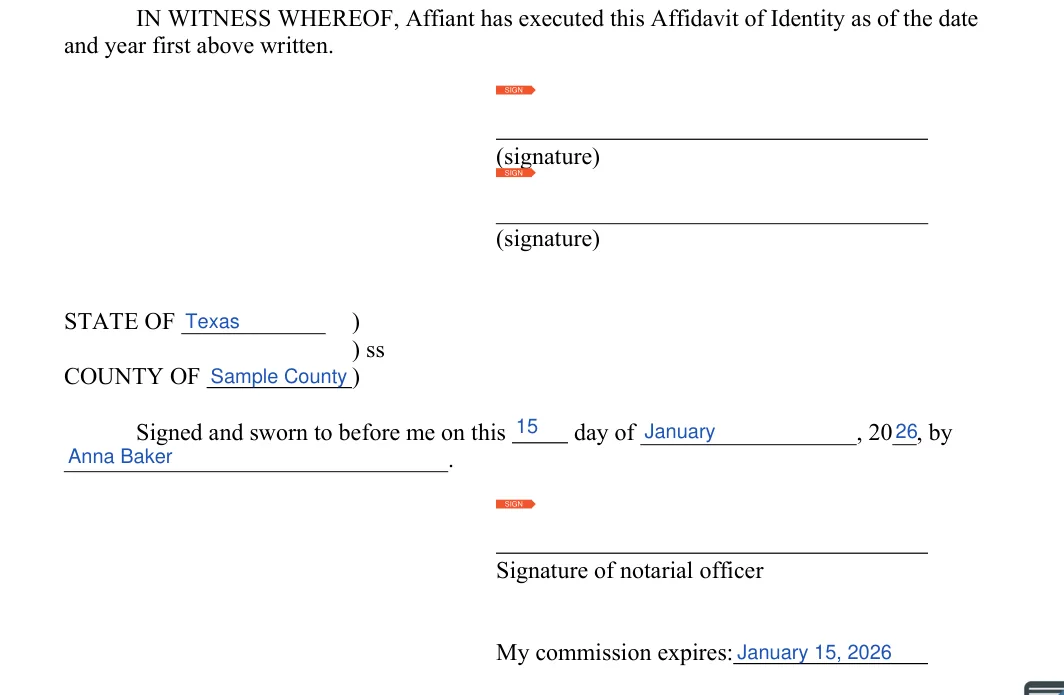
The date of the affidavit should be put next along with the following statement: “IN WITNESS WHEREOF, Affiant has executed this Affidavit of Identity as of the date and year first above written.” Then, you have to put your signature in the affidavit.

Sign on the signature line under the IN WITNESS WHEREOF statement. The notary block sits below it. Make a copy of the finished affidavit for your records, and ask the recipient whether they need the original or a copy.
Lastly, the affidavit should be notarized. In a free form that you can find on our website, there will be a specific section for notary acknowledgment that is filed by a notary public. It should mention the state and county of executing the affidavit, the statement about the affidavit being signed and sworn to the notary, and their signature and the date of their commission expiration.
Tip: Bring an official photo ID when you meet the notary public, so it is easy to verify your identity.


An affidavit of identity might be needed in plenty of situations. Banks, courts, agencies and businesses may ask for one when they want sworn, written proof of who you are. The most common cases are listed below:
Another category of situations where an affidavit is an essential legal document is being a victim of identity theft, for instance, a driver’s license or ID theft. Then, the document helps properly file state income tax returns when dealing with credit agencies or law enforcement agencies, etc.
Circumstances where an identity affidavit is needed might vary and commonly, governmental and business entities notify applicants of the need to provide this legal document for a certain type of transaction or deed.
An identity affidavit works best when the recipient can match every detail to your ID and your signature. There is a minimum number of details that should be included in every identity affidavit. Among them are:
If the legal document is created for the purpose of alleging fraud, an SSN or its last 4 digits might be needed as well.
Tip: Check that your name, date of birth and address match your official ID exactly before you sign.
No. Once you created this legal document, it will be valid for an unlimited period of time. At the same time, affidavits might slightly differ in terms of the contents, which is why different life situations might call for the need to create several affidavits of identity for each of them.
Yes. The main purpose of this legal document is to verify the affiant’s identity and signature, and specifying information that is known only to the affiant facilitates the identification process. It is especially relevant for those affiants who have common names, such as James Williams or Tom Johnson. The personal information included in the document will let distinguish people with the same names from each other.
Here is what happens at the notary’s office.
No. You might put your name, address, and other needed information in the legal document. It is the notary who needs to witness it which is why you should first see the notary and only then sign the affidavit.
No, the format of the document is optional, but some states such as New Jersey might offer their free forms. To avoid the need to look for the documents on the internet, use our free form that can be downloaded and filled out in minutes.
General information, not legal or tax advice.
