
An affidavit of birth form is a document that records a sworn account of one person's birth: the date, time, place and parents. It might be completed by a parent, relative, or medical professional who was a witness to the birth if a birth certificate cannot be found. The main goal of the fillable affidavit form is to help prove an individual’s citizenship or file an application for a new birth certificate. Once filled out, the affidavit should be notarized to get legal force.
Last Updated: October 2026. This guide is reviewed and updated regularly to reflect current law. If you notice an error or outdated information, please contact us.
Build Your Document
Answer a few simple questions to make your document in minutes
Save and Print
Save progress and finish on any device, download and print anytime
Sign and Use
Your valid, lawyer-approved document is ready
An affidavit of birth form is a sworn written account of when, where and to whom a person was born. A family member, a doctor or another person who knows the facts first-hand makes it under oath. People attach it as a supporting record when the original birth certificate cannot be produced or no other proof of the birth exists.
Many people add it to other supporting documents, such as medical records, school records or family records, in an immigration case, a government application or a family matter. Affidavits of birth are plain documents, so a short and clear version is easier for the receiving office to read.
An affidavit of birth gives an agency a sworn account of a birth when the usual proof, such as a birth certificate, is missing, incomplete or not enough on its own. People use it in situations like these:
When an affidavit of birth is used for official purposes, for instance for USCIS or Department of State, there are certain requirements that should be followed strictly when crafting the document. Please note that immigration officers are evaluating the document in terms of its probative value and credibility, which is why the following information is necessary in the affidavit.
In all 48 jurisdictions FormsPal's verified state data covers (47 states and DC), a birth that was not registered on time can still be registered later. This is called a delayed registration. The rules differ on the waiting period, the proof and the person who signs.
The waiting period and the proof differ by jurisdiction. Contact the vital records office that issues birth certificates in the place of birth before you start.
One of the requirements for an affidavit is that details of a person’s birth contained in it need to be truthful as otherwise, a person might face a penalty for perjury.
Another requirement is that it should be created by a person who is a first-hand witness to an individual’s birth, for instance a medical worker who helped with the delivery or one of the parents.
These people should have direct knowledge of the birth and its circumstances and they should mention the reason why it is them who are submitting the affidavit instead of a person’s parents. The affiant does not necessarily have to be a US citizen.
Please note that the petitioner or their beneficiaries cannot be affiants in an affidavit of birth.
The form should also be signed, dated, and notarized before it gets legal force.
An affidavit of birth form has four parts, and you complete them in order. You identify yourself first, then describe the birth under oath, then close with the place and the date. A notary completes the last part, the acknowledgement.
Work through the four parts in order and keep the finished affidavit with your other documents. Fill in every field in full, spell each name the way the birth certificate or birth record does, and leave the notary acknowledgement blank until you stand in front of the notary. The steps below walk through each part.
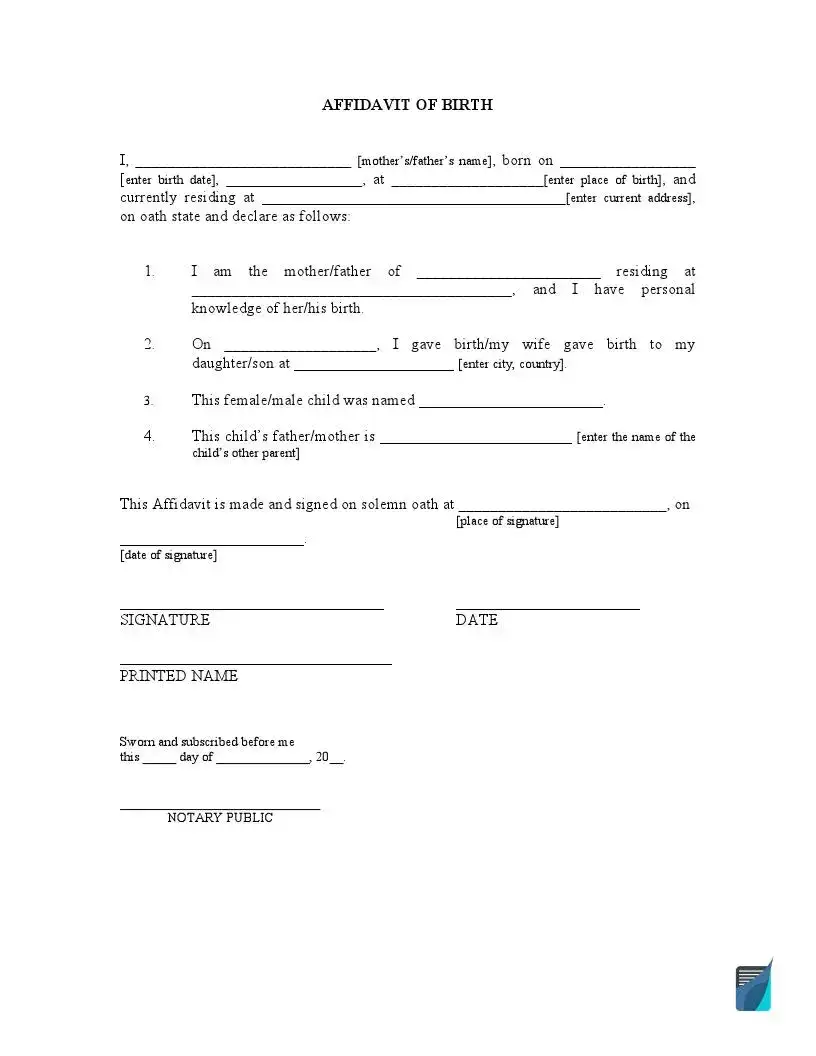
In the first paragraph of the document, include your name, birth date, place of birth, and place of current residence. Then, there should be a statement: “…on oath state and declare as follows.”

The first statement in the affidavit of birth should be your relation to the person witnessing the birth of whom you are swearing about. It should state that you are the mother of the father of the person, their place of residence, and that you have personal knowledge of your child’s birth.
The next statement should be that on a certain date, you or your wife gave life to your child at the specified place.
Further, you need to state the name of your child.
As the last statement, tell the name of the child’s other parent.

The affidavit should end with stating that it was made and signed on solemn oath at a certain place and on a specified date. Then, include your signature, date and printed name.

The last section in the affidavit of birth should be notary acknowledgement. A notary public should put the date when the affidavit was sworn and signed in front of them and their signature.
There is no standard form of the affidavit of birth which is why to save your time and efforts, use our document builder. It will let you create an affidavit of birth in minutes. Just answer several questions regarding the birth of a person, and get a ready-made document in no time.

The sample below shows how the sworn account usually reads. Replace the bracketed items with the facts of your own case and keep the wording plain, because a short and clear affidavit is easier for the receiving authority to read. Notarization comes after you write the account, so wait to finish the oath until you are with the notary.
I, [full name], of [address, city and state], being duly sworn, state that I was present at the birth of [child's full name] on [date] at [place of birth, including the state]. The mother of the child is [mother's full name, including maiden name] and the father is [father's full name]. I make this affidavit from my own knowledge.
Small errors in names and dates are easy to make and easy to avoid. Check the affidavit against the birth certificate or birth record before you take it to a notary. These are the slips to watch for:
An affidavit of birth is a sworn account of one person's birth, made by someone who knows the facts first-hand. Most people want to know who can sign it, whether it needs a notary and what happens if the information is wrong or the registrar says no.
The person who signs is the affiant. The affiant swears to facts they know first-hand. In 10 of the 48 jurisdictions FormsPal's verified state data covers, a rule sets who may swear the affidavit and requires personal knowledge of the facts of birth.
In 4 of the 48 jurisdictions covered, a rule requires the affidavit to be sworn before a notarizing official. Ask the office that will receive your affidavit whether it wants a notarized copy. Notarization is the step where a notary public confirms who made the affidavit and when, so check which documents the receiving office wants before you go to the notary.
In 11 of the 48 jurisdictions covered, a rule sets a penalty for knowingly making a false statement in a birth record or affidavit. Check every name, date and place against the birth certificate before you swear the affidavit.
In 2 of the 48 jurisdictions covered, a person whose delayed registration is denied may petition a court. Ask the registrar's office for the reason and for the next steps it offers.
Some people add an affidavit of birth to an immigration case as a supporting record when the birth certificate is missing. Whether it is enough depends on the immigration office handling the case, so ask that office which documents it wants. Keep a copy of every certificate, record and affidavit you send to support the case.
Yes. You have two ways to do it:
General information, not legal or tax advice.
