
Updated:
Get Form Now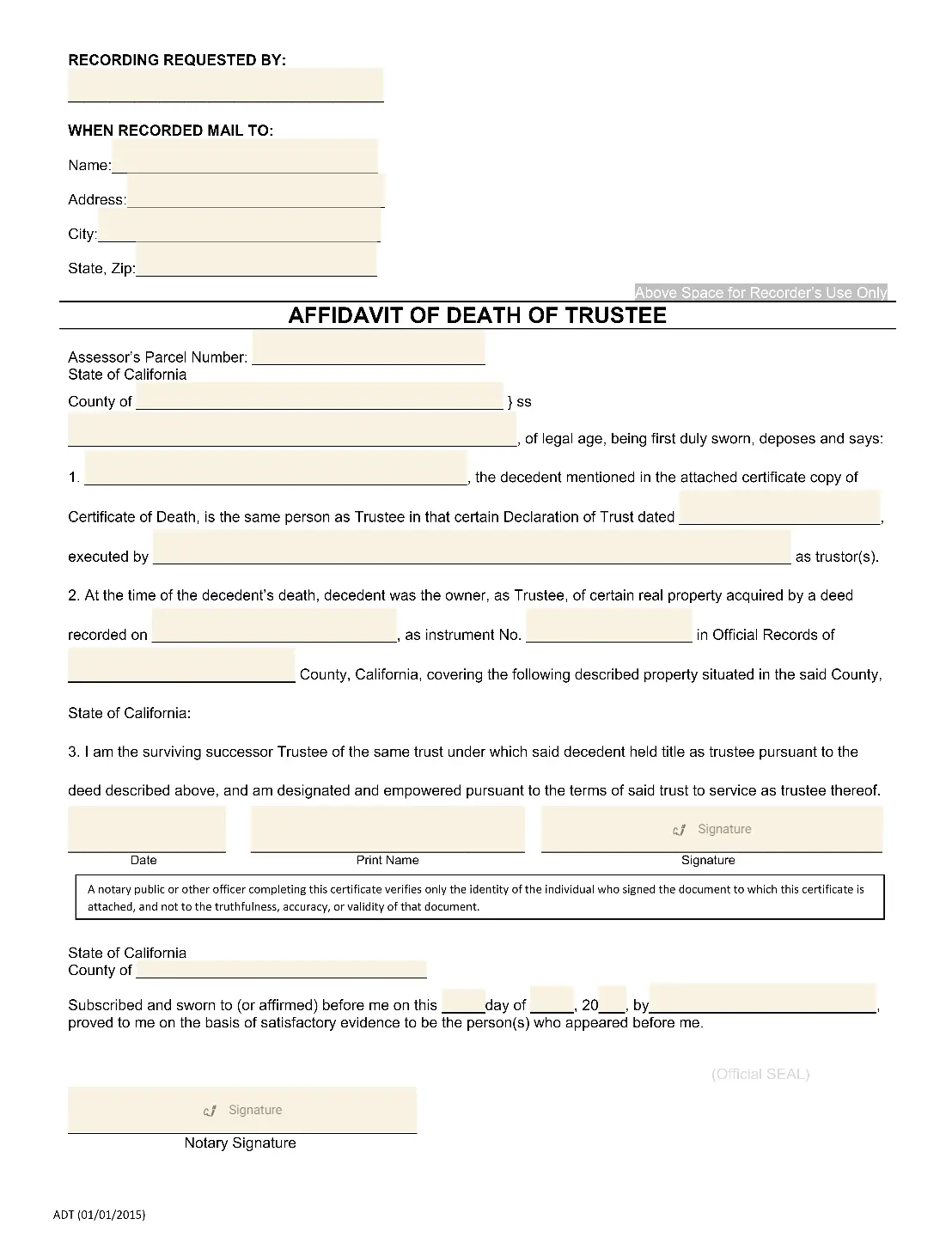
An affidavit of death of trustee swears that a trustee has died. The California form takes the deceased trustee's name off the title of trust real estate. Successor trustees use it, especially when the trust holds a house or land.
Key facts
An affidavit of death of trustee is a sworn statement that a named trustee of a trust has died, made for one piece of California real estate the trust holds. The affidavit identifies the decedent, the trust, the property and the person who now serves as trustee.
The form does not create a new trust or change who benefits from it. It updates the paper trail on the title: the deceased trustee's name comes off, and the successor trustee becomes the person who signs for the trust. The trust papers themselves still decide who receives the property in the end.
The affidavit uses six terms from trust and property papers, and knowing who is who makes each line easier to complete. The trustor, the trustee and the successor trustee are often different people.
The affidavit fits a trust that holds California real estate in the name of a trustee who has died. The successor trustee prepares it before selling, refinancing or distributing that property, because the title still shows the old trustee's name.
This form has space for one parcel: one parcel number, one set of deed details and one legal description. For a trust with a house and a rental lot, the usual practice is to fill in a separate copy of the form for each property.
A joint-life trust names both spouses as trustees. When one spouse dies, the surviving spouse often keeps managing the trust, and the affidavit takes the deceased spouse's name off the title. The trust papers say whether the property goes to the recipients at the first death or only after the second.
The affidavit is usually signed by the successor trustee, and the signer is the person the form names as the one making the affidavit. In the signature part, the signer swears that the facts in the form are true, including that the decedent was the trustee of the trust listed on the form.
The signer's name appears twice: once near the top as the person making the affidavit, and again under the signature. Both entries should match the name written in the trust papers. When the trust names more than one successor trustee, read the trust to see whether they act together or one at a time before deciding who signs.
An affidavit of death of trustee covers trust real estate only; other affidavits of death cover other ways of holding property. Pick the form that matches how the title reads on the current deed.
| Form | Fits when |
|---|---|
| Affidavit of death of trustee | The deed shows a trustee of a named trust as owner |
| Affidavit of death of joint tenant | The deed shows two or more owners as joint tenants |
| Affidavit of death of life tenant | The deed shows an owner with a life estate |
An acceptance of trusteeship is a separate paper: in it, the successor trustee agrees to serve. It does not replace the affidavit of death on the title.
The affidavit draws on four papers, and having them on the desk prevents most errors.
Check that every name, date and number you enter matches the death certificate and the trust papers.
The California affidavit is filled in from top to bottom in eight steps, each taken from the papers gathered above. Open it in our online PDF editor and work through the steps in order.
Type the full legal name of the new owner or owners of the property.

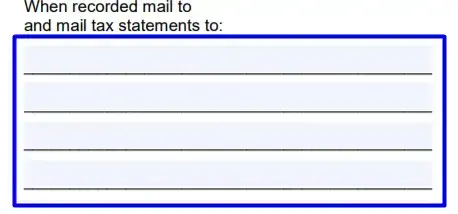
Enter the full name and mailing address of the person who will receive the stamped copy and the tax statements after recording.
Enter the Assessor's Parcel Number in the main body. Copy it from the current deed or the tax bill.

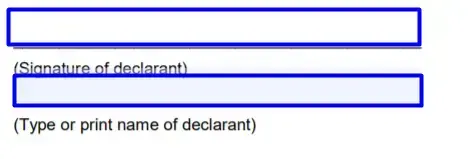
Enter the full name of the person who will sign the affidavit.

Fill in the deceased owner's part. Write the name exactly as it appears on the death certificate, then repeat it on the following line. Next, enter the date the trust was signed. On the last line of this part, enter the name or names of the trustor(s) shown on the trust papers.

Describe the property from the deed that moved it into the trust. Enter the street address, then the trustor names shown on that deed.
Use the next spaces for the dates it was signed and recorded. After that, enter the Instrument Number, the Book or Reel number, and the Page or Image number, if any were used before. Finally, write the name of the county in California where the process took place.

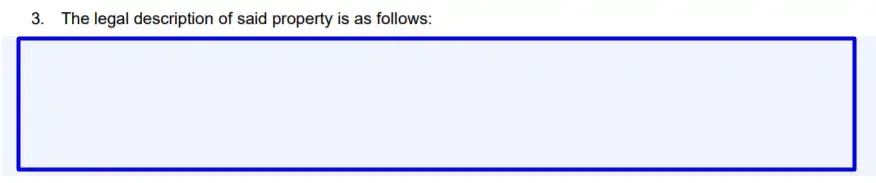
Enter the legal description of the property exactly as it is written in the deed. If it does not fit, type or photocopy it on a separate sheet labeled "Exhibit A," attach it, and enter "See Exhibit A" in this space.
Date and sign the affidavit in front of a notary public, who completes the notary section at the end of the form. Print the signer's name on the line below the signature.

A signed affidavit of death of trustee goes to the county where the property sits, and the death may also set off a property tax report. The steps below cover both.
Cal. Rev. & Tax. Code § 480 requires a change in ownership report from the buyer of real property that has changed ownership, as the California State Board of Equalization explains. When the change in ownership was the result of a death and there is no probate, Cal. Rev. & Tax. Code § 480 sets the deadline at 150 days from the date of death. When the estate is probated, Cal. Rev. & Tax. Code § 480 sets it at the same time the inventory and appraisal is filed.
The California State Board of Equalization lists the substitution of a trustee of a trust among the transfers excluded from reassessment.
The example below uses made-up details to show how a completed affidavit can look. Replace every entry with the details from your own trust papers and property records.
| Part of the affidavit | Example entry |
|---|---|
| New owner | Ben Carter, successor trustee |
| Deceased owner | Anna Baker, written as on the death certificate |
| Trust date | March 3, 2015 |
| Property address | 123 Main Street, Anytown, California |
| County | Sample County |
| Assessor's Parcel Number | 123-456-789 |
| Legal description | See Exhibit A |
| Signer | Ben Carter |
Most errors on the affidavit are mismatches with the source papers. Check each entry against the deed, the trust and the death certificate before signing.
The affidavit takes a deceased trustee's name off the title of trust real estate. It lets the successor trustee sign for the trust when the property is sold, refinanced or distributed.
Start with the new owner's details and the mailing address for the stamped copy. Then add the signer, the deceased owner, the property details and the legal description. The last part holds the date, the signature and the notary section.
The parcel number is on the property tax bill and the current deed. Enter it in the main body exactly as it appears there.
Yes. Type or photocopy the description on a separate sheet labeled "Exhibit A," attach it, and write "See Exhibit A" in the legal description space.
No. The affidavit of death of trustee is written for the title of one piece of real estate. A form titled affidavit of successor trustee is a broader statement of who now serves as trustee, so read its wording to see what it covers.
No. The affidavit only changes who acts as trustee on the title; the trust's own terms decide who receives the property.
General information, not legal or tax advice.
