
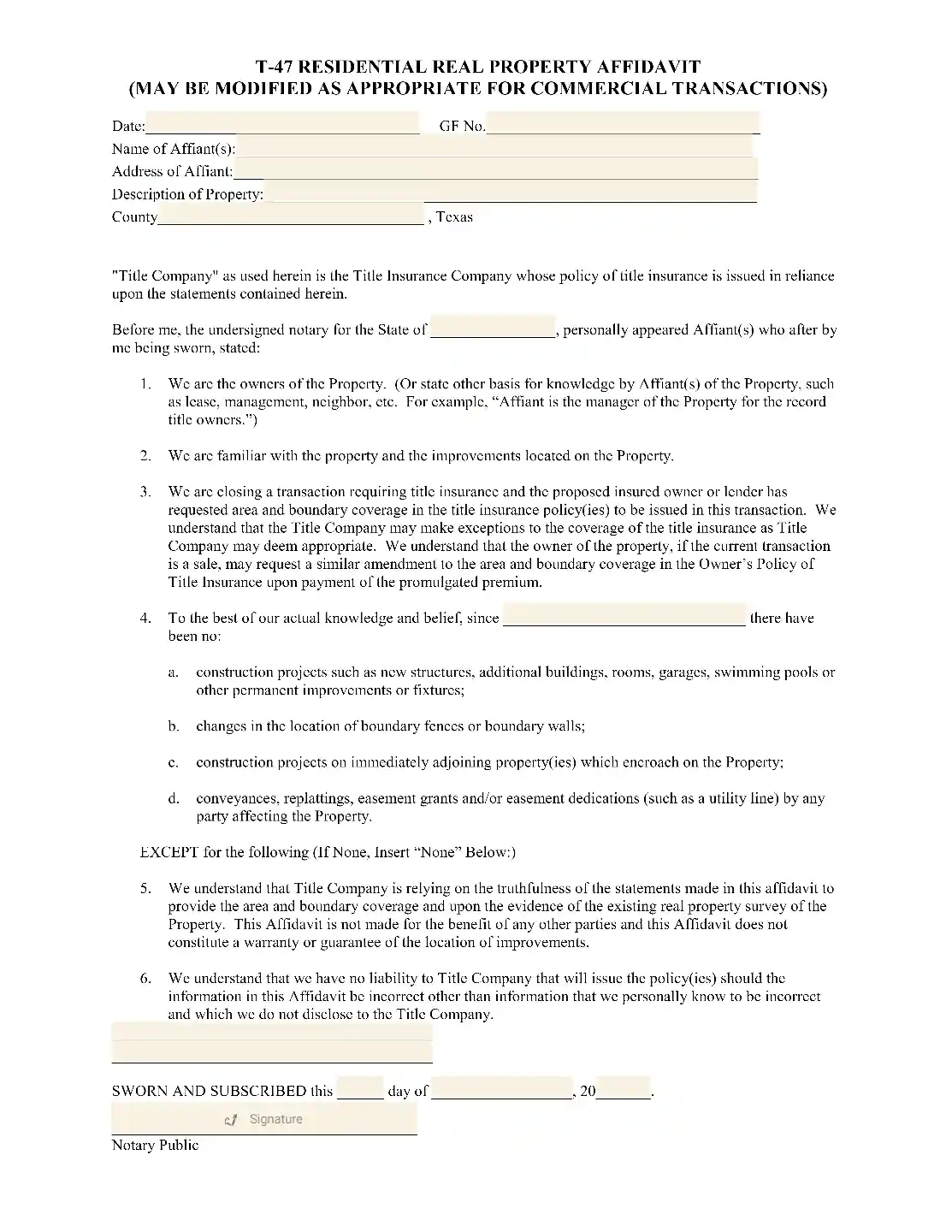
The Texas residential real property affidavit, also called Form T-47 or the T-47 affidavit, is a seller’s statement about a home. In it, the seller says that nothing major has changed since the last survey. It goes with an existing survey when a home is sold. The part that takes the most thought is Paragraph 4, the date of the last major changes.
Last Updated: October 2026. This guide is reviewed and updated regularly to reflect current law. If you notice an error or outdated information, please contact us.
As mentioned above, this type of residential real property affidavit follows and authorizes an estate transactions survey. The buyer and seller may either agree to pay to get a new survey composed or use an already existing one for the transaction to come into force. If the parties eventually decide not to spend money on a new survey, they should use this affidavit form to complement and authorize an older survey.
Thus, the seller should use the T-47 form to attest the accuracy of a performed survey from their point of view.
| Full name | Texas Residential Real Property Affidavit |
|---|---|
| Short names | Form T-47 and the T-47 affidavit |
| Goes with | An existing survey of the home |
| Trickiest part | Paragraph 4, the date of the last major changes |
| Steps below | Nine steps, from the date and file number to the notary |
In plain words, the state title insurance companies use this document to assess and then claim the amount of coverage they are ready to provide for the subject piece of real property.
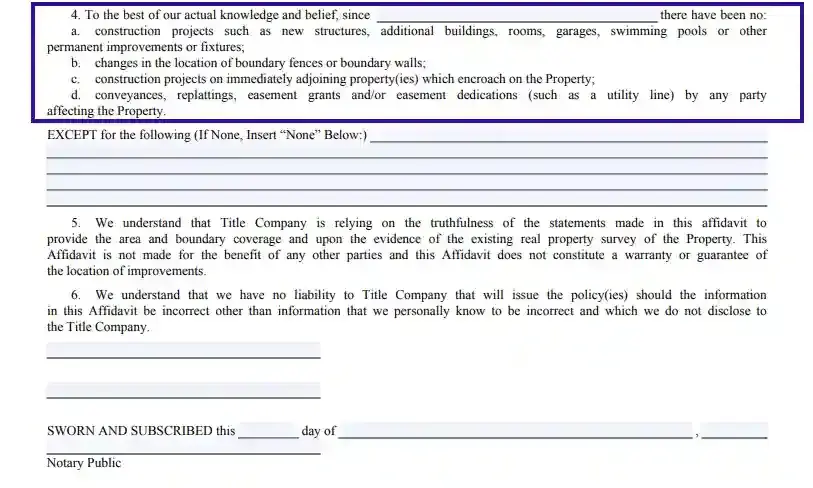
The purpose looks clear until you reach Paragraph 4 of the document. In this paragraph, the seller must indicate the date since when the real property unit has suffered no major changes.
Keep these at hand when you reach Paragraph 4:
To sum up, the primary purpose of the T-47 affidavit form is to affirm there is no problem with the property’s title and all the necessary papers are in order.
It is worth mentioning that should the seller put any date other than indicated in the last survey in an already notarized residential real estate affidavit, they will be facing some legal circumstances. If they do so by accident, they shall immediately inform the title company and request a new title survey.
First off, you should obtain the proper T-47 form template. You can either download it from the official state government’s website or go to the Texas Department of Insurance and receive it in person. You can also build and edit the form online with FormsPal tools, instead of working on paper. Editing online lets you fix a mistake right away, which helps because an affidavit needs precise details.
The document is straightforward, but a few details need care when you fill out this form. Follow the steps below in order.
Put the Date and File Number
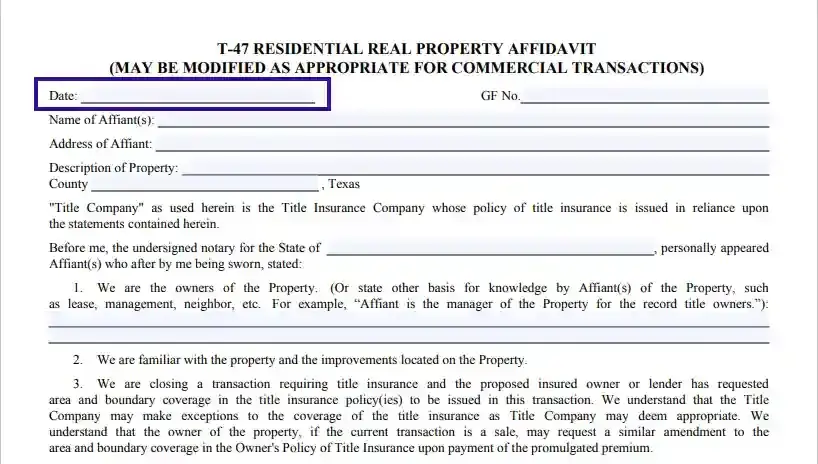
Insert the current calendar date in the top left corner of the form. Make sure it is the very same date when the document is composed and notarized.
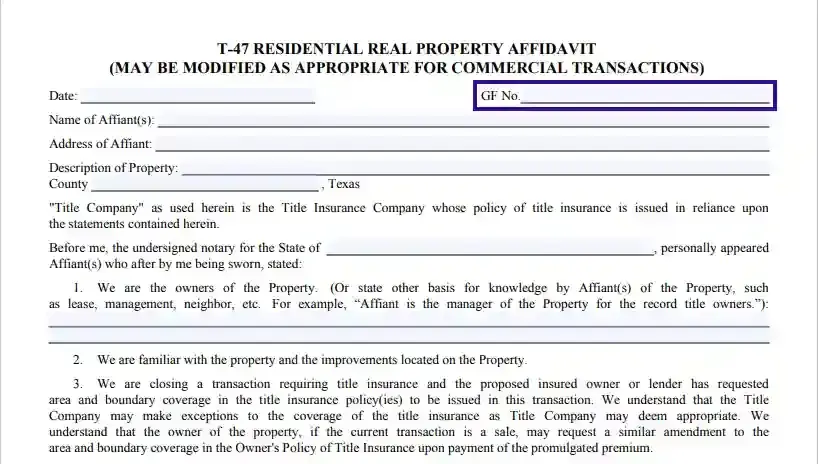
On the opposite side of the line, one must enter the general file number. Leave the space for the title company to fill out to avoid any mistakes and misunderstandings.
Identify the Affiant(s)
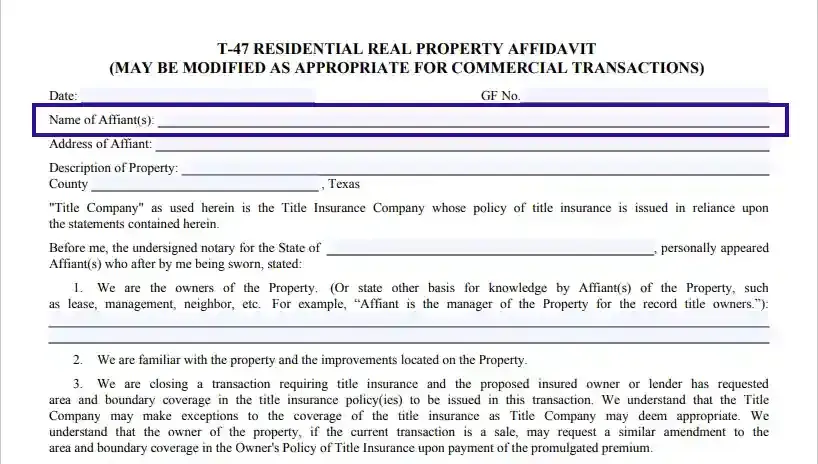
The next two lines are designed to indicate the affiant’s personal information. Enter your full legal name (or multiple names in case there are several affiants) in the first blank line.
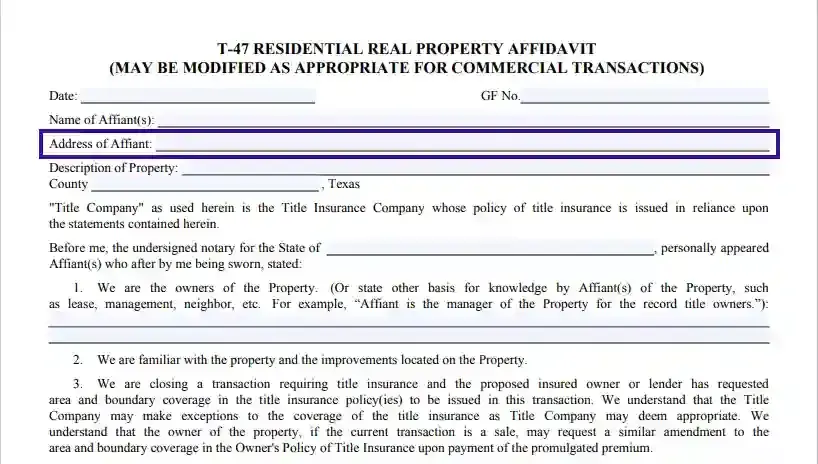
Provide the Affiant’s Physical Address
Next, write your physical address on the second line. If there are several affiants, list every address, one after another.
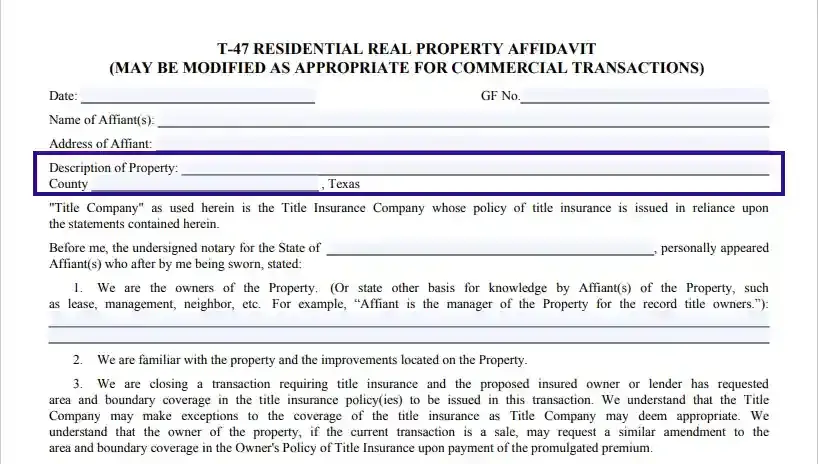
Describe the Property and Its Location
The seller should enter the legal description of the subject real property in the following lines. Technically, the description the seller decides to fill out should match the one indicated in the survey the seller is providing. If you do not have access to the previous survey for some reason, you can look the property’s legal description up in your tax records.
If neither option works, ask your realtor for help. Include every detail, down to the subdivision if there is one.
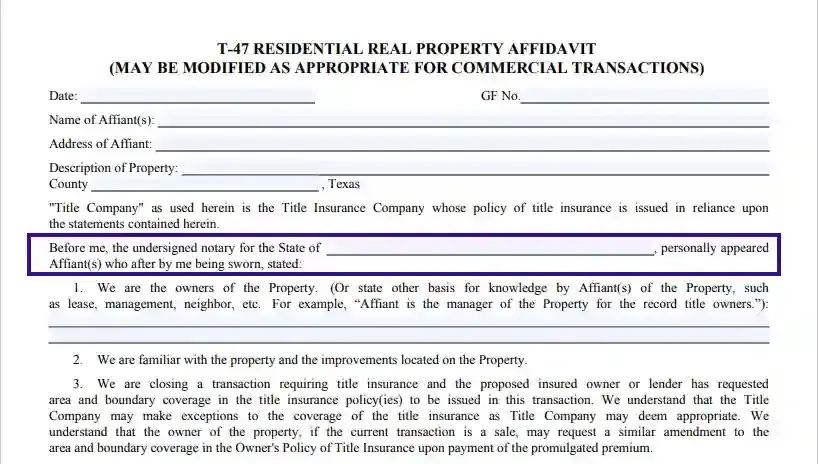
Identify the Notary Public
You need to confirm that all sections of the affidavit are completed in the presence of a notary public. Therefore, indicate the notary’s full legal name in the following line.
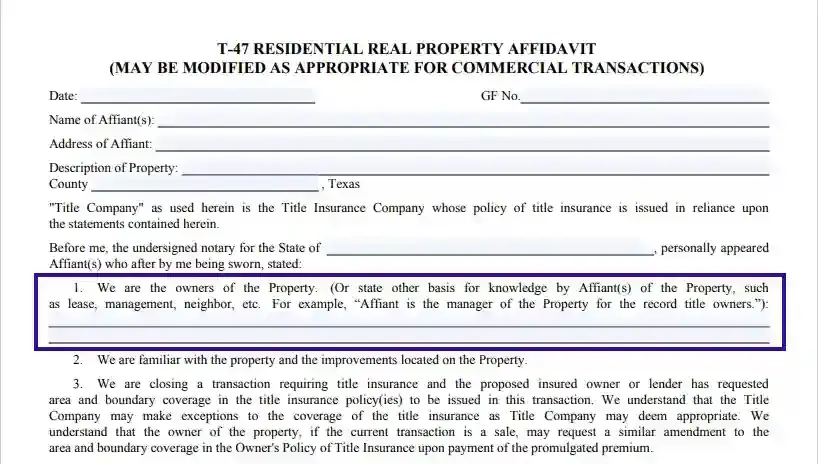
State Your Ownership Rights Type
Record the ownership rights that you have over the subject property. Besides the ownership itself, it can also be a lease, property management, or even neighborhood. Choose the option most appropriate for your particular case. An agent can fill out the form on your behalf, provided they have a relevant power of attorney.
Put the Date of the Last Major Changes
This is the trickiest part of the document. There is only one thing you need to determine in Paragraph 4, and it is the most recent date when any major changes to the subject real property have been made.
You should enter the date indicated in the previous title survey (regardless of whether it was performed by you or the previous owner). The seller can also indicate the date when they purchased the house or any other tangible property.
Provide Details (If Any)
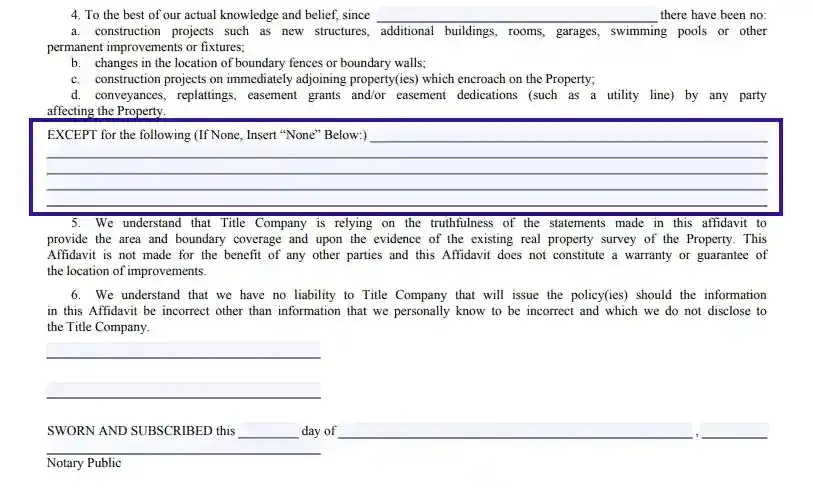
Once you indicate the date, you need to define the changes that were made. If there were no major changes in the residential real estate since the designated date, put “None” in the section below. Thus, the seller confirms that there are no significant flaws or territorial changes of the property to their knowledge at the moment of transaction and ownership transition.
Notarize the Document
The document requires notarization. Therefore, you need to invite a notary public to the signing. You may also find yourself a notary in a bank, attorney’s office, a state governmental office, or title insurance companies. All of them would be equally suitable to notarize your completed T-47 affidavit form.
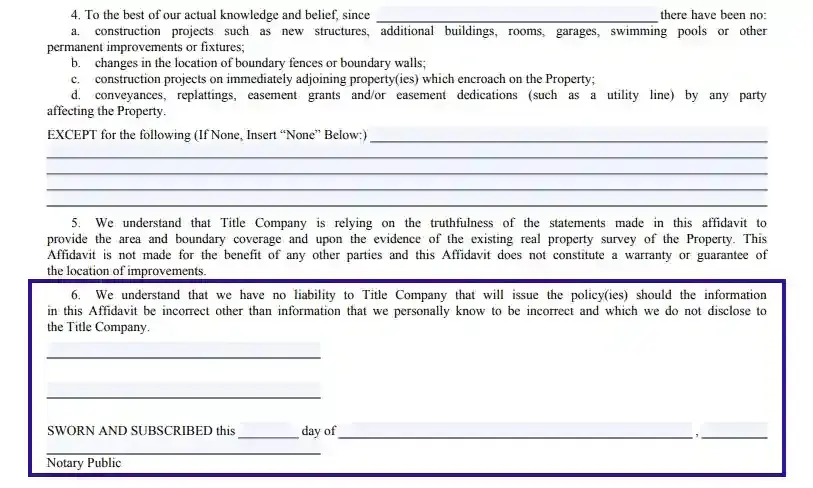
Before you leave the signing, check that the names, addresses and dates match your survey and your IDs, and keep a signed copy for your records.
There are plenty of legal reasons for a property seller in Texas to use the residential real estate affidavit form. For a seller, the benefits come down to trust, cost and peace of mind.
Naturally, when a real property unit is sold, a proper title survey must be performed so that the future owner does not have any problems. Parties to the sales transaction should come to terms as to what survey to use for the ownership transfer and whether they need a new survey to be held. As the seller is more interested in resolving the matter, that person is responsible for providing a residential property affidavit.
As a rule, people buying residential real property across the US require title insurance. The latter is a mutual legal commitment that one sells and another buys the exact property as described in the papers. It is crucial for the buyer to know that they are buying what they think they are buying. Otherwise, they might become part of fraudulent actions.
To prove the accuracy of either statement, the seller needs to perform a title survey or perform its existence. A title survey, in turn, may cost between $350 and $550 in Texas. This fact effectively means that the seller may save up to $500 by simply using a Texas residential real estate affidavit form.
It is also worth mentioning that not only the seller might be held responsible for providing a new title survey. It really depends on how the parties negotiate and what conclusions they come to. Thus, the buyer and the seller may agree to share their duties as property owners and share the new title survey expenses.
Form T-47 is the Texas residential real property affidavit, also known as the T-47 affidavit. In it, the seller states that no major changes have been made to the home since the date of the last survey. It is used together with that survey when the home is sold.
The seller completes it. The steps above walk through each line, from the date and file number to the notary’s name, so you can fill it in one line at a time.
Enter the most recent date when a major change was made to the home. Use the date shown on the previous survey, or the date you bought the home. Then describe any changes in the details section that follows.
Read the form once more, line by line, so you understand every answer. If you build it online, you can fix a mistake right away. Look at these points:
Keep a signed copy for your records. Then ask your title company how they want to receive the original.
General information, not legal or tax advice.
