
An Illinois firearm bill of sale is a written record of a gun sale or transfer between a seller and a buyer. It names both parties, describes the gun by make, type, caliber and serial number, and states the price and date. Both sides sign it and keep a copy. State law adds a check before a private sale, and the check is required.[2]
Last Updated: October 2026. This guide is reviewed and updated regularly to reflect current Illinois law. If you notice an error or outdated information, please contact us.
Build Your Document
Answer a few simple questions to make your document in minutes
Save and Print
Save progress and finish on any device, download and print anytime
Sign and Use
Your valid, lawyer-approved document is ready
In Illinois, a private seller who is not a licensed dealer must verify the buyer's Firearm Owner's Identification (FOID) card before the sale.[2] The statute is 430 ILCS 65/3(a-10). A licensed dealer must run a federal background check before transferring a gun to someone who is not licensed.[1.2] Which rule applies depends on who is selling, and the process differs for a private transfer.
Illinois residents must hold a Firearm Owner's Identification (FOID) card, issued by the Illinois State Police, to legally possess firearms or ammunition.[3.1]
Illinois law requires the seller in a private sale to keep a record of the transfer for 10 years, including the date, the firearm's description and serial number, the buyer's FOID number and the State Police approval number (430 ILCS 65/3(b)).[2.1]
A licensed dealer photocopies the buyer's photo ID and attaches it to the record of sale (430 ILCS 68/5-20).[4.1]
| Situation | What happens before the transfer |
|---|---|
| The seller is not a licensed dealer | The seller must contact a licensed dealer to conduct the transfer. Or the seller must contact the Illinois State Police with the buyer's FOID card number to determine whether the card is valid under state and federal law, including the national instant criminal background check system.[2] |
| The seller is a licensed dealer and the buyer is not licensed | The dealer must contact the national instant criminal background check system before the completion of the transfer.[1.2] |
| What the buyer provides | The transferee's or purchaser's Firearm Owner's Identification Card number, which the seller gives to the Illinois State Police when that route is used.[2] |
Federal law bars a sale to anyone the seller knows, or has reasonable cause to believe, is in one of these groups. Licensed dealers also face minimum age limits for buyers.[1.1]
A dealer may not sell a gun to a person the dealer knows or has reasonable cause to believe is less than eighteen years of age. For any firearm other than a shotgun or rifle, the limit is twenty-one years of age.[1.1]
The Illinois State Police's FOID eligibility rules also exclude anyone convicted of a felony and anyone adjudicated as a mental defective, among other grounds.[3.2]
A gun bill of sale is a signed record of the sale. It shows who sold the gun, who bought it, what it is and when the deal happened. Each side keeps a copy, which helps if a question about the sale comes up later.
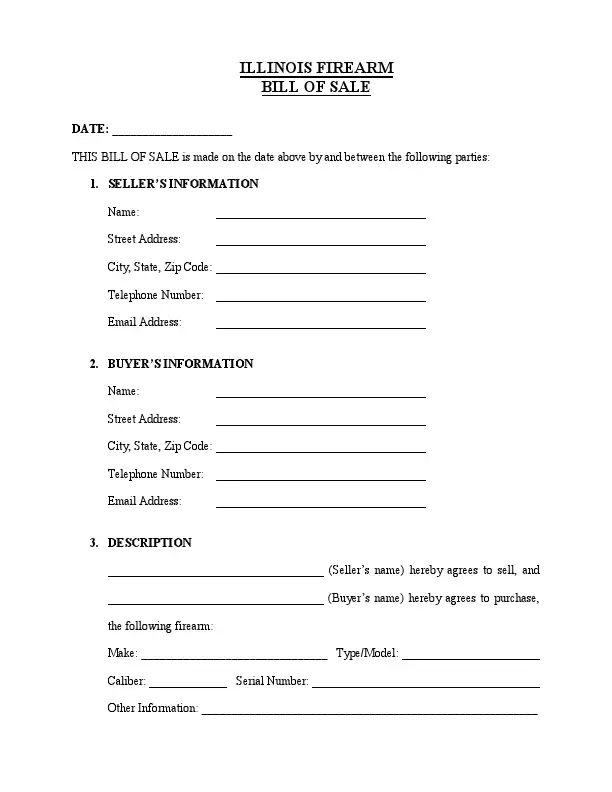
The form asks for these required details:
The form has signature lines for both sides. The payment part also includes a gift option, so the same form can record a family transfer when no money changes hands.
You can also use our general free firearm bill of sale template. Browse more Illinois bill of sale templates, or read our bill of sale guide.
Our free Illinois firearm bill of sale is a fill-in PDF with parts for the seller, the buyer, the gun, the price and the signatures. Build it online and print it, or download the blank PDF. Then fill it in with our online PDF editor or write it by hand.
These steps follow the parts of the form in the order they appear. Each step names its part of the form and its page number, so you can fill in the PDF from top to bottom.


Most problems come from missing or unclear details. A few quick checks before you sign can prevent them. Read each line once, and look for these slips. They are practice tips rather than legal requirements.
If the seller is not a licensed dealer, there are two steps before the transfer. The seller can contact a licensed dealer to conduct the transfer. Or the seller can contact the Illinois State Police with the transferee's or purchaser's Firearm Owner's Identification Card number to check the card.[2]
The form records the date, the seller and the buyer, the gun's make, type or model, caliber and serial number, the price and how it is paid. It ends with signature lines for the seller, the buyer and a witness.
General information, not legal or tax advice.
