A New York trailer bill of sale is a written record of a private trailer sale. It names the seller and the buyer, describes the trailer by make, model, year, color and VIN, and states the price, how it is paid and the date of sale. People use it for utility trailers, boat trailers and homemade trailers. Build one online or download the PDF, then check it against the NY DMV bill of sale details below.
Last Updated: October 2026. This guide is reviewed and updated regularly to reflect current New York law. If you notice an error or outdated information, please contact us.
Create a free high-quality New York Trailer Bill of Sale online now!
Build Your Document
Answer a few simple questions to make your document in minutes
Save and Print
Save progress and finish on any device, download and print anytime
Sign and Use
Your valid, lawyer-approved document is ready
... or download your New York Trailer Bill of Sale Form as a PDF file
A New York trailer bill of sale records the sale in writing. NY DMV Form MV-912 lists four details for a vehicle sale: the seller's signature, the date of the sale, the purchase price and the vehicle identification number. Each one is explained below.
Seller. The signature of the seller is required.[1]
Trailer. The vehicle must be identified by its vehicle identification number (VIN) or the hull identification number (HIN).[2]
The FormsPal template has a place for each detail. The date is on page 1, the trailer description and VIN are on page 1, the purchase price is on page 2 and the signatures are on page 3.
Create a free high-quality New York Trailer Bill of Sale online now!
Transferring Ownership of a Trailer in New York
To transfer ownership of a trailer, the New York DMV says the owner can use the transferable registration and a bill of sale.[1] Two more points from the same DMV guidance apply to the paperwork around the sale: which copy of a title is accepted, and who signs the transfer section.
Title copy. A state certificate of title used as proof of ownership must be the original or a certified copy, not a photocopy.[1]
Transfer section. The person whose name appears on the proof of ownership must sign the transfer section.[1]
The DMV's guidance puts the second point in these words:
The person whose name appears on the proof of ownership must sign the transfer section.
In plain terms, the name on the trailer's proof of ownership is the name of the person who signs when ownership changes hands. To see how a title and a bill of sale work together, read vehicle title with a bill of sale.
Details to Collect Before You Start
Collect the details below before you start, because having them on hand prevents crossed-out entries and second drafts. It also allows the seller and the buyer to check every item against the trailer before anyone signs.
Names, street addresses, telephone numbers and email addresses for the seller and the buyer
The trailer's make, model, year and color
The VIN, copied exactly as it appears on the trailer or on its title
The agreed price and whether it is paid in full, in two parts or not at all because the trailer is a gift
The method of payment: cash, check, cashier's check or money order
The date of sale
The same list works for a utility trailer, a cargo trailer or a boat trailer. If the boat is part of the sale, it needs its own boat bill of sale. It helps to compare the VIN on your paperwork with the number on the trailer itself before anyone signs.
How to Write a New York Trailer Bill of Sale
The FormsPal form has twelve parts across four pages. Each step below matches one part, in the order it appears on the form. Complete it with the builder at the top of this page, or fill in the downloaded PDF with our online PDF editor. For a version that is not specific to New York, read the guide to the trailer bill of sale.
The screenshots under each step show the FormsPal New York trailer bill of sale template filled with sample entries in blue, so you can see where each answer goes. The names, addresses, dates and amounts are examples only.
Enter the date of the bill of sale. Type the date on the DATE line at the top of page 1. The form says it is made on this date.
Step 1: sample entries, not a real document.
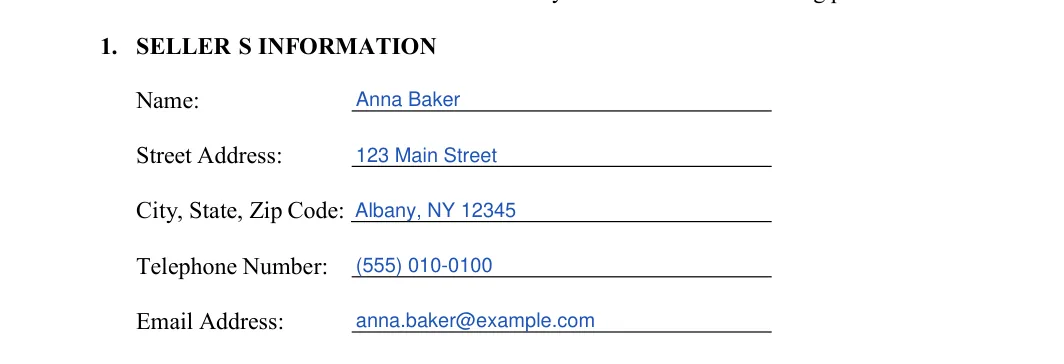
Fill in the seller's information (Section 1). Enter the seller's name, street address, city, state and zip code, telephone number and email address.
Step 2: sample entries, not a real document.
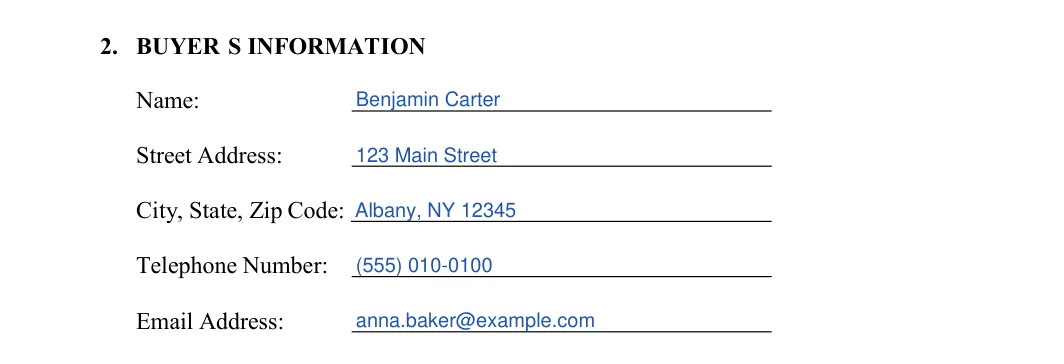
Fill in the buyer's information (Section 2). Enter the buyer's name, street address, city, state and zip code, telephone number and email address in the same order.
Step 3: sample entries, not a real document.
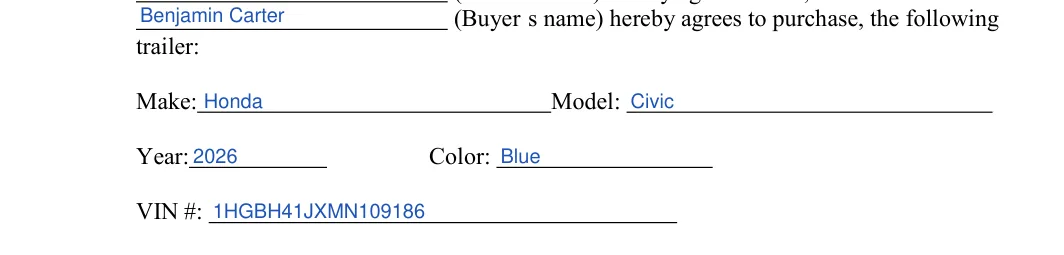
Name the parties in the agreement sentence (Section 3). Type the seller's name and the buyer's name into the sentence that opens Section 3, where the seller agrees to sell and the buyer agrees to purchase the trailer.
Step 4: sample entries, not a real document.
Describe the trailer (Section 3). Enter the make, model, year, color and VIN # of the trailer. Copy the VIN exactly as it appears on the trailer's paperwork.
Step 5: sample entries, not a real document.
Enter the purchase date (Section 4). On page 2, enter the date of sale on the purchase date line at the top of Section 4.
Step 6: sample entries, not a real document.
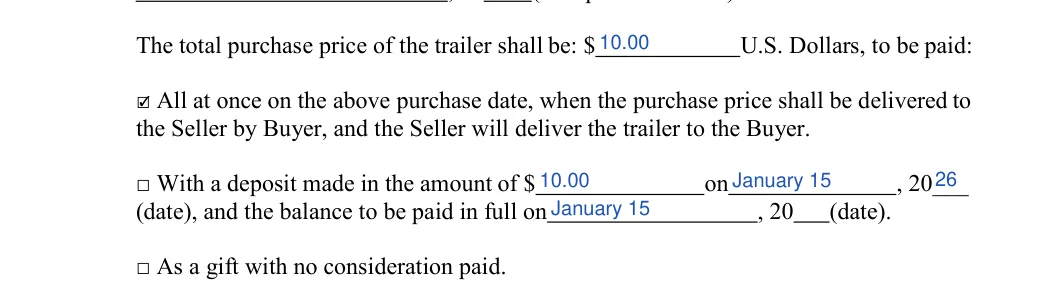
Enter the price and choose how it is paid (Section 4). Enter the total purchase price in dollars, then initial one option: all at once, a deposit with the balance due on a later date, or a gift with no consideration. For a deposit, fill in the deposit amount, the deposit date and the balance date.
Step 7: sample entries, not a real document.
Choose the payment method (Section 4). Initial one method: cash, check, cashier's check or money order. If you choose check, enter the check number.
Step 8: sample entries, not a real document.
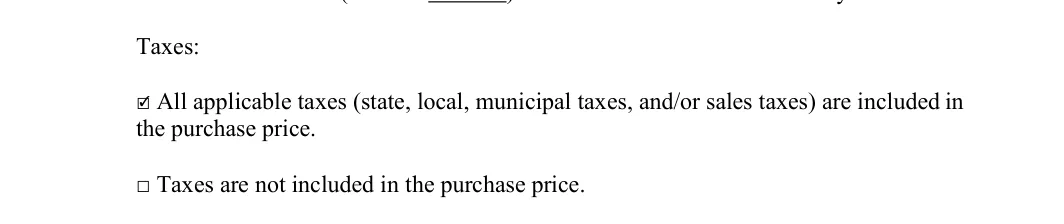
Mark the taxes line (Section 4). Initial one box: either all applicable taxes are included in the purchase price, or taxes are not included. Section 5 on the same page holds printed terms, including that the trailer is sold as is. Read it before signing.
Step 9: sample entries, not a real document.
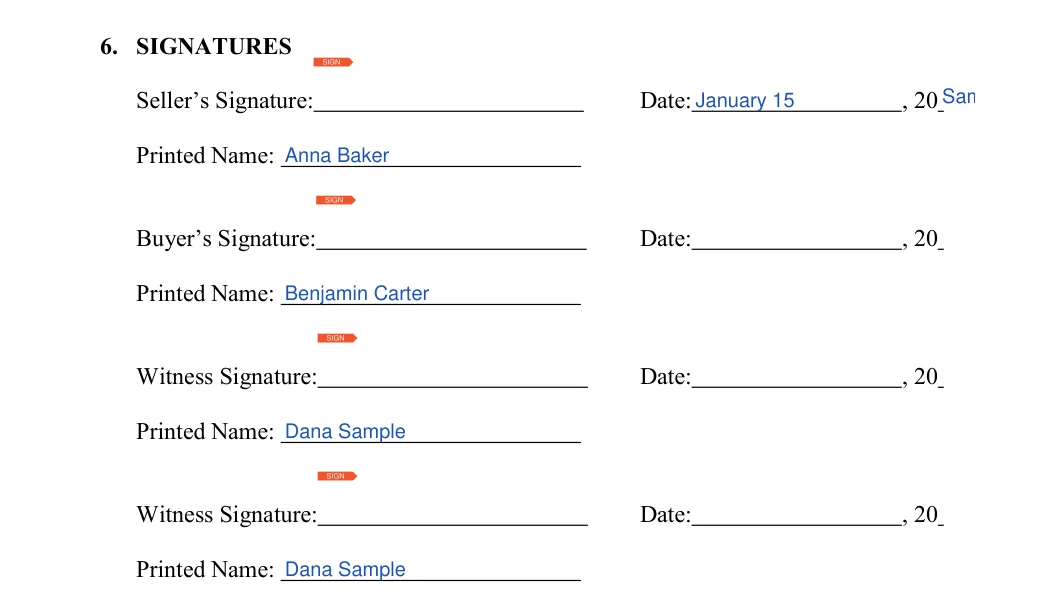
Sign and date the form (Section 6). On page 3, the seller and the buyer each sign, print their name and enter the date on their own lines. The form also has two witness lines, each with a signature, a printed name and a date.
Step 10: sample entries, not a real document.
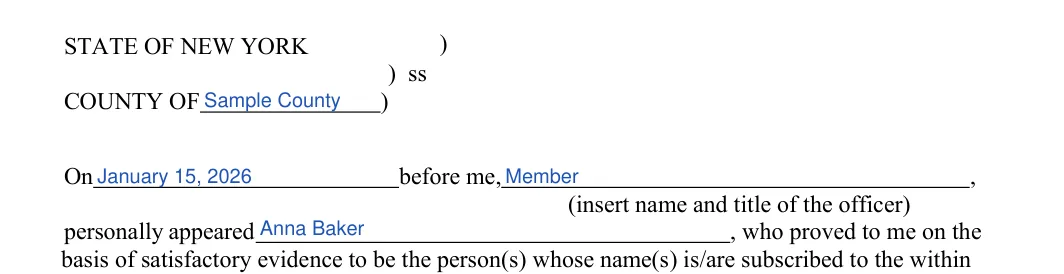
Complete the acknowledgment details. On page 4, enter the county, the name and title of the officer, the date, and the name of the person who appears before the officer.
Step 11: sample entries, not a real document.
Notary signature and seal. The officer signs the acknowledgment on the Signature (seal) line and adds the seal.
Step 12: sample entries, not a real document.
Sign two identical copies, so the seller and the buyer each keep an original.
Example of a Completed Trailer Bill of Sale
Here is a made-up example of how the details fit together on the form. It is not a real sale, and every name, address and number in it is invented only to show what each field looks like once it is filled in.
Seller: Dana Ortiz of Albany, New York. Buyer: Marcus Lee of Utica, New York.
Trailer: a 2018 white utility trailer, with the VIN copied exactly from its title.
Price: $1,800, paid in full by cashier's check.
Date of sale: June 3, 2026.
Signatures: Dana and Marcus each sign and date the form, and each keeps an original.
Common Mistakes on a Trailer Bill of Sale
Most problems with a trailer bill of sale come from small slips that are easy to avoid. Check the points below before anyone signs, because a corrected entry after signing can raise questions about what was agreed.
Typing the VIN from memory instead of copying it from the trailer or its title, which can leave a digit wrong.
Leaving the price blank or writing a figure that differs from the amount actually paid.
Leaving out the date of the sale, which NY DMV Form MV-912 lists as a required detail.[2]
Signing before every field is filled in or marked N/A.
Walking away with a single copy, so that one person has no record of the sale.
After You Sign
Once both people have signed the document, a few simple habits will keep the record useful if questions come up later. None of them is a legal rule, because they are simply good practice for any private sale, and each one takes only a minute. To learn how much weight the document carries, read how binding a bill of sale is.
Give the buyer the original and keep a complete copy, so that both people can show exactly what was agreed.
Keep your copy together with your other paperwork for the trailer, such as receipts and maintenance records.
Write N/A in any field that does not apply, instead of leaving an unexplained blank in the document.
If you notice a mistake before signing, print a fresh form rather than writing over the incorrect entry.
Here are three short answers about a New York trailer sale and its bill of sale. Each answer that states a rule points to its source, so you can read the official wording yourself.
Do you need a bill of sale to sell a trailer in New York?
The NY DMV says that to transfer ownership, the owner can use the transferable registration and a bill of sale.[1] The FormsPal template on this page is a bill of sale for a trailer.
Does New York require a bill of sale to be notarized?
New York has no statute that requires a bill of sale to be notarized.
What details must a New York trailer bill of sale show?
The seller's signature, the date of the sale, the purchase price and the vehicle identification number are the details NY DMV Form MV-912 lists.[1][2] The FormsPal template has a field for each one.
Mara has been practicing estate planning and trust law in California since 2003, taking pride in helping clients of all backgrounds and asset profiles form a complete and customized estate plan. Her specialties are: estate planning, wills and trusts, trust and probate administration.