
An Ohio firearm bill of sale is a written record of a private gun transaction. It names the seller and the buyer, describes the firearm, and states the price and the terms. Our free form takes a few minutes to fill out online, or you can download the PDF and print it.
Last Updated: October 2026. This guide is reviewed and updated regularly to reflect current Ohio law. If you notice an error or outdated information, please contact us.
Build Your Document
Answer a few simple questions to make your document in minutes
Save and Print
Save progress and finish on any device, download and print anytime
Sign and Use
Your valid, lawyer-approved document is ready
State and federal laws limit who may sell or buy a gun. The three rules below come from section 2923.20 of the Revised Code and 18 U.S.C. § 922. The first is a state rule, and the other two are federal rules written for licensed dealers.[1.1]
The two federal rules above are written for licensed dealers. If you are unsure which laws apply to a private sale, ask a licensed dealer or an attorney before you go ahead.
Ohio has no license or permit to own an ordinary firearm. Dangerous ordnance is different: no one may acquire, have, carry or use it without the license to possess dangerous ordnance (Sections 2923.17 and 2923.18 of the Revised Code).[3.1]
Under federal law, an Ohio resident who is not a licensed dealer may sell a firearm to another Ohio resident but not to someone who lives in another state (18 U.S.C. § 922(a)(5)). Anyone engaged in the business of dealing in firearms must hold a federal firearms license, and occasional sales to build or sell off a personal collection do not count as being in the business (18 U.S.C. § 922(a)(1)(A)).[1.3]
When you buy from a licensed dealer, federal rules require the dealer to record the sale on ATF Form 4473, the Firearms Transaction Record, which the buyer fills out (27 CFR 478.124).[4.1]
Federal rules also require a licensed dealer to keep records of its gun sales, including each Form 4473 with the firearm and buyer details, until the dealer goes out of business (27 CFR 478.129).[5.1]
A bill of sale gives both sides a written record of the transaction. In practice, it shows who sold it, who bought it, which firearm was sold and what was paid. Each side can keep a signed copy of the terms. The same form also works for a trade-in or a gift.
Each of these details has its own field:
Copy the serial number exactly as it appears on the item. Serial numbers identify firearms, so keep your signed copy with your records.
Our bill of sale guide explains the document in general, and our firearm bill of sale article covers these sales across states. You can also browse more Ohio bill of sale forms.
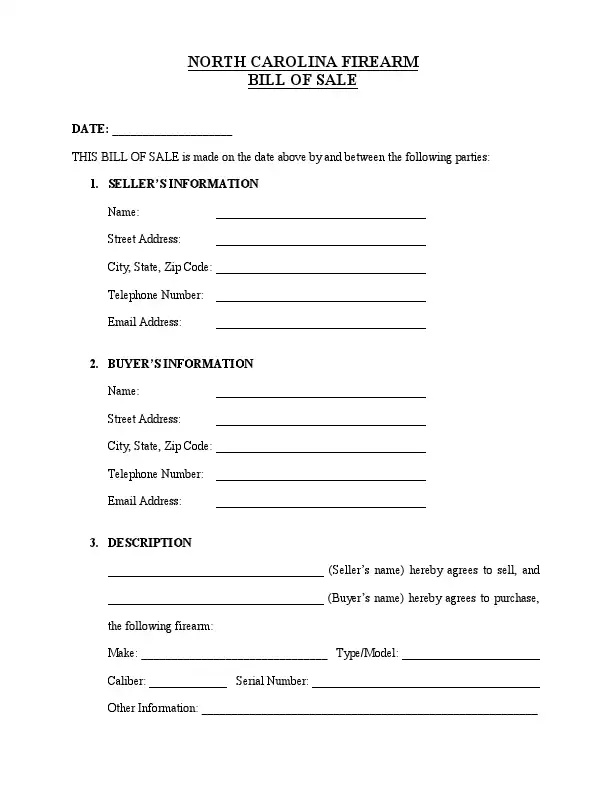
Our form is a printable PDF that you can also fill out online. It has fields for the seller, the buyer, the item, the price and the payment method, plus signature lines and a notary acknowledgment. Use the button below to create it, or download the file and complete it with our PDF editor before you print.
Work down the pages in the order they are printed. It runs from the date and the two parties through the item and the payment to the signatures, with a notary acknowledgment on the last page.


Section 2923.20 bars selling, lending, giving or furnishing a firearm to anyone that section 2923.13 or 2923.15 prohibits from acquiring or using one. Sections 2923.13 and 2923.15 set out who those persons are.[2]
It has the date, the seller's and buyer's details, a description of the item, and the purchase date, price and payment method. It also has seller and buyer statements, signature lines with a witness line, and a notary acknowledgment.
Yes. The payment section has a choice for a gift with no payment and a choice for a trade-in. For a trade-in, you describe what the buyer gives in trade.
General information, not legal or tax advice.
