
Updated:
A business plan template is a ready-made outline for your company's plan. It covers the executive summary, products, market, marketing, team and financial projections in a fixed order. A business plan template suits founders and owners, especially when they seek a loan or investment.
Answer a few questions in the free builder below to get a printable business plan, then use this guide to write and check each part.

Build Your Document
Answer a few simple questions to make your document in minutes
Save and Print
Save progress and finish on any device, download and print anytime
Sign and Use
Your valid, lawyer-approved document is ready
The standard business plan format runs from the executive summary through the company, its products, the market, marketing, management and finances, and ends with an appendix. Many lenders and investors ask for a traditional plan with these sections, but you can use the sections and the order that make the most sense for your business.
You can write the plan in a traditional or a lean format. The table shows how they differ.
| Format | What it looks like | Best for |
|---|---|---|
| Traditional business plan | Full sections in prose, with market research and financial projections | A bank loan, investors, partners |
| Lean business plan | Short bullet points on a single page: value, customers, costs, income | Testing an idea, planning for yourself |
| Internal or operating plan | Goals, tasks, owners and deadlines for the team | Running or growing an existing company |
Choose the traditional format when someone outside the company will judge the plan. Choose the lean format when the plan is a working tool for you and your team. A lean plan can grow into a traditional one later, because the parts keep the same names.
The free builder on this page follows the traditional order, from your business details to the appendix.
A business plan includes a title page, an executive summary, the product or service, the target audience, a marketing plan, goals and metrics, the management team and the financials. Use this business plan outline as a checklist, and adjust the detail of each part to your business and your reader.
The title page names the business and the person who wrote the plan. Write your name and job title, your phone number and email, and then the name of the business.
The executive summary gives a reader the essence of your business in a few short paragraphs. Keep it informative and short, with the facts you want an investor to remember first.
Open the executive summary with your mission statement: the core idea of the business and its aims, in a few sentences. Then give a short overview of the plan and its main points:
The product or service section explains the solution you offer and why it beats the alternatives. Describe what the customer gets, the problem it solves, and the competitive advantages that set you apart from similar companies.
The target audience section defines who will buy from you. A clear picture of your customers shapes every later choice in the plan, from prices to sales channels and advertising.
The marketing plan lists the ways you will reach interested customers. It can include printed flyers, local events, search ads, social media campaigns or partnerships with other businesses.
The goals section sets short-term and long-term targets for the business, each with a date and a person in charge. Add the measures you will use to track progress, such as daily visitors, new leads or button clicks on your website.
The management team section shows who will carry the business toward its goals. Give each person's name, experience in the field and role in the plan, and explain why this team can deliver the results you promise.
To fill out a business plan template, work through its sections in order, enter facts and figures about your own company, and proofread the finished plan. The steps below follow the order of the FormsPal builder, from the first page to the last.
Funding. Say whether the business seeks funding. For a business loan, enter the loan amount and the repayment period in months or years.
Explain how the business will use the money, such as marketing, staffing or equipment. Add your estimate of the return on the investment, the point at which the business breaks even, and any collateral you can offer against a loan.
Financial projections. Show why the business can become profitable, with forecast profit and loss, balance sheets, cash flow and expenses for the next several years. For more detail, add quarterly and monthly projections for the first year of operation.
Match your projections to your funding request. If you attach a separate financial statement, mention it in the plan. A company already in business adds its past profit and loss, balance sheets and cash flow as well.
If you don’t want to search among numerous websites for good business plan templates, make use of our sample business plans in PDF, DOC, or ODT.
If you download your plan as a PDF, you can fill in or edit it online with the FormsPal PDF editor.
A business plan sample shows how the parts of a plan read once they are filled in. The short example below is made up for a fictional coffee cart; replace every name and number with your own.
Example only (fictional business).
Executive summary. Corner Cup is a coffee cart that will serve office workers at the Main Street business park from 7 a.m. to 2 p.m. We ask for a $25,000 loan to buy the cart and equipment and expect to break even in month 10.
Product. Espresso drinks, drip coffee and pastries from a local bakery, with a loyalty card for regular customers.
Target market. About 3,000 people work in the park, and the nearest coffee shop is a 12-minute walk away.
Marketing. Opening-week free tastings, flyers in each building lobby and a weekly offer on social media.
Financials. Forecast sales of $9,000 a month in the first year against costs of $7,200 a month, with loan repayments over 36 months.
A full sample business plan adds the management team, competitor analysis, a SWOT analysis and the financial tables behind each figure.
A business plan helps new businesses, established companies that change direction, and freelancers who want to grow. It turns an idea into goals, steps and numbers, and it shows a lender or investor why the business is worth funding.
A startup uses a business plan to set its goals, show how it will reach them and work out how much money it needs. A startup plan usually covers:
An established company uses a business plan when it changes course, for example with a new product, a new market or a plan to scale. In that case the plan covers:
Regular updates also show whether the business reached its earlier targets or whether those targets changed.
Freelancers do not always need a business plan. Having one still helps if you want to become an expert in a certain field and are about to spend much time and energy on it. A short lean plan is often enough to set your prices, your target clients and your income goals.
You can assess a business opportunity with four checks: the mission, the objectives, a break-even analysis and a market analysis. Each check comes down to a few questions you can answer in a few sentences of your business plan.
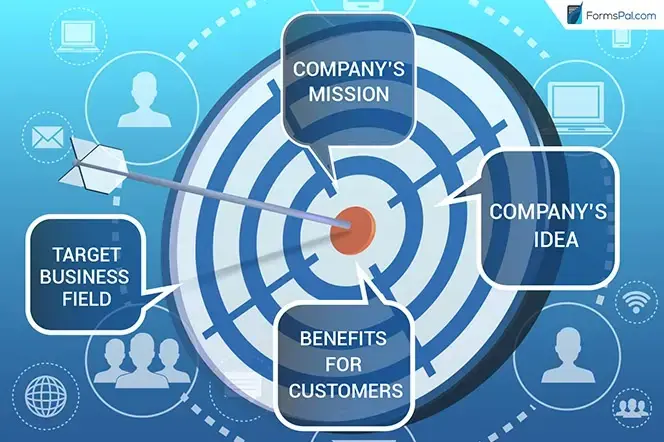
The mission assessment tests whether your idea is clear and useful to customers. Answer these questions:


The objectives assessment checks whether your goals can be measured. Answer these questions:


A break-even analysis shows when income will cover your costs and the business starts to make a profit. Answer these questions:


A market analysis estimates how many customers you can reach and how fast that group will grow. Base the answers on your own market research:
The most common business plan mistakes are figures that do not match, claims without evidence and an executive summary that runs too long. Check your draft against this list before you send it to anyone:
Most questions about a business plan come down to length, order and audience. A short plan suits a quick introduction, a longer one suits lenders and investors, and the executive summary goes first for every reader.
Length depends on who will read it. A template for your own use can be a few pages. A plan you send to investors often needs more detail on the market, the competitors and the finances. Keep each part as short as the reader allows.
Start with the parts you know best, such as the business description and your product or service. Leave the executive summary for last, because it summarizes everything else in the plan.
The main types of business plans are the traditional plan, the lean plan and the internal or operating plan. Some writers also name startup plans, growth plans and plans for a loan, which follow the same parts with a different focus.
A business plan for investors puts the funding request, the market opportunity and the financial projections up front. Investors also look at the management team and at how and when they could earn a return.
An AI tool such as ChatGPT can draft wording and suggest an outline, but it cannot know your costs, customers or goals. Supply your own figures, check every claim it makes, and rewrite the result in your own voice before anyone reads it.
A marketing plan covers how you reach customers. It is one part of a business plan, which also covers the product, the team, the targets and the finances.
Review your business plan whenever your targets, market or finances change. A yearly review is also a good habit, because it shows how far you have come.
General information, not legal or tax advice.
