
Updated:
Get Form Now
A root canal consent form is a signed patient agreement to endodontic treatment. The form names the tooth, the diagnosis, the risks and the alternatives the dentist explained. Patients and parents of minor patients sign it before a root canal or a retreatment.
This page explains what the form covers, how to fill it out and sign it, who signs for a minor, and what a signed form does under the rules of several states. It is one of our medical consent forms.
Key facts
A root canal consent form is the patient's written agreement to endodontic treatment, signed after the dentist or endodontist explains the procedure, its risks and the other options.
Endodontic treatment, often called root canal therapy or RCT, removes infected or inflamed pulp from inside a tooth, then cleans, shapes and seals the canals. The goal is to keep the natural tooth instead of removing it.
For the patient, the form is a checklist of what to understand before treatment starts. For the dental office, it is a signed note that the conversation took place.
A retreatment consent form covers a tooth that already had a root canal and needs its canals reopened, cleaned and sealed again. The retreatment form usually adds the reason the first treatment is being redone, so the patient signs a form that names the second procedure.
An endodontic consent form is the same document as a root canal consent form, because endodontics is the dental specialty that performs root canals. A general dental treatment consent form covers a wider set of procedures, such as fillings, crowns or extractions, in one document.
A root canal consent form lists the diagnosis, the treatment, its risks, the alternatives and the cost, so the patient signs with the same facts the dentist has.
When a Hawaii provider seeks consent, Haw. Rev. Stat. § 671-3 lists the information the patient receives first: the condition to be treated, the proposed treatment, its intended results, the recognized alternatives including no treatment, the material risks of each, and the benefits of the alternatives.
In New York, N.Y. Pub. Health Law § 2805-d defines a lack of informed consent as the failure to disclose the alternatives and the reasonably foreseeable risks and benefits that a reasonable dental practitioner would have disclosed when in the same position.
Fla. Stat. § 766.103 names dentists among the providers it covers, and one of its tests, when consent is disputed, is whether a reasonable patient, given the dentist's information, would have a general understanding of the procedure, the acceptable alternatives and the substantial risks.
The diagnosis line names the tooth and the condition being treated, such as an infected or inflamed pulp or an abscess. A tooth number on the form lets the patient check that the treatment and the tooth match the conversation in the chair.
The risk section describes what can go wrong during or after treatment. Dental offices commonly list items such as these:
The dentist explains which of these apply to the patient's tooth.
The alternatives section names the other options: removing the tooth, a referral to a specialist, or no treatment at all, with what each one means for the tooth. The section also says what can happen if the patient declines, such as the infection spreading or the tooth being lost.
The medication section asks about allergies, current medicines and past dental treatment, because local anesthetics, antibiotics and pain relievers are part of a root canal. A patient who lists every drug allergy and any earlier root canal makes the procedure easier for both the patient and the dentist.
The cost section sets out the fee and any extra charges, such as a crown, a follow-up visit or a later retreatment.
The consent form asks for a signature, a date, the patient's name and a witness signature, and little other personal data, which keeps it short. Its main purpose is to show that the patient read and understood its content.
Sign the form
Sign only after reading every line, to confirm that you agree to the procedure, and write the date next to your signature.
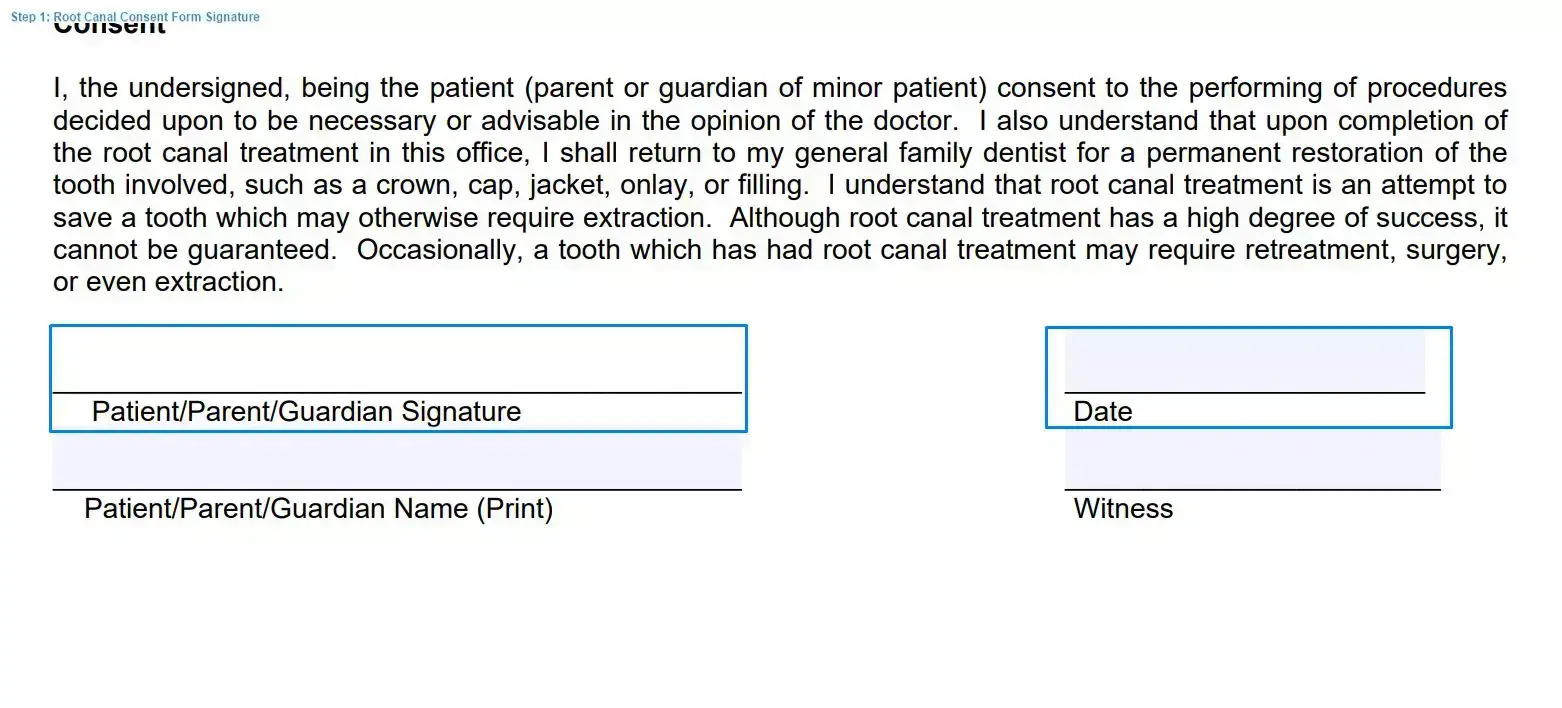
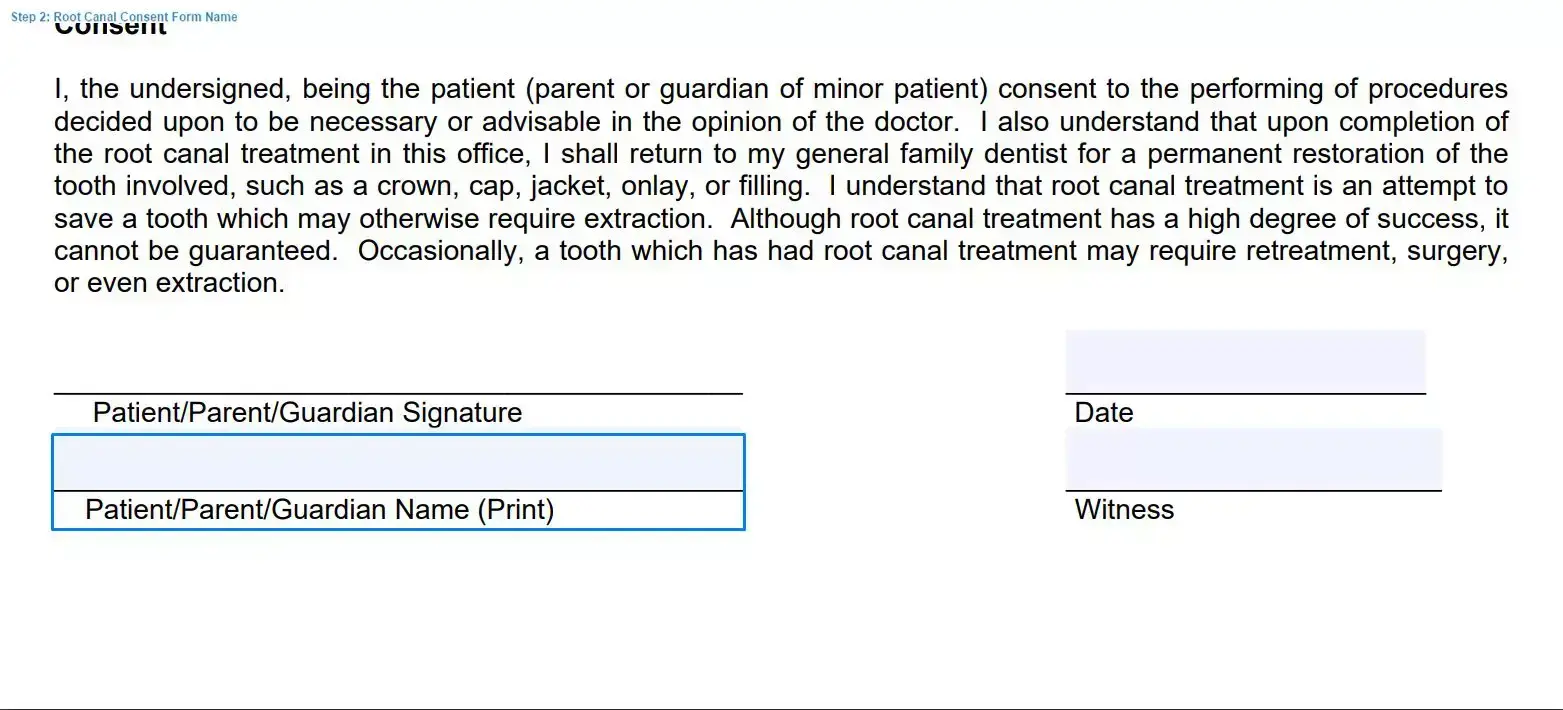
Enter the patient's name
Type in the patient's full name as it appears on their ID, also for a minor patient. A parent or guardian who signs for a minor writes their own name on the signer's line.
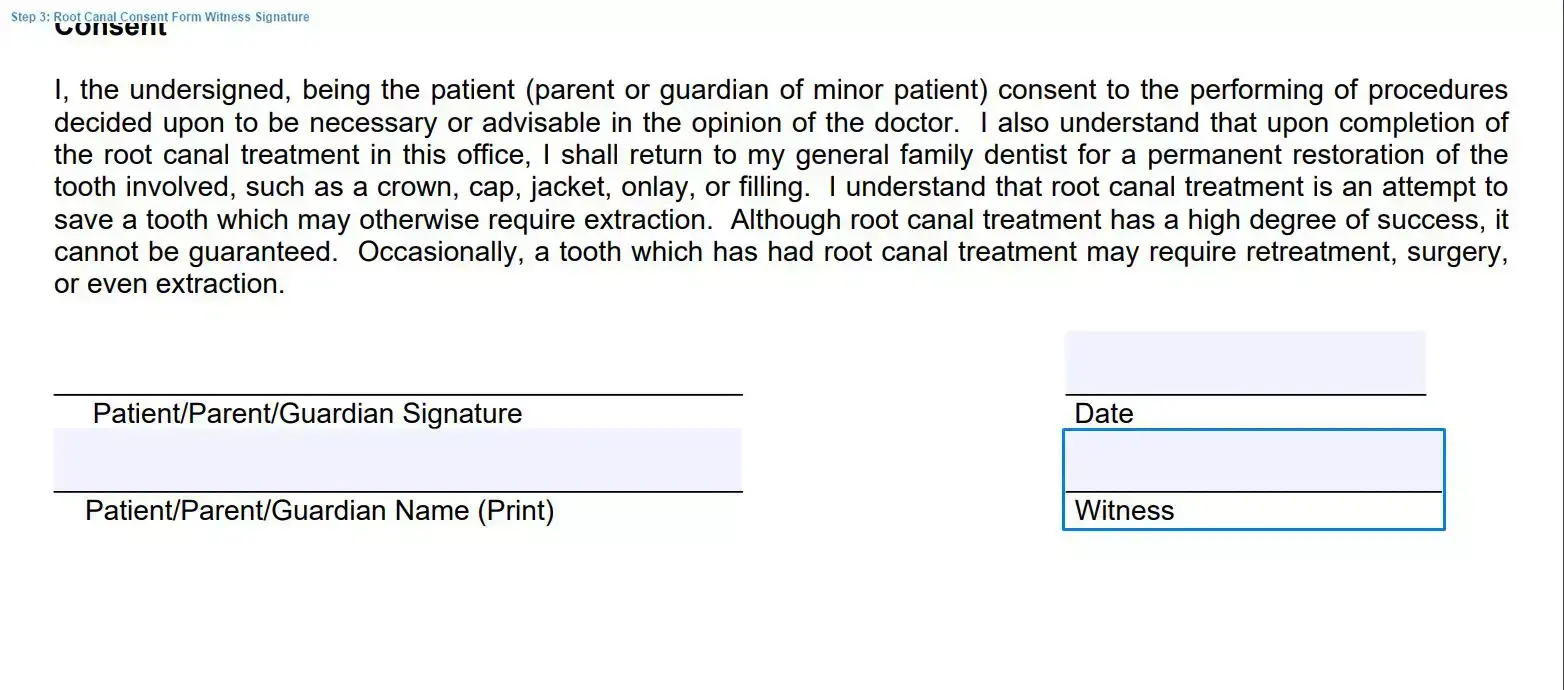
Include the signature of the witness
Hand the form to the witness, who signs to confirm that the patient signed it and knows about the treatment. Ask the dental office who signs this line.
Ask for a copy of the signed form and keep it with your dental papers.
The consent form for a child is signed by a parent or guardian in most cases, and some states let certain minors sign for dental care themselves.
The table lists state sections that name dental care, with the condition each one sets. States not listed have no such rule in the sources behind this page, so ask the dental office.
| State | Who can consent to dental care | Section |
|---|---|---|
| Alaska | A minor who lives apart from their parents or legal guardian and manages their own financial affairs, for medical and dental services, except as AS 18.16.010(a)(3) prohibits | Alaska Stat. § 25.20.025(a)(1) |
| Delaware | A parent or guardian, a married minor, a minor parent for their child, or a minor of the age of 18 years or more, when a licensed dental practitioner treats the minor | 13 Del. C. § 707(b) |
| Kentucky | An emancipated minor, or a minor who has married or borne a child, when consenting to dental care for themselves or their child | Ky. Rev. Stat. § 214.185(4) |
| New York | A person who is eighteen or older, is the parent of a child or has married, among others the section lists, when consenting to dental services for themselves | N.Y. Pub. Health Law § 2504(1) |
| Oregon | A minor 15 years of age or older, without a parent's consent, only for dental or surgical diagnosis or treatment by a dentist licensed by the Oregon Board of Dentistry | Or. Rev. Stat. § 109.640(4) |
| Pennsylvania | A minor who is eighteen or older, has graduated from high school, has married or has been pregnant, when consenting to dental services for themselves | 35 P.S. § 10101 |
A signed consent form is evidence that the patient agreed, and several states presume that a signed written consent meeting their terms is valid.
Most sections below name what can overturn the signed consent, most often fraud or misrepresentation. Under NRS 41A.110 the consent is conclusive. Under Wash. Rev. Code § 7.70.060(1) the patient can rebut it by a preponderance of the evidence. Each row keeps the section's own scope, such as a medical, surgical or dental procedure.
| State | What a signed written consent does | When it applies or fails | Section |
|---|---|---|---|
| Florida | Raises a rebuttable presumption of a valid consent | Only if it meets subsection (3) of the section and is validly signed by the patient or another authorized person | Fla. Stat. § 766.103 |
| Georgia | Is conclusively presumed to be a valid consent to surgical or medical treatment | If it discloses the treatment in general terms and is signed by the patient or an authorized person, unless fraudulent misrepresentations of material facts were used to obtain it | O.C.G.A. 31-9-6(d) |
| Iowa | Creates a presumption that informed consent was given to a medical or surgical procedure | Only if the written consent meets the requirements of the section | Iowa Code § 147.137 |
| Louisiana | Is presumed valid and effective | Unless there is proof that misrepresentation of material facts induced its execution | La. Rev. Stat. § 40:1157.1 |
| Maine | Is presumed to be a valid consent | If it is in writing, meets the section's standards and is signed by the patient or another authorized person; rebuttable only upon proof of fraud, deception or misrepresentation of material fact | Me. Rev. Stat. tit. 24, § 2905(2) |
| Nevada | Shows that the dentist has conclusively obtained consent to a dental procedure | Only if the dentist explained the procedure, the alternatives and the general nature of the risks, and the patient signed a statement explaining them | NRS 41A.110 |
| Ohio | Is presumed valid and effective for a surgical or medical procedure | If it meets divisions (A), (B) and (C) of the section, unless bad faith, fraud, or the signer's inability to communicate in the form's language is shown | Ohio Rev. Code Ann. § 2317.54 |
| Utah | Is a defense to a claim of failure to obtain informed consent | Unless the patient proves the signer lacked capacity, or shows by clear and convincing evidence that fraud induced the signing | Utah Code § 78B-3-406(4) |
| Washington | Is prima facie evidence that the patient gave informed consent | If a patient with capacity, or the representative of a patient without it, signs a form that sets out the items the section lists | Wash. Rev. Code § 7.70.060(1) |
States not in the table have no such presumption in the sources behind this page. The signed form still shows what the patient was told and when.
The consent form works only when the patient can read and understand it, so a Spanish-speaking patient can ask the dental office for a Spanish version or an interpreter.
In Ohio, Ohio Rev. Code Ann. § 2317.54 lets a patient overturn the presumption of a valid written consent if the signer was not able to communicate effectively in spoken and written English or any other language in which the consent is written.
The consent form is easiest to rely on when it is complete, and most slips are easy to catch before you hand the form back.
A dentist asks for consent before a planned root canal, and the exceptions in the sources behind this page are for emergencies. In Kentucky, Ky. Rev. Stat. § 304.40-320 sets no need for a previous consent only in an emergency where the patient's consent cannot reasonably be obtained before care.
Yes, a patient can decline the proposed treatment, and the form's alternatives section shows what declining means for the tooth. Idaho Code § 39-4506 treats a refusal of care like a consent: either is valid if the person is sufficiently aware of the need for, the nature of and the significant risks of the care.
No section cited on this page names a notary for a dental consent form. The form has lines for the patient's signature, the date and a witness.
No, scaling and root planing is a deep cleaning of the gums and tooth roots, a different procedure with its own risks. A patient having it signs a consent that names it, such as a dental treatment consent form.
The rules on this page come from US sources only. An Australian dental practice works under its own rules, so ask the practice for its consent form.
Ask the dental team to explain it in plain words before you sign. If you can, review the form at home first and bring your questions to the appointment.
General information, not legal or tax advice.
