
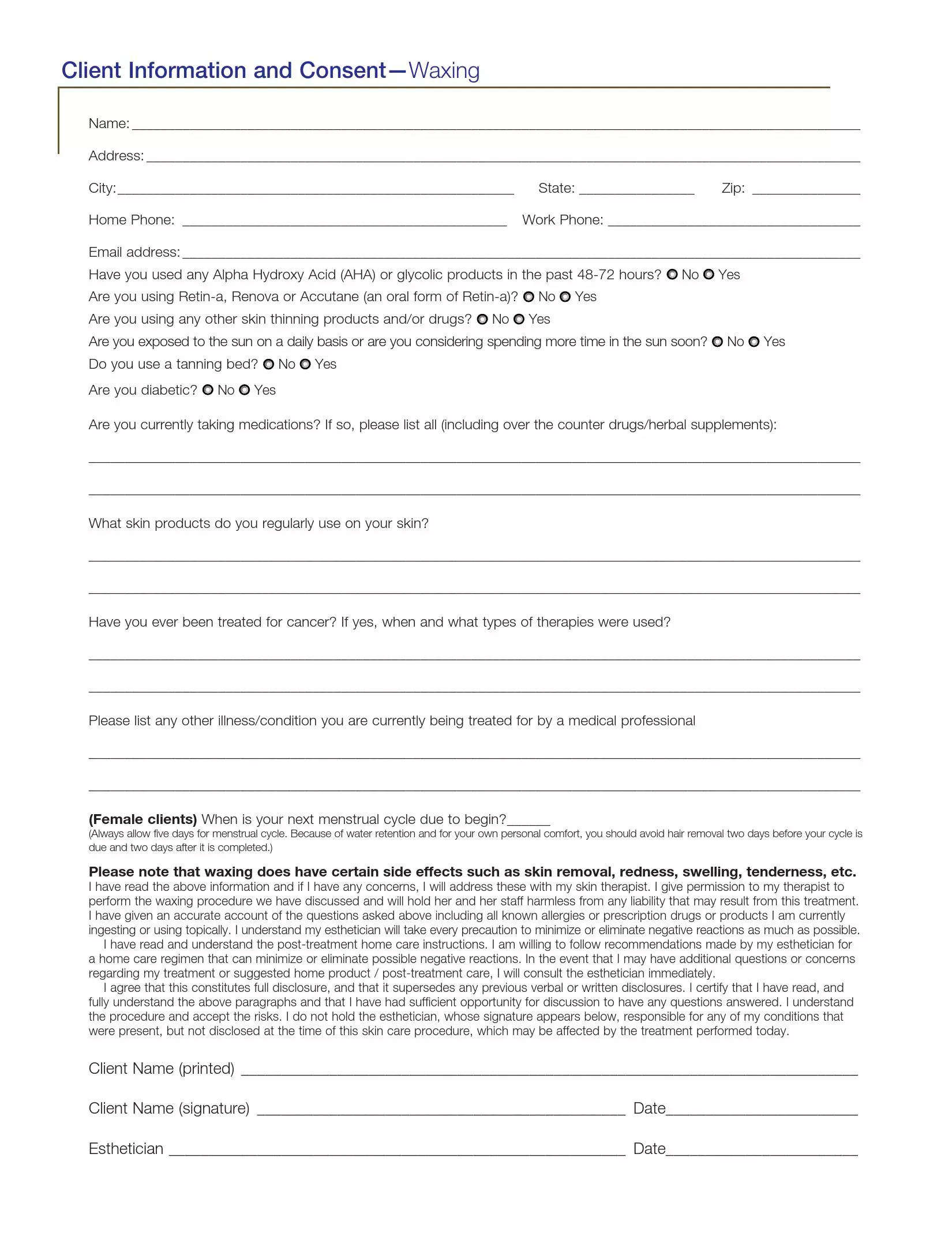
A waxing consent form is a document in which a client confirms that a spa or salon explained the waxing treatment, its possible side effects and the aftercare. The template below has 4 parts: personal details, skin questions, health history and a signature. Read each part before you sign so that your answers are accurate.
Last Updated: October 2026. This guide is reviewed and updated regularly to reflect current law. If you notice an error or outdated information, please contact us.
Across the US, waxing is one of the most popular cosmetological procedures. However, it can sometimes be dangerous. Therefore it is in the interest of both parties to sign a consent form that will protect parties from serious legal consequences if something bad happens during or after the procedure.
This form allows a spa salon to provide all the necessary information about waxing treatment and possible consequences to a client. It is very important because the waxing procedure can be harmful to rather sensitive skin and can trigger some unpleasant side effects.
Tip: Take time to read every line before answering. Skin conditions and medications are easy to forget when you are in a hurry.
Signing is the last step, not the first. A good conversation before the form is signed makes the answers on it more accurate and lets everyone ask what they want to know.
Before giving this form to a client for signing, a service provider must explain the process, results, and possible side effects of the procedure in detail. Also, the service provider must explain to a client what they have to do after the procedure and how to deal with swelling, redness, and any other common side effects of the waxing procedure.
Also, it must be explained to a client which consequences they may expect. The service provider has to give information in an understandable way and be sure that the client understands it.
Here is a simple checklist of topics for that conversation:
The talk ends with a short look at your skin and a decision about whether to go ahead. Take your time with both, because the form is only as useful as the answers on it.
Also, a service provider should ask a client about any special needs of the skin. If the customer, after hearing the information, still wants to undergo the procedure, they have to sign the form. By signing this form, a client accepts all the responsibility for possible problems connected to the procedure.
If the client is a minor, a parent or a guardian shall have to sign this form.
Keep a signed copy of the form. Both sides can then look back at what was discussed on the day of the appointment.
It is also important to know that in most states, the waxing procedure can be done only by a licensed specialist, and if the procedure was performed by a person without a license, he or she could be sued regardless of the outcome of the procedure.
Before you book, ask the salon about the technician's training and experience. If you have sensitive skin, say so when you book so the provider can plan the treatment around it.
Filling out the waxing consent form is an easy task that can be accomplished in a few minutes. Follow this guide to do it in the most efficient way possible, following 4 short steps.
During the first step, you must write down all your personal information, such as
The exact information asked may differ by service provider. The list above shows the most common items.
You must pay a lot of attention when filling out this section of the document because here, you will be asked questions, the answers to which are crucially important to determine whether you have a risk of developing some adverse reactions after the procedure. To complete this step, you must answer in affirmative or negative to the next question:
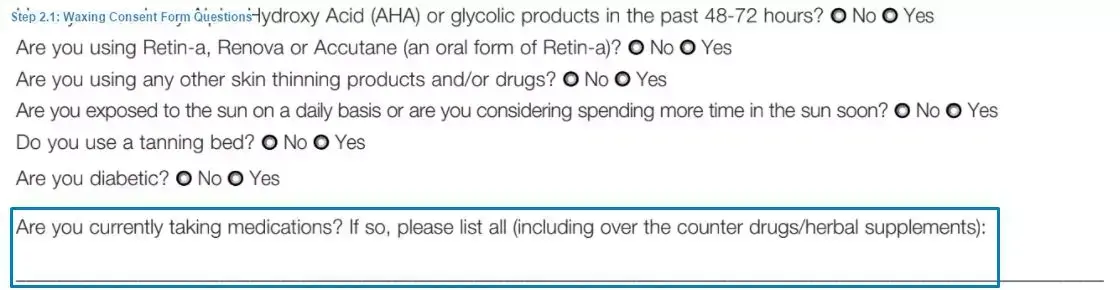
After those questions, a blank space lets you list the medications and skin products you currently use.
One more field is dedicated only to women; in this field, they must specify when their cycle is due to begin.

In the third section of the form, you may be asked whether you have or had such illnesses as HIV, cancer, herpes, or hepatitis.
Answer honestly, because the provider relies on these answers to plan your treatment.
In the final section of the form, you must read the warnings about possible side effects and give consent by signing the document in a dedicated space. If you are a minor, you should pass this form to a parent or guardian.

Write the date next to your signature so the form shows when you agreed.
Here is how a completed form might look. All names and details below are made up.
| Part of the form | Example entry |
|---|---|
| Name and surname | Anna Baker |
| Address | 123 Main Street |
| City and State | Anytown, CA |
| Phone number and email | (555) 010-0123, anna.baker@example.com |
| Skin section | Answered yes or no for each line |
| Medications and skin products | Daily moisturizer |
| Signature and date | Anna Baker, signed on the day of the appointment |
A little preparation makes the appointment easier and calmer for everyone involved. These tips lead to complete answers and help the provider plan the treatment with all the facts in hand.
These short answers cover what people ask most often about the waxing consent form. Each one is brief, so you can find what you need and get back to your appointment.
A waxing consent form is a document that collects your answers about skin and health, describes the possible side effects of waxing, and ends with your signature. Salons and spas use it so that both sides start the appointment with the same information.
You complete the personal details and answer the skin and health lines. The provider reads your answers, talks through the treatment, and answers anything you ask before you sign.
Say so and ask the provider to explain the line. A quick check now is better than a wrong answer on the form, because the answers help plan your treatment.
The skin section has 6 yes-or-no lines. They ask about:
These answers help the provider spot anything that could change how your skin reacts to wax.
Yes. Keep a signed copy with your own records and note the date of the appointment next to it. It is a handy reminder of the products and conditions you listed.
General information, not legal or tax advice.
