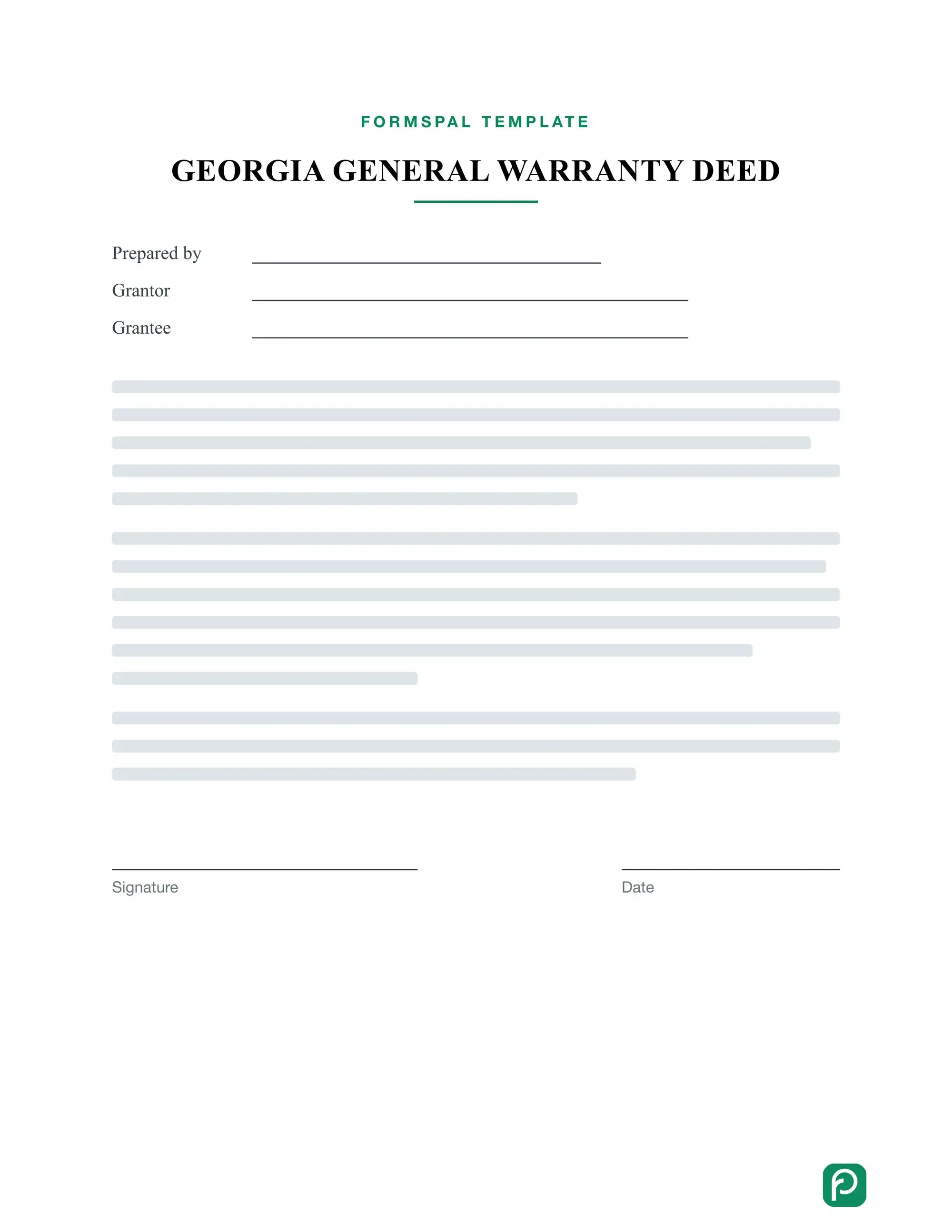
A Georgia warranty deed is a land transfer that guarantees the title. Its general warranty covers the right to sell, quiet enjoyment and freedom from encumbrances (O.C.G.A. § 44-5-62). Georgia sellers use it; this page explains each part, step by step.
Key facts
The deed promises the buyer a right to sell, quiet enjoyment and freedom from encumbrances (O.C.G.A. § 44-5-62).
The deed is an original document, in writing, signed by the maker (O.C.G.A. § 44-5-30).
The deed is attested by an officer and one other witness (O.C.G.A. § 44-5-30).
The deed is delivered to the purchaser and made on a good or valuable consideration (O.C.G.A. § 44-5-30).
The deed is recorded with the clerk of the superior court of the county where the land is located (O.C.G.A. § 44-2-1).
Create a free high quality Georgia Warranty Deed Form online now!
Build Your Document
Answer a few simple questions to make your document in minutes
Save and Print
Save progress and finish on any device, download and print anytime
A Georgia general warranty deed is a deed that transfers land from a seller to a buyer and warrants the title against the claims of all persons. The seller is the grantor, and the buyer is the grantee. The buyer keeps the deed as proof of ownership.
The deed differs from a plain transfer by its warranty. The seller does not only hand over the property: the seller also stands behind the title the buyer receives.
What the General Warranty Promises
A general warranty of title against the claims of all persons includes covenants of a right to sell, of quiet enjoyment, and of freedom from encumbrances (O.C.G.A. § 44-5-62). Each covenant is a separate promise:
Right to sell: the grantor owns the land and may convey it.
Quiet enjoyment: the grantee may hold the land without a superior claim taking it away.
Freedom from encumbrances: the land carries no lien or other charge beyond those the deed names.
Key Terms in a Warranty Deed
Grantor: the seller, who transfers the property.
Grantee: the buyer, who receives the property.
Title: the owner's legal right to the property.
Warranty of title: the seller's promise that they own the property and can transfer it.
Consideration: what the grantee gives for the land. A Georgia deed is made on a good or valuable consideration, so it need not be a price paid (O.C.G.A. § 44-5-30).
Encumbrance: a lien, easement or other claim that burdens the land.
Legal description: the full written description of the property being transferred.
Attestation: the signature of a person who watched the grantor sign.
Georgia Warranty Deed Requirements
A Georgia deed to lands has its formal requirements in a single statute, O.C.G.A. § 44-5-30: writing, the maker's signature, attestation, delivery and consideration. The sections below take them one at a time.
Writing and the Grantor's Signature
Under O.C.G.A. § 44-5-30, a deed to lands shall be an original document, in writing, signed by the maker. The maker is the grantor, the person who conveys the land.
Officer and Witness Attestation
The deed must be attested by an officer and by one other witness (O.C.G.A. § 44-5-30). The deed form carries an officer's block and a witness line for these signatures.
Delivery and Consideration
The deed shall be delivered to the purchaser or his or her representative and be made on a good or valuable consideration (O.C.G.A. § 44-5-30). Delivery means the grantor hands over the signed deed. Consideration is what the buyer gives for the land, and the deed states it.
Recording a Warranty Deed in Georgia
Every deed conveying lands shall be recorded in the office of the clerk of the superior court of the county where the land is located (O.C.G.A. § 44-2-1). The clerk's office of that county is also where a buyer later finds the recorded copy.
The clerk's office of each county publishes its own submission steps. Ask that office before you send the deed.
What to Have Ready Before You Start
The deed needs the parties' names, addresses, the county, the consideration and the legal description before you begin. Keep the current deed nearby so you can copy the description from it.
The full names of the seller and the buyer, written as they appear on their IDs
The mailing addresses of both parties
The Georgia county where the property is located
The consideration: what the grantee gives for the land, such as a price or another good or valuable consideration (O.C.G.A. § 44-5-30)
The full legal description from the current deed
Any lien or easement the buyer accepts, so the deed can list it as an exception
Tip: copy the description word for word from the current deed.
How to Fill Out a Georgia Warranty Deed
The deed form follows the order of the deed itself: heading, parties, consideration and description, then signatures. The steps below follow the same order.
Fill in the heading. Write the name and mailing address for the return of the finished deed. Leave the blank space at the top for the clerk's stamp.
Name the county. Enter the Georgia county where the property is located.
Name the parties. Enter the full names and mailing addresses of the grantor and the grantee, spelled the same way everywhere in the deed.
State the consideration. Write what the grantee gives for the land, such as a price paid or another good or valuable consideration (O.C.G.A. § 44-5-30).
Copy the legal description. Copy it word for word from the current deed, including any lot, block or plat reference.
List the exceptions. Name any lien or easement the buyer accepts, so the warranty does not cover it by mistake.
Check the deed. Compare every name, the amount and the description with your own papers before anyone signs.
How to Sign and Deliver the Deed
The signed deed needs the grantor's signature, an officer and one other witness, then delivery and recording (O.C.G.A. § 44-5-30; O.C.G.A. § 44-2-1).
Bring the grantor, the attesting officer and one other witness together (O.C.G.A. § 44-5-30).
Have the grantor sign the deed while the officer and the other witness watch.
Have the officer and the other witness sign their lines and the officer complete the officer's block.
Deliver the signed deed to the purchaser or the purchaser's representative (O.C.G.A. § 44-5-30).
Take the deed to the office of the clerk of the superior court of the county where the land is located (O.C.G.A. § 44-2-1).
Keep the original deed with your property papers.
Common Mistakes When Filling In a Warranty Deed
Most deed problems come from small slips, such as a misspelled name or a mistyped description. A second look before signing catches most of them.
Spelling a name in more than one way in the same deed
Mixing up the grantor and the grantee
Retyping the legal description from memory instead of copying it
Leaving the date, the amount or an address blank
Leaving out a lien or easement the buyer accepts
Signing without the officer and the other witness present
Before signing, compare the names, the sale amount and the legal description with your own papers.
Keep Your Records in Order
A finished deed is easiest to find when all sale papers sit together in one safe place. A scanned copy on a computer or in cloud storage serves as a backup.
The recorded deed
The closing papers from the sale
Your payment receipt or bank statement
A note of the date and place where the deed was signed
Frequently Asked Questions
What is a Georgia warranty deed?
A Georgia warranty deed transfers land from a seller to a buyer and warrants the title. Its general warranty includes covenants of a right to sell, of quiet enjoyment and of freedom from encumbrances (O.C.G.A. § 44-5-62).
Is a warranty deed different from a property deed?
Yes. "Property deed" names any deed that transfers real estate, and a warranty deed is the kind that adds a promise about the title.
Who attests a Georgia deed?
A Georgia deed to lands is attested by an officer and by one other witness (O.C.G.A. § 44-5-30).
Where is a warranty deed recorded in Georgia?
Every deed conveying lands shall be recorded in the office of the clerk of the superior court of the county where the land is located (O.C.G.A. § 44-2-1).
How do I get a copy of my deed in Georgia?
Ask the clerk of the superior court of the county where the land is located, the office that records Georgia deeds (O.C.G.A. § 44-2-1).
What is consideration in a warranty deed?
Consideration is what the buyer gives for the property. A Georgia deed is made on a good or valuable consideration (O.C.G.A. § 44-5-30).
Can I transfer a deed without a lawyer?
An owner who prepares their own deed works from O.C.G.A. § 44-5-30, which lists the deed's form: writing, the maker's signature, attestation by an officer and one other witness, delivery and consideration. That section does not say who may prepare a deed for another person or conduct a real estate closing. For a deed drafted for someone else, or for a closing, ask a Georgia attorney which rules apply.
General information, not legal or tax advice.
Mara Erlach
Writer & Attorney
Mara has been practicing estate planning and trust law in California since 2003, taking pride in helping clients of all backgrounds and asset profiles form a complete and customized estate plan. Her specialties are: estate planning, wills and trusts, trust and probate administration.