
An Arizona DNR, or do not resuscitate, order is what the state calls a prehospital medical care directive. It tells emergency medical technicians and hospital emergency staff not to restart your heart or breathing. The patient and a licensed health care provider both sign it.[1] This page has a free Arizona DNR form you can download or fill out online, plus the signing rules and a step-by-step guide to the form.
Last Updated: October 2026. This guide is reviewed and updated regularly to reflect current Arizona law. If you notice an error or outdated information, please contact us.

Build Your Document
Answer a few simple questions to make your document in minutes
Save and Print
Save progress and finish on any device, download and print anytime
Sign and Use
Your valid, lawyer-approved document is ready
This DNR form records a refusal of emergency resuscitation. It does not cover other treatment choices, so it does not replace a living will. On the form, the patient refuses these measures if the heart or breathing stops:
The form's instructions add that emergency personnel will still give care that keeps you comfortable or relieves pain.
Arizona governs this document in Ariz. Rev. Stat. § 36-3251, which calls it a prehospital medical care directive. It must be printed on an orange background and signed by the patient and a licensed health care provider. It stays in effect until it is revoked or superseded by a new document.[1]
A prehospital medical care directive shall be printed on an orange background and may be used in either letter or wallet size.
Check the color before you print. The form header says orange paper.
The directive has a signature line for the patient and one for a licensed health care provider:
Some patients have designated an agent to make health care decisions or have been appointed a guardian for health care decisions. That agent or guardian must sign if the person is no longer competent to do so.[1]
Our Arizona medical power of attorney form is a separate document, and this page does not cover it.
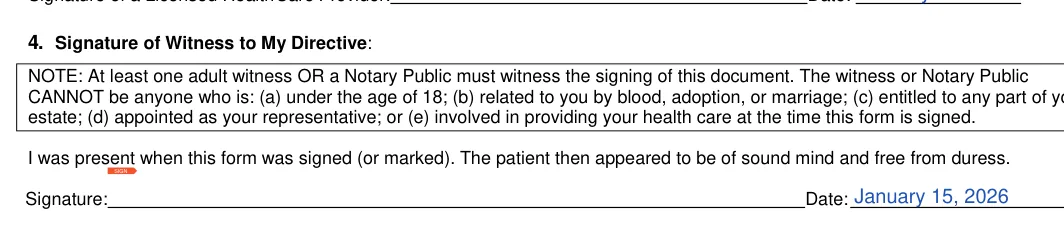
The form also has a witness block (Section 4). The instructions printed on the form say the witness cannot be anyone who is:
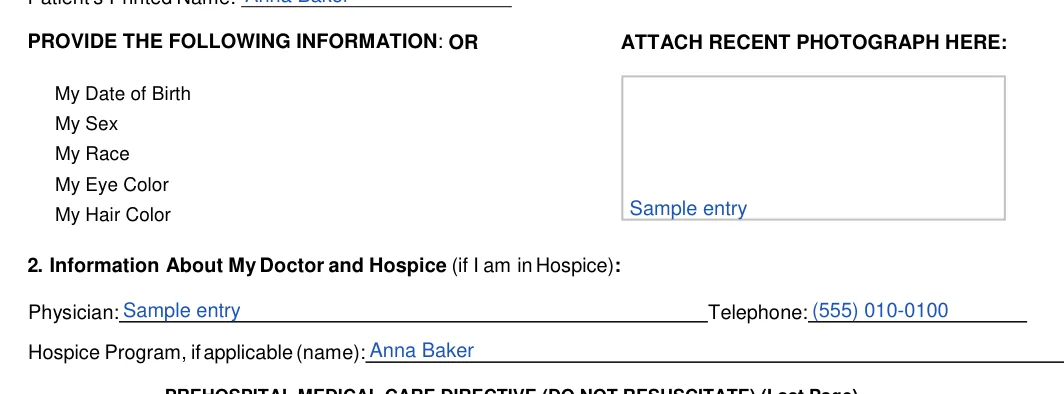
A direct care staff person may comply with a directive if the physician of the person who has the valid directive has ordered a hospice plan of care.[1] Section 2 of the form asks for the hospice program name if the patient is in hospice.
The statute does not apply to situations involving mass casualties. It also does not apply to medical emergencies involving children and adults with disabilities in public or private schools that are not licensed health care institutions.[1]
An Arizona directive is effective until it is revoked or superseded by a new document.[1] If you change your mind, tell your doctor and everyone who holds a copy, then sign a new document to replace the old one.

The Arizona DNR form is one page with four numbered parts, and you complete them in order. You can open the downloaded Adobe PDF in Adobe Acrobat Reader, type into it with the PDF editor, or print it and write by hand. If your device cannot open the file, download Adobe Acrobat Reader first. Make sure the patient, the health care provider and the witness each sign their own part.
The screenshots under each step show the FormsPal Arizona DNR order template filled with sample entries in blue, so you can see where each answer goes. The names, addresses, dates and amounts are examples only.


These two answers explain what an Arizona DNR order is and what it requires. Both come from the prehospital medical care directive statute, Ariz. Rev. Stat. § 36-3251, and from the text printed on the form. Read the current statute before you sign.[1]
A DNR, or do not resuscitate order, tells emergency medical staff not to restart your heart or breathing. Arizona calls it a prehospital medical care directive and sets the rules in Ariz. Rev. Stat. § 36-3251.[1]
The directive must be printed on an orange background and may be used in either letter or wallet size. It is effective until it is revoked or superseded by a new document. The patient signs with a signature or mark, and a licensed health care provider signs too.[1]
An Arizona DNR order must meet these requirements:
A direct care staff person may comply with the directive if the patient's physician has ordered a hospice plan of care. The statute does not apply to mass casualties or to certain school emergencies.[1]
General information, not legal or tax advice.
