
Updated:
A Colorado DNR form, also called a CPR directive, is a written order for emergency medical services and other health care providers. It tells them not to start cardiopulmonary resuscitation (CPR) if your heart or breathing stops. The patient signs first, and then the attending physician signs and dates it.[1.1] You can download a free Colorado DNR form or fill it out online.
Build Your Document
Answer a few simple questions to make your document in minutes
Save and Print
Save progress and finish on any device, download and print anytime
Sign and Use
Your valid, lawyer-approved document is ready
This DNR form covers one decision: no CPR if your heart or breathing stops. The form says the directive does not apply to other medical interventions for comfort care. A Colorado living will is a separate document for other treatment wishes.
Any adult over age eighteen who has decisional capacity to give or refuse informed consent to medical treatment may make a Colorado CPR directive. An authorized agent may act for an adult who lacks that capacity.[2.1] The person making the directive signs first, and the attending physician then signs and dates the form.[1.1]
Emergency medical service personnel, health care providers and health care facilities must comply with a person's CPR directive that is apparent and immediately available.[2.3]
Here are the exact words on who may make a directive:
Any adult over age eighteen who has the decisional capacity to provide informed consent to or refusal of medical treatment
If an adult lacks that ability, an authorized agent acting for that adult may make the directive instead.[2.1]
The declarant, the person making the directive, signs first. Colorado's CPR Directives rule then has the attending physician sign and date the form:
The attending physician shall execute the CPR directive by signing and dating the form after a signature is obtained from the declarant.
In order, that means:
Without a CPR directive, Colorado law presumes that a person consents to CPR.[2.2] Many people who do not want CPR complete a directive for this reason.
A CPR directive may be revoked at any time. The state's rule lists two ways:

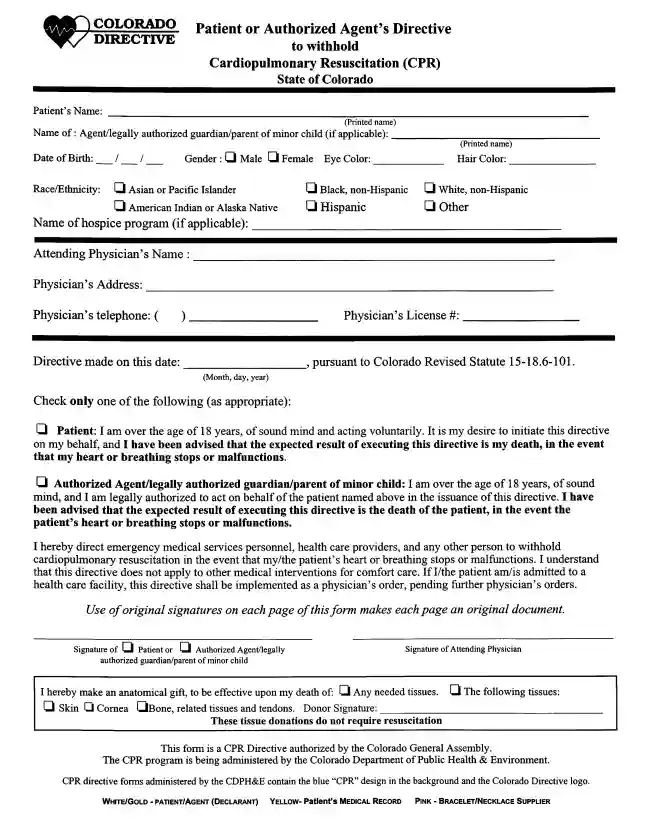
The Colorado DNR form is a one-page form with five parts: patient information, the attending physician, the directive date and box, signatures, and an optional anatomical gift. You can download the form and fill it in by hand, or build it online with the button above. Complete the parts in order.
Step 1: Patient Information
Start at the top of the form. Print the patient's name, then fill in the other patient details:


Step 2: Attending Physician
Enter the details of the attending physician, the doctor who will sign the form:


Step 3: Directive Date and "Check Only One"
Write the date the directive is made, then check the one box that fits:


Read the statement beside the box before you check it. Each statement says that the expected result of the directive is death if the heart or breathing stops or malfunctions.
Step 4: Signatures
On the first signature line, check the Patient box or the Authorized Agent box that applies, and sign. The attending physician then signs on the second line.
Make sure every part is filled out correctly before anyone signs.

Step 5: Anatomical Gift (Optional)
This part is optional. To make an anatomical gift effective on your death, check "Any needed tissues" or "The following tissues," then check Skin, Cornea, or Bone, related tissues and tendons. Sign on the Donor Signature line. Leave the part blank if you do not want to make a gift.

These answers come from the sources listed under Sources at the end of this page. They are general information, so ask your physician or a lawyer about your own situation and check the current text before you sign anything.
Any adult over age eighteen who has the decisional capacity to provide informed consent to or refusal of medical treatment may make a CPR directive. An authorized agent may act for an adult who lacks that capacity.[2.1] In the absence of a CPR directive, a person's consent to CPR is presumed.[2.2]
General information, not legal or tax advice.
