
An Illinois DNR order is a written document that directs health care providers not to attempt resuscitation. Under the state's POLST law, a person of sound mind who has reached the age of majority, or who is legally emancipated, may sign one.[1.1] Create the free Illinois DNR form below, or download the PDF.
Last Updated: October 2026. This guide is reviewed and updated regularly to reflect current Illinois law. If you notice an error or outdated information, please contact us.

Build Your Document
Answer a few simple questions to make your document in minutes
Save and Print
Save progress and finish on any device, download and print anytime
Sign and Use
Your valid, lawyer-approved document is ready
An individual of sound mind who has reached the age of majority may sign the state's uniform POLST form, which directs that resuscitation efforts not be implemented. So may a person who has become legally emancipated under the Emancipation of Minors Act.[1.1] A qualified health care practitioner may also execute the document.[1.2]
POLST stands for Practitioner Orders for Life-Sustaining Treatment. Consent to the form may come from any of these people:
Signing a DNR or POLST form in Illinois is voluntary. No person can be required to execute the state's uniform POLST form.[1.1] The same law limits what facilities and providers can demand, and it says when emergency staff and providers must follow a signed form.
The statute limits providers this way:
Execution of a POLST form shall not be a requirement for admission to any facility or a precondition to the provision of services by any provider of health care services.
In plain words, a facility or health care provider cannot make you sign before it admits you or treats you.
Providers also have a duty to follow the form. Except as otherwise provided by law, emergency medical services personnel, health care providers and health care facilities must comply with a qualifying form. That includes a POLST form or an out-of-hospital DNR order from another state. The form must meet both conditions:
A person who has signed the state's uniform POLST form should review the form annually and when the person's condition changes. The person who signed may also revoke the document at will, which means whenever they choose.[1.1]
A surrogate decision maker has extra steps. Before voiding or revoking a POLST form the individual executed, the individual's legally authorized surrogate decision maker must first:
Substituted judgment means choosing as the patient would have chosen.
If you are planning other legal documents, FormsPal also offers an Illinois living will, an Illinois will template and other Illinois power of attorney forms. You can also browse DNR forms for other states.

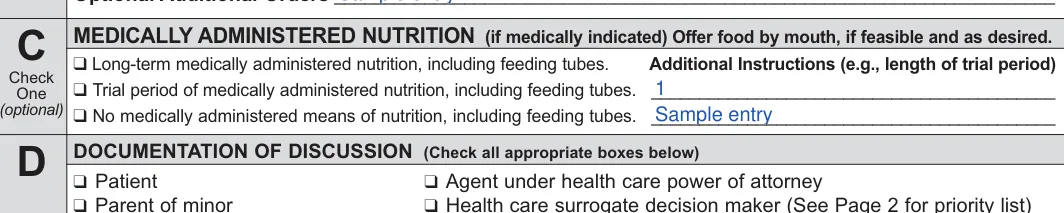
The Illinois DNR/POLST template is a form with all of its fillable fields on page 1. You work through it from top to bottom. The first lines ask for the patient's name, date of birth and address, then you mark a CPR choice and a treatment level. The five steps below cover the rest.
Download the Illinois DNR form PDF and complete it with our online PDF editor, or print it and fill it in by hand.
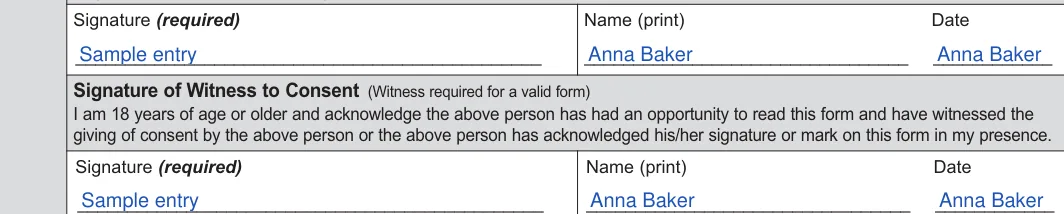
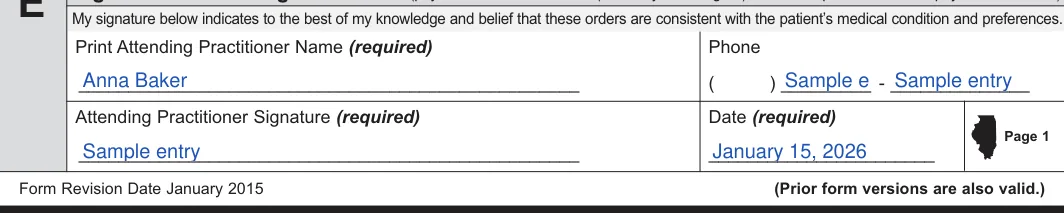
The screenshots under each step show the FormsPal Illinois DNR order template filled with sample entries in blue, so you can see where each answer goes. The names, addresses, dates and amounts are examples only.


These two answers draw on 755 ILCS 40/65, the Illinois law that covers do-not-resuscitate orders and POLST forms. The first explains what must be recorded in the patient's medical record. The second sums up who may sign and how providers must treat a signed form.
A qualified health care practitioner must document the reasons for the action taken in the patient's medical record.[1.1]
Illinois covers these orders in its POLST law, 755 ILCS 40/65. An adult of sound mind may sign the state's uniform POLST form to direct that resuscitation efforts not be implemented. Signing is voluntary, and providers must follow a qualifying form that is apparent and immediately available.[1.1]
General information, not legal or tax advice.
