
Updated:
An Indiana out of hospital DNR order is a written document that tells medical staff not to start cardiopulmonary resuscitation (CPR) outside an acute care hospital. It has two parts, a declaration signed by the declarant and an order issued by a health care professional, under Ind. Code §§ 16-36-5-11, 16-36-5-12, 16-36-5-15 and 16-36-5-18.[1] A general printable DNR form is also available.

Build Your Document
Answer a few simple questions to make your document in minutes
Save and Print
Save progress and finish on any device, download and print anytime
Sign and Use
Your valid, lawyer-approved document is ready
Three parties act on an Indiana out of hospital DNR: the declarant, at least two competent witnesses, and the health care professional who issues the order. The form has a signature block for each of them, and the Indiana Code sets a rule for the declarant's signature, the witnesses and the order.
A representative may execute the declaration for the declarant only if the declarant is at least 18 and incapacitated or incompetent (Ind. Code § 16-36-5-11(b)). The statute defines a representative as the declarant's legal guardian or other court appointed representative responsible for making health care decisions, a health care representative appointed under Ind. Code § 16-36-1-7 or Ind. Code ch. 16-36-7, or an attorney in fact for health care (Ind. Code § 16-36-5-9).[1]
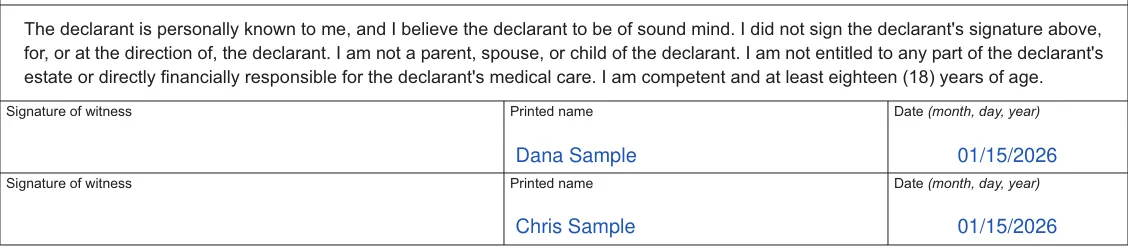
Each witness also makes a statement about their ties to the declarant. In the statute's wording:
I am not entitled to any part of the declarant's estate or directly financially responsible for the declarant's medical care.
A competent witness must be at least 18 and cannot be the person who signed the declaration for the declarant, the declarant's parent, spouse or child, a person entitled to any part of the declarant's estate, or a person directly financially responsible for the declarant's medical care (Ind. Code § 16-36-5-2).[2]
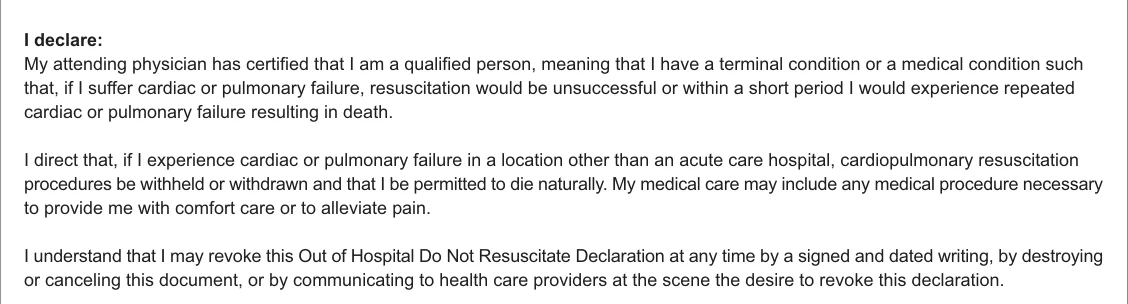
The attending physician, advanced practice registered nurse, or physician assistant may certify a patient as a qualified person after determining, in accordance with reasonable medical standards, that the patient has a terminal condition, or has a medical condition such that, if the patient suffered cardiac or pulmonary failure, resuscitation would be unsuccessful or the patient would within a short period experience repeated cardiac or pulmonary failure resulting in death (Ind. Code § 16-36-5-10).[1]
An attending physician who does not issue an out of hospital DNR order for a qualified person may transfer the patient to another physician, who may issue the order (Ind. Code § 16-36-5-13(a)).[2]
A health care provider must withhold or discontinue CPR to a patient in an out of hospital location if the provider has actual knowledge of an original or a copy of a signed out of hospital DNR declaration and order executed by the patient, or of an out of hospital DNR identification device the patient wears or has (Ind. Code § 16-36-5-19(a)).[2]
The declarant may revoke an Indiana out of hospital DNR declaration and order at any time. The three ways to revoke it are a signed, dated writing, physical cancellation or destruction of the declaration and order, or an oral expression of intent to revoke.[1]
A health care provider who is told of the revocation must immediately notify the declarant's attending physician, advanced practice registered nurse, or physician assistant, if known. That professional must then immediately add the revocation to the declarant's medical file, cancel the declaration and order by entering the word VOID on each page of the declaration and order in the medical file, and notify any health care facility staff responsible for the declarant's care (Ind. Code § 16-36-5-18(d) and (e)).[1]

The screenshots under each step show Indiana State Form 49559 (Out of Hospital Do Not Resuscitate Declaration and Order), the official Indiana form, filled with sample entries in blue, so you can see where each answer goes. The names, addresses, dates and other entries are examples only.
Create the Indiana DNR form online with the FormsPal builder, or print the PDF and fill it in by hand. The declarant, the witnesses and the physician each complete their own part of the form, so follow the parts below in the order they appear on the page.





When every part is complete, keep the signed original where family and care providers can find it. Related Indiana health care forms on FormsPal include the Indiana living will and the Indiana medical power of attorney.
Yes, the order comes from a health care professional. In Indiana, an out of hospital DNR order may be issued only by the declarant's attending physician, advanced practice registered nurse, or physician assistant.[1] The declarant signs the declaration, and one of those professionals issues the order.
General information, not legal or tax advice.
