
A Kansas DNR order is a written "do not resuscitate" (DNR) directive. It states that if your heart stops or you stop breathing, no cardiopulmonary resuscitation (CPR) will be started. In Kansas, the order must be in writing, signed and dated.[1] A completed form puts those wishes on paper for your doctors and family.
Last Updated: October 2026. This guide is reviewed and updated regularly to reflect current Kansas law. If you notice an error or outdated information, please contact us.

Build Your Document
Answer a few simple questions to make your document in minutes
Save and Print
Save progress and finish on any device, download and print anytime
Sign and Use
Your valid, lawyer-approved document is ready
Under Section 65-4943 of the Kan. Stat. Ann., a "do not resuscitate" directive must be in writing, signed and dated. The person making the declaration signs it, or another person signs in the declarant's presence and at the declarant's expressed direction.[1]
A "do not resuscitate" directive shall be: in writing; signed by the person making the declaration, or by another person in the declarant's presence and by the declarant's expressed direction; dated;
The statutory directive form in Section 65-4942 of the Kan. Stat. Ann. has three signature blocks.[2]
A physician or physician assistant does not have to sign in one case. The person named in the order belongs to a church or religion that, instead of medical care and treatment, provides treatment by spiritual means through prayer alone. The care must follow that church's or religion's tenets and practices.[2]

Create your DNR order online with the builder above, or download the PDF to fill in by hand. The fillable part of the template is the Pre-Hospital DNR Request Form on page 4. It has four parts, and each step below follows one of them in order, with a screenshot of sample entries.
To type into the PDF instead, use our online PDF editor.
The screenshots under each step show the FormsPal Kansas DNR order template filled with sample entries in blue, so you can see where each answer goes. The names, addresses, dates and amounts are examples only.


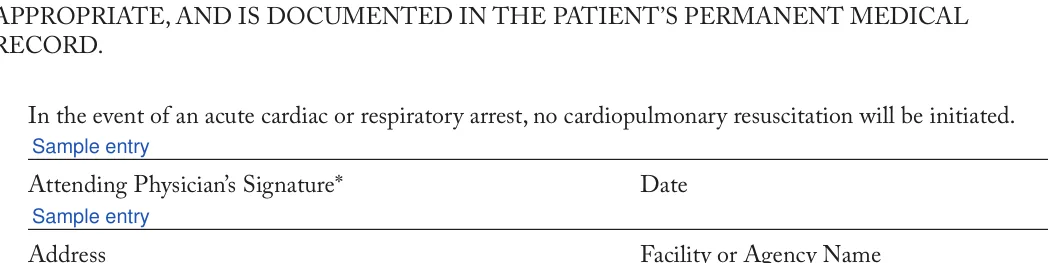

Once the form is signed and dated, the remaining work is practical. A DNR order only helps if the people who care for you know it exists and can find it quickly. The steps below are common practice, not Kansas legal requirements.
A DNR order covers one decision. It says whether CPR is started if your heart stops or you stop breathing. A living will is a separate document where people record wider wishes about health care near the end of life. Some people keep both, and each is signed on its own.
If you also want to record those wider wishes, see our Kansas living will form. To name someone who can act for you in other matters, see our Kansas power of attorney forms. Living in more than one state? Browse our DNR forms for every state.
A DNR order is complete in Kansas when it is in writing, signed and dated. The questions below show where to sign the form and what the statutory form contains, using the wording of the Kansas statutes cited on this page.
Sign on the Signature line under the statement "I hereby agree to the "Do Not Resuscitate" (DNR) directive."[2] The order must also be dated. Either you sign it, or another person signs in your presence and at your expressed direction.[1]
A Kansas DNR order must be in writing, signed and dated.[1] The statutory form adds three parts.[2]
The physician's signature is not required for a member of a church or religion that treats illness by spiritual means through prayer alone.[2]
Yes, in one situation. The statute allows another person to sign in the presence of the person making the declaration and at that person's expressed direction. The order must still be in writing and dated.[1]
Yes. Section 65-4943 lists the date next to writing and signature as the three basic elements of the order.[1] The statutory form also has a date line beside the physician's signature and beside the revocation provision.[2]
The statutory form includes a revocation provision. It reads "I hereby revoke the above declaration." and has its own signature and date lines.[2]
General information, not legal or tax advice.
This page relies on two sections of the Kansas Statutes Annotated. Section 65-4943 sets out what a do not resuscitate order must be, and Section 65-4942 contains the statutory form with its signature lines and revocation provision.
