
An Ohio DNR order, also called a do not resuscitate order, is a written instruction that tells emergency medical services not to use CPR (cardiopulmonary resuscitation) to restart a person's heart or breathing. This Ohio DNR form lets you pick one of two protocols, DNRCC or DNRCC-Arrest, and has a section for a physician to certify the order.
Last Updated: October 2026. This guide is reviewed and updated regularly to reflect current Ohio law. If you notice an error or outdated information, please contact us.
Build Your Document
Answer a few simple questions to make your document in minutes
Save and Print
Save progress and finish on any device, download and print anytime
Sign and Use
Your valid, lawyer-approved document is ready
A DNR order, short for do-not-resuscitate, records that a person does not want CPR if their heart or breathing stops. Page 2 of the form prints the Ohio DNR Comfort Care Protocol. It tells emergency medical services and other health care workers what they will and will not do once the order applies. The focus is comfort care, not resuscitation.
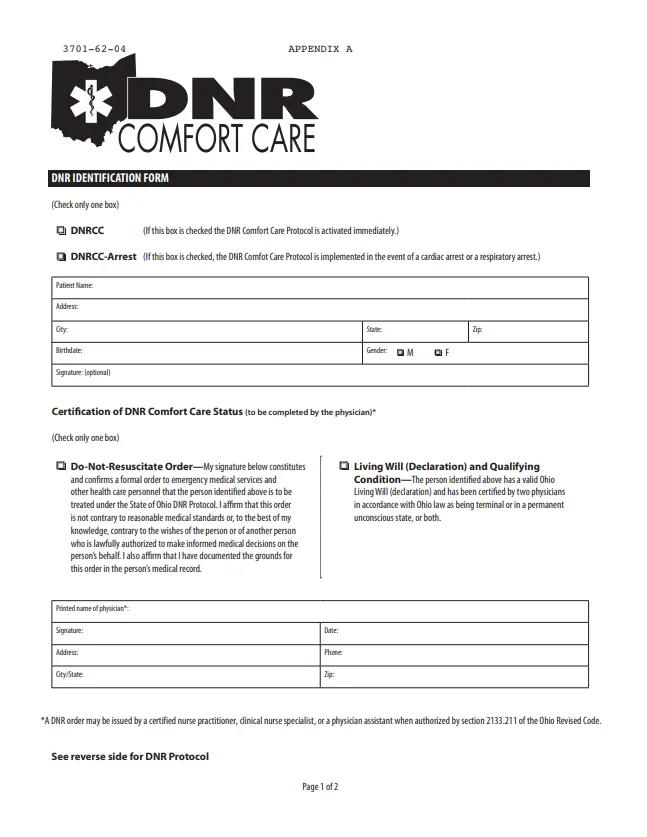
The form gives two choices for when the protocol applies. DNRCC activates it immediately. DNRCC-Arrest implements it in the event of a cardiac arrest or a respiratory arrest.
The patient fills in the top of page 1, and a physician completes the Certification of DNR Comfort Care Status below it. Under Section 2133.23(A) of the Ohio Rev. Code Ann., an attending physician may issue the order if the statute's requirements are met. That includes giving emergency medical services personnel, other than physicians, an oral DNR order directly.[2.1]
The physician checks only one of two boxes. The first confirms a formal order to emergency medical services and other health care personnel that the person is to be treated under the State of Ohio DNR Protocol. The second says the person has a valid Ohio living will (declaration) and has been certified by two physicians as terminal, in a permanent unconscious state, or both.
By signing, the physician also affirms on the form that:
Download the printable DNR form as a PDF and fill in the patient section. Under Ohio's DNR rules, you obtain the copy that serves as DNR identification from a physician, advanced practice registered nurse, physician assistant or health care facility and complete it together with your authorized health care provider.[3.2]
The form does not name anyone to make other medical decisions for the patient. To appoint a person for that, see the Ohio medical power of attorney form. FormsPal also has an Ohio durable power of attorney form and a list of all Ohio power of attorney forms.
Under Rule 3701-62-02 of the Ohio Admin. Code, a licensed advanced practice registered nurse may take any action an attending physician may take under Sections 2133.21 to 2133.26 of the Ohio Rev. Code Ann. and the DNR rules.[3.3]
Nothing in Sections 2133.21 to 2133.26 of the Ohio Rev. Code Ann. or the DNR rules gives a provider immunity for issuing a DNR order that is contrary to reasonable medical standards, or that the provider knows or has reason to know is contrary to the wishes of the patient or of a person lawfully authorized to make informed medical decisions for the patient.[3.4]
Emergency crews can only follow a DNR order they know about, so people usually carry or wear DNR identification. Under Section 2133.23(A) of the Ohio Rev. Code Ann., emergency medical services personnel who are not physicians must follow the DNR protocol in three cases. They are shown DNR identification, they are shown a written DNR order, or a physician gives them an oral order directly.[2.1]
Common types of DNR identification include:
Section 2133.23(C) of the Ohio Rev. Code Ann. covers transfers between facilities. Suppose a person with DNR identification or a current DNR order moves from one health care facility to another. The transferring facility must then notify the receiving facility and the people transporting the person. It must do so before or at the time of the transfer, and the notice must say that the DNR identification or order exists.[2.2]
Under Rule 3701-62-04(A)(1) of the Ohio Admin. Code, a do-not-resuscitate order documented on the state of Ohio DNR order form is approved DNR identification.[3.5]
A living will declaration serves as DNR identification only when the declarant specifies on it that they wish to use it as DNR identification.[3.6]
Page 2 of the form lists what emergency medical services and other health care workers will and will not do once the protocol is activated. The two lists below follow that page. The form also tells responders to stop any listed action they started before they confirmed the protocol applies.
Responders will:
Responders will not:
The form says responders may continue respiratory assistance, IV medications and similar care that were already part of the patient's ongoing treatment for an underlying disease. The top of the form is labelled 3701-62-04, Appendix A. Rule numbers that start with 3701-62 belong to Chapter 3701-62 of the Ohio Administrative Code, which holds the rules for the state DNR order form.[3.7]


The Ohio DNR Comfort Care form is a two-page document with fields and checkboxes. Page 1 holds the order, with a patient section and a physician section, and page 2 prints the protocol. There are four parts to complete, and the patient completes the first two. The physician completes the rest.


A person with DNR identification can make an oral or written request to receive CPR. Under Section 2133.22 of the Ohio Rev. Code Ann., anyone who then provides CPR at that request is protected. That person is not subject to criminal prosecution, civil damages or professional discipline for providing it. The same protection covers the health care facility and its administrator.[1]
If, after DNR identification is discovered in the possession of a person, the person makes an oral or written request to receive CPR, any person who provides CPR pursuant to the request, any health care facility in which CPR is provided, and the administrator of any health care facility in which CPR is provided are not subject to criminal prosecution as a result of the provision of the CPR, are not liable in damages in a tort or other civil action for injury, death, or loss to person or property that arises out of or is related to the provision of the CPR, and are not subject to professional disciplinary action as a result of the provision of the CPR.
General information, not legal or tax advice.
Unless noted otherwise, the sources below are from the Ohio Rev. Code Ann..
