
An Oklahoma DNR order is a written do-not-resuscitate document in which you decline cardiopulmonary resuscitation (CPR). The Oklahoma DNR form says no medical procedure to restore breathing or heart function will be started if your heart stops beating or you stop breathing. That applies to any health care provider, including emergency medical services (EMS) personnel. It does not stop other care, such as the Heimlich maneuver, oxygen and comfort care. Build the form online below or download the PDF.
Last Updated: October 2026. This guide is reviewed and updated regularly to reflect current Oklahoma law. If you notice an error or outdated information, please contact us.
Build Your Document
Answer a few simple questions to make your document in minutes
Save and Print
Save progress and finish on any device, download and print anytime
Sign and Use
Your valid, lawyer-approved document is ready
An Oklahoma DNR order is a written decision to decline CPR if your heart or breathing stops. CPR is not a single procedure but a set of medical measures that providers use to restart a heartbeat or breathing, and the rest of your care continues. The measures that CPR includes are:
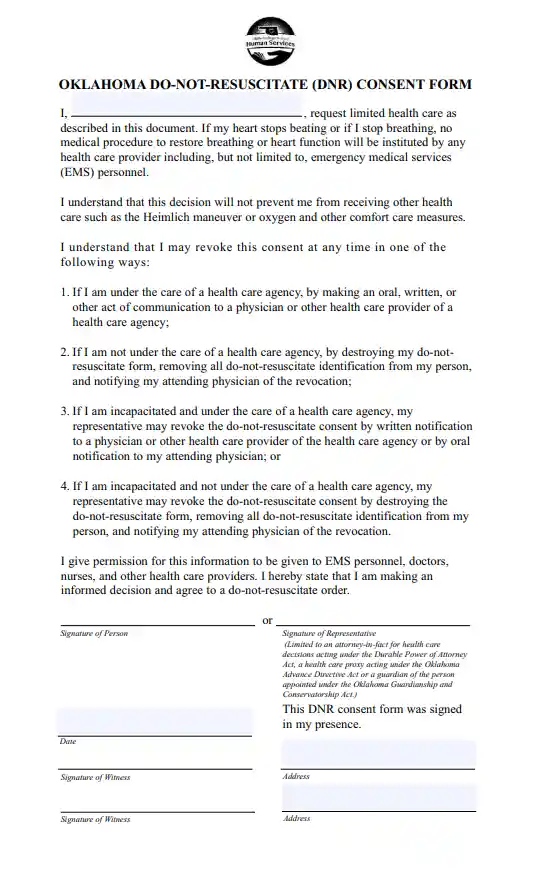
The consent form says your decision does not prevent other health care, such as the Heimlich maneuver, oxygen and other comfort care measures. It also gives permission to share the information with EMS personnel, doctors, nurses and other health care providers.
Many people with a DNR keep identification where paramedics will see it, such as a wallet card, a bracelet, a necklace or a copy of the signed form. The form itself mentions DNR identification that you carry or wear.
Oklahoma law starts from a default. Under Okla. Stat. tit. 63, section 3131.4(A), every person is presumed to consent to CPR if their heart or breathing stops. The presumption holds unless a condition listed in the statute applies and the health care provider actually knows of it.[1.1] The DNR consent form puts the choice to decline CPR in writing.
Every person shall be presumed to consent to the administration of cardiopulmonary resuscitation in the event of cardiac or respiratory arrest, unless one or more of the following conditions, of which the health care provider has actual knowledge, apply:
Section 3131.5 of the same title sets out the consent form itself. Three of its rules matter when you complete the form:
The Oklahoma DNR form has two pages, and each does a different job. Page 1 is the consent form for the person making the decision. Page 2 is a Certification of Physician, which an attending physician uses only for an incapacitated person without a representative.[1.2]

Complete the two pages of the Oklahoma DNR form in the order below. Each step names the part of the form it covers, so you can follow along with a printable DNR form or the one you build on this page. If you download the PDF, you can fill it in with our online PDF editor before you print it.
Enter your name. Write your full name on the "I," line at the start of page 1. Read the revocation paragraphs that follow before you sign.

Sign and date. Sign on the line for the person and add the date.

Use a representative if needed. If someone signs for you, they sign on the representative line. The form limits that line to an attorney-in-fact for health care decisions, a health care proxy or a guardian of the person.

Have two witnesses sign. Under the words "This DNR consent form was signed in my presence," each of two witnesses signs and writes an address on a separate line.
Write the patient's name on page 2. Page 2 has a line for the name of the incapacitated person. The form says this page is for an attending physician only.

Physician signs and adds details. The physician signs, prints their name, adds an address or phone number and dates the page.

Keep copies of the signed form where your family and your health care providers can find them, and tell your family where the original is stored.
Most problems with a completed Oklahoma DNR form come from missed lines, not hard decisions. Check the form against this list before you sign it and again before you hand it to anyone:
The consent is not permanent. Page 1 of the form states that you may revoke it at any time, and it lists four ways to do so. Which one applies depends on whether you are under the care of a health care agency and whether you are incapacitated:
Two of the four methods involve removing all do-not-resuscitate identification from your person, so keep track of every card, bracelet or copy that you carry or wear.
In Oklahoma, the DNR consent must be signed, with the statement that the person is making an informed decision and agrees to a do-not-resuscitate order. An attending physician uses the Certification of Physician only to certify that an incapacitated person without a representative would not have consented to CPR. The consent can be revoked by an oral, written, or other act of communication to a physician or other health care provider of a health care agency.[1.2]
General information, not legal or tax advice.
