
A Pennsylvania DNR (do not resuscitate) order is a written out-of-hospital medical order. It tells emergency medical services (EMS) not to start CPR (cardiopulmonary resuscitation) if a person's heart or breathing stops. The Pennsylvania DNR form has places for the attending physician, the patient and, when needed, a surrogate to sign.
Last Updated: October 2026. This guide is reviewed and updated regularly to reflect current Pennsylvania law. If you notice an error or outdated information, please contact us.
Build Your Document
Answer a few simple questions to make your document in minutes
Save and Print
Save progress and finish on any device, download and print anytime
Sign and Use
Your valid, lawyer-approved document is ready
A patient may request and receive a Pennsylvania out-of-hospital DNR order from the patient's attending physician if the patient has a terminal condition. The patient must also meet one of the conditions below.[1.1]
Before the attending physician completes, signs and dates the order, the physician must make sure of three things:
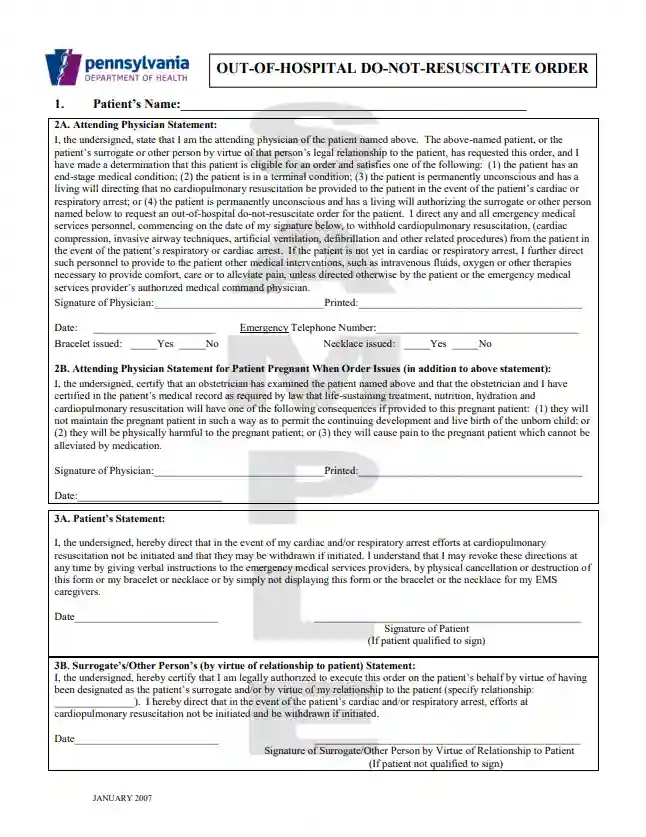
The form has a place for each signature. The attending physician signs in Section 2A, and the patient signs in Section 3A. If the patient is not qualified to sign, the surrogate or other person with a legal relationship to the patient signs in Section 3B.
A DNR order deals with CPR in an emergency. Many people also record wider medical care and end-of-life wishes in advance directives. You can prepare a Pennsylvania living will or name an agent with a Pennsylvania medical power of attorney. More options are listed with our Pennsylvania power of attorney forms.
Pennsylvania's statute on these orders is known as the Out-of-Hospital Nonresuscitation Act (20 Pa.C.S. § 5481).[2.1]
The Act defines the order as one in the standard format, supplied by the Department of Health and issued by the attending physician, that directs emergency medical services providers to withhold cardiopulmonary resuscitation if the patient has a respiratory or cardiac arrest (20 Pa.C.S. § 5483).[3.1]
One part of the Act's definition of an out-of-hospital do-not-resuscitate patient is that the person has an end-stage medical condition or is permanently unconscious (20 Pa.C.S. § 5483).[3.2]
Under the Act, an attending physician must issue the order at the request of a patient who meets one of the conditions above, or of the patient's surrogate if the surrogate is so authorized (20 Pa.C.S. § 5484(a)).[4.1]
An out-of-hospital DNR bracelet or necklace is worn so that emergency crews can tell the patient has an order and know not to resuscitate. In Pennsylvania, the attending physician may not provide a bracelet or necklace for a patient without also issuing, or having issued, an out-of-hospital DNR order for that patient.[1.3] The form records whether the physician issued a bracelet, a necklace, or both.
Two more rules apply when a physician asks for the return of an order, bracelet or necklace:
An out-of-hospital DNR tells responders not to resuscitate the patient, but it does not end their care. Pennsylvania sets rules for emergency responders, which the code calls prehospital practitioners, who comply with an order. Within their scope of practice, they must provide the other medical interventions necessary and appropriate to comfort the patient and relieve pain. The patient or the practitioner's medical command physician can direct otherwise.[1.5]
The rules for cardiopulmonary resuscitation depend on the situation:
Two Pennsylvania rules apply in special situations. A health care provider must give life-sustaining treatment, CPR, nutrition and hydration to a pregnant patient, even if an order says otherwise, unless a narrow exception applies.[1.6] An out-of-hospital DNR order, bracelet or necklace that is valid in another state is effective in Pennsylvania to the extent it is consistent with Pennsylvania law.[1.7]
The pregnancy exception needs a certification on the patient's medical record from the attending physician and a second physician, an obstetrician who has examined the patient. Section 2B of the form lists three consequences. The physician certifies that treatment would have one of them:[1.6]

The Pennsylvania out-of-hospital DNR form is a one-page form with five parts. They are the name line, the physician's statement (2A), a statement for pregnancy (2B), the patient's statement (3A) and the surrogate's statement (3B). Follow the six steps below in the order the form lists them.
The screenshots under each step show the FormsPal Pennsylvania DNR order template filled with sample entries in blue, so you can see where each answer goes. The names, addresses, dates and amounts are examples only.












Need a DNR form for another state? Browse the DNR forms by state. Other Pennsylvania documents are in our Pennsylvania forms library.
Yes. Pennsylvania has an out-of-hospital do not resuscitate order, which the attending physician issues. Chapter 1051 of Title 28 of the Pennsylvania Code sets the rules for who can request one, who signs it, and what emergency responders do when they find one.[1.1]
Pennsylvania sets these requirements for an out-of-hospital DNR:
Ask your attending physician for an out-of-hospital DNR. The physician can issue one if you have a terminal condition and meet one of the age or status conditions.[1.1] Once you or your surrogate has signed, the physician completes, signs and dates the form.[1.2]
Fill in the name line on the Pennsylvania DNR form, then sign it yourself or have your surrogate sign. The attending physician then prints their name, signs and dates the form, and records whether a bracelet or necklace was issued.[1.2] The steps above show each part of the form.
An emergency responder who becomes aware of an effective out-of-hospital DNR after starting CPR must discontinue resuscitation and must provide comfort care. A responder who is unsure whether the order was revoked provides CPR unless a medical command physician directs otherwise.[1.5]
General information, not legal or tax advice.
