Free Texas DNR Form for Out-of-Hospital Orders

A Texas DNR order is a written out-of-hospital do-not-resuscitate (OOH-DNR) order. It directs health care professionals outside a hospital to withhold cardiopulmonary resuscitation (CPR) and certain other life-sustaining treatment. A competent person may sign one at any time under Section 166.082 of the Tex. Health & Safety Code.[1] Create the free Texas DNR form below, then see who must sign it and how to fill it out.

Last Updated: October 2026. This guide is reviewed and updated regularly to reflect current Texas law. If you notice an error or outdated information, please contact us.

Texas do not resuscitate order form preview

Create a Personalized Texas DNR Order Form online in under 5 minutes!

Build Your Document

Answer a few simple questions to make your document in minutes

Save and Print

Save progress and finish on any device, download and print anytime

Sign and Use

Your valid, lawyer-approved document is ready

... or download your Texas DNR Order Form as a  PDF file

What the Texas OOH-DNR Form Covers

The out-of-hospital DNR form tells health care providers who are acting outside a hospital not to start or continue five resuscitation measures. The form says this includes a hospital emergency department. The person signing, or someone declaring for them, confirms that choice in the section that fits their situation.

The form lists these measures:

  • cardiopulmonary resuscitation (CPR)
  • transcutaneous cardiac pacing, which paces the heart from outside the body
  • defibrillation, which restarts the heart with an electric shock
  • advanced airway management
  • artificial ventilation, also called artificial respiration

The form also states that comfort care will be given as needed, so the person stays comfortable. It has six declaration sections, so the right one depends on who is making the decision:

  • Section A is for the adult person.
  • Section B is for a legal guardian, agent or proxy of an adult who cannot communicate.
  • Section C is for the spouse, adult child, parent or nearest living relative of an adult who cannot communicate.
  • Section D is for the attending physician, based on a directive the adult gave earlier or a request the adult made without writing it down.
  • Section E is for the parent, legal guardian or managing conservator of a minor.
  • Section F is for two physicians acting for an adult who cannot communicate and has no guardian, agent, proxy or relative.
Good to know: the document is called the Texas OOH-DNR order, the out-of-hospital DNR order, or simply the Texas do not resuscitate form. These names describe the same document.

Texas DNR Order Requirements

Section 166.082 of the Tex. Health & Safety Code sets the basic requirements for an out-of-hospital DNR order. The order is written, the declarant (the person making the order) signs it in front of two qualifying witnesses, and the attending physician signs it too.

  • The order must be in writing. A competent person may sign a written order at any time to direct health care professionals in an out-of-hospital setting to withhold CPR.[1]
  • The declarant must sign the order in the presence of two witnesses who qualify under Section 166.003. At least one of the two must be a witness who qualifies under Section 166.003(2).[2]
  • The attending physician of the declarant must sign the order. The physician must also make the existence of the order and the reasons for it part of the declarant's medical record.[2]

The statute puts the witness rule this way:

Except as provided by this subsection, the declarant must sign the out-of-hospital DNR order in the presence of two witnesses who qualify under section 166.003, at least one of whom must be a witness who qualifies under section 166.003(2).

Tex. Health & Safety Code § 166.082
Check witness eligibility before anyone signs. Section 166.003 decides who may serve as a witness, and the order needs at least one witness who meets the extra test in subsection (2).

Instead of signing in front of witnesses, the declarant may sign the order and have the signature acknowledged before a notary public (Section 166.082(b)). If no qualified relative is available to act for the person under Section 166.088(b), the order must be concurred in by another physician who is not involved in the person's treatment or who represents the ethics or medical committee of the health care facility where the person is a patient (Section 166.088(f)).[2]

How to Fill Out the Texas OOH-DNR Order Form

The OOH-DNR document has a declaration section for each situation, a witness area, a notary acknowledgment block and the attending physician's statement. You complete the parts in the order the form follows. Before you fill out the DNR form, decide who is making the declaration. Then work through the four steps below.

Download the PDF and complete it with our online PDF editor, or print it and fill it in by hand.

The screenshots under each step show the FormsPal Texas DNR order template filled with sample entries in blue, so you can see where each answer goes. The names, addresses, dates and amounts are examples only.
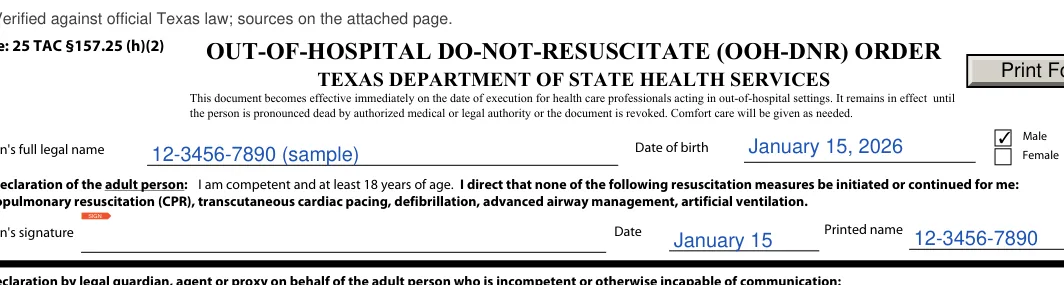
  1. Name, date of birth and Section A. Write the person's full legal name and date of birth, and mark Male or Female. In Section A, the adult confirms being competent and at least 18 years of age, then signs and dates.
    Texas DNR order: Form1[0].#subform[0].printbutton1[0], Form1[0].#subform[0].imagefield1[0] and more, filled with sample entries
    Step 1: sample entries, not a real document.
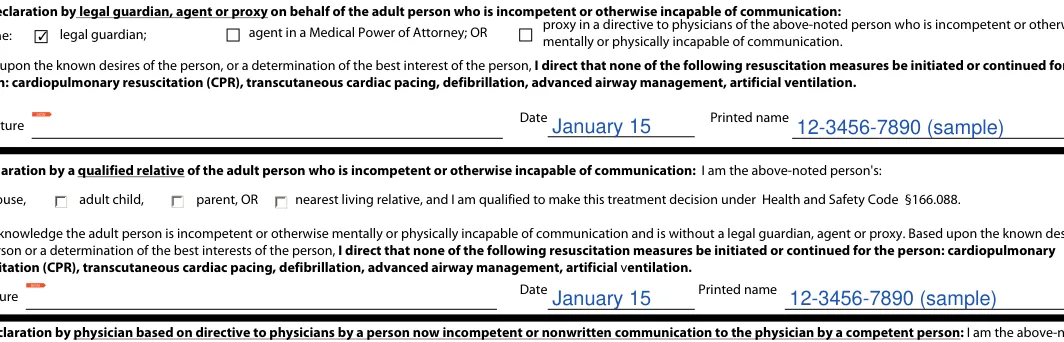
  2. Sections B and C. Use Section B if a legal guardian, agent or proxy declares for an adult who cannot communicate. Use Section C if a spouse, adult child, parent or nearest living relative does. The person declaring prints their name, signs and dates.
    Texas DNR order: I am the, filled with sample entries
    Step 2: sample entries, not a real document.
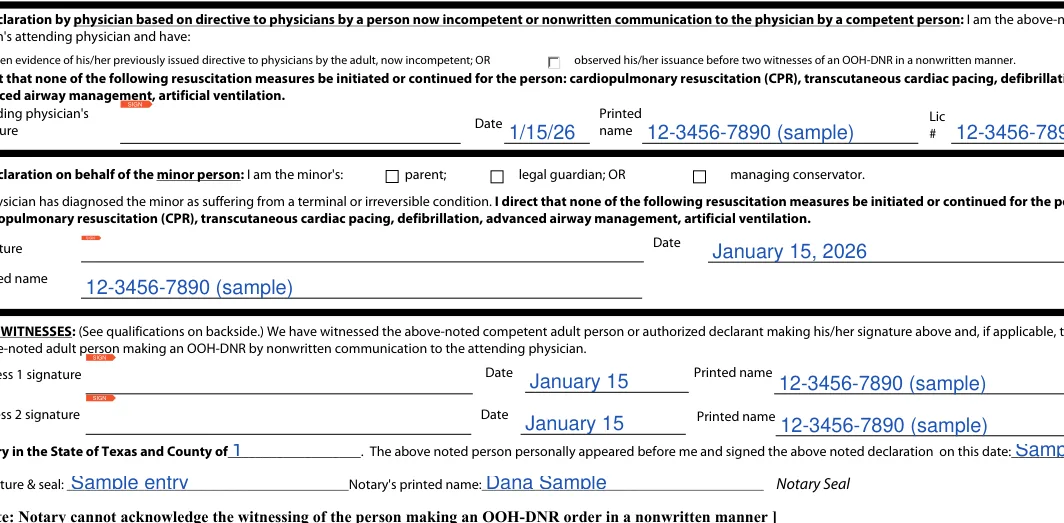
  3. Section D, Section E, witnesses and notary. Section D is for the attending physician and Section E is for a minor's parent, legal guardian or managing conservator. Two witnesses print their names, sign and date. The form also has an acknowledgment block for a notary.
    Texas DNR order: person's attending physician and have, filled with sample entries
    Step 3: sample entries, not a real document.
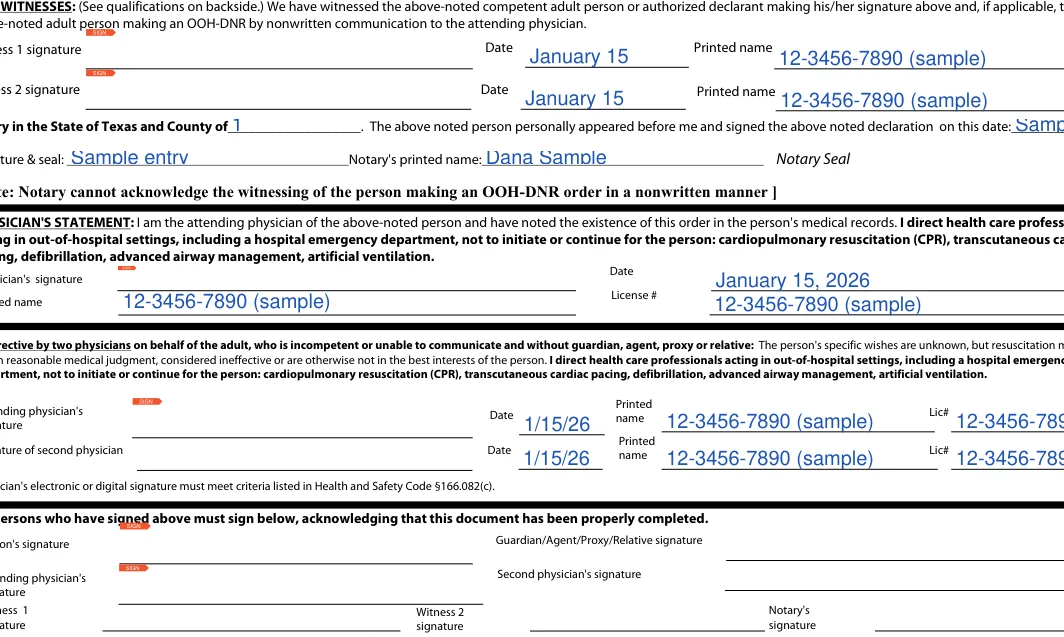
  4. Physician's statement and Section F. The attending physician prints their name and license number, signs and dates the statement. Use Section F only when two physicians act together, and each signs and dates. At the bottom, everyone who signed above signs again to acknowledge that the form was completed properly.
    Texas DNR order: Form1[0].#subform[0].datetimefield3[0], Form1[0].#subform[0].signaturefield11[0] and more, filled with sample entries
    Step 4: sample entries, not a real document.

Texas DNR Identification Devices

After the order is signed, many people also get a DNR identification device so that medical providers can spot the directive quickly. A device is optional. Keeping a copy of the signed form where emergency responders can find it is another common precaution.

Devices come as:

  • a plastic bracelet with the word “Texas” or the logo of the geographical shape of the state with the word “STOP” printed over it
  • a metal bracelet with the phrase “Texas Do Not Resuscitate”
  • a metal necklace with the same message

If you are planning ahead for medical care and end of life wishes, you can also create a Texas living will or a Texas medical power of attorney on FormsPal.

A DNR identification device on a person's body is conclusive evidence that the person has a valid out-of-hospital DNR order, and responding health care professionals must honor it as if the signed order form were found with the person (Section 166.090(b)).[2]

A photocopy or other complete facsimile of the signed out-of-hospital DNR order may be used for any purpose the original can (Section 166.083(d)).[2]

Template Preview
Create a Personalized Texas DNR Order Form online in under 5 minutes!

Frequently Asked Questions

These answers cover three common questions about signing a Texas out-of-hospital DNR order. They address how many witnesses are needed, whether a physician must sign, and who may serve as a witness.

How many witnesses are required to sign a do-not-resuscitate (DNR) order in Texas?

Texas requires two witnesses. The declarant must sign the out-of-hospital DNR order in the presence of two witnesses who qualify under Section 166.003, and at least one of them must qualify under Section 166.003(2).[2]

Does a do-not-resuscitate (DNR) order in Texas require a physician's signature?

Yes. The attending physician of the declarant must sign the order. The physician must also record the existence of the order and the reasons for it in the declarant's medical record.[2]

What eligibility restrictions apply to witnesses of a do-not-resuscitate (DNR) order in Texas?

Who may serve as a witness is restricted by statute. Both witnesses must qualify under Section 166.003, and at least one of them must be a witness who qualifies under Section 166.003(2).[2]

General information, not legal or tax advice.

Sources

Unless noted otherwise, the sources below are from the Texas Family Code, published by the Texas Legislature Online.

  1. Texas Legislature Online. Texas Family Code Tex. Health & Safety Code 166.082(a).
  2. Texas Legislature Online. Texas Family Code § 166.082.
Published: Apr 17, 2022
Mara Erlach
Mara Erlach
Writer & Attorney
Mara has been practicing estate planning and trust law in California since 2003, taking pride in helping clients of all backgrounds and asset profiles form a complete and customized estate plan. Her specialties are: estate planning, wills and trusts, trust and probate administration.