
Updated:
A 14-day notice to vacate is a landlord's written eviction warning. The notice names the unpaid rent or broken lease term and sets a date to cure or leave. Landlords send it when rent is late or a lease term is broken.
Build Your Document
Answer a few simple questions to make your document in minutes
Save and Print
Save progress and finish on any device, download and print anytime
Sign and Use
Your valid, lawyer-approved document is ready
Key facts
| Document Name | 14-Day Eviction Notice to Vacate Form |
| Other Names | 14-Day Notice to Quit, Fourteen-Day Eviction Notice |
| Avg. Time to Fill Out | 13 minutes |
| # of Fillable Fields | 55 |
| Available Formats | Adobe PDF |

A notice to vacate form is a written notice that tells a tenant to fix a problem or move out by a set date. The 14-day version is one kind of notice to vacate, also called a 14-day notice to quit or a fourteen-day eviction notice.
The notice is not an eviction. It is the warning that comes before one, and it gives the tenant a chance to respond. A printable notice to vacate works the same way as one filled in on screen: the landlord completes it, signs it and hands a copy to the tenant.
Notices to vacate come in three common forms:
A 14-day notice to vacate fits unpaid rent, a lease violation or illegal activity at the rental, where the rental's location uses that notice period. The notice names the problem, gives the tenant time to respond and says what the landlord plans to do next.
A notice for unpaid rent lists the amount owed and the date it was due. Any late fees the lease sets go on their own line, apart from the rent.
A notice for a lease violation points to the lease clause that was broken. It describes what the tenant did and how the tenant can fix it.
A notice for illegal activity describes what happened, when it happened and how the landlord learned about it. Some of these notices give no chance to fix the problem, only a date to leave.
The table below lists 18 states whose statutes set a 14-day period for at least one kind of notice, each with the section that sets it. Each row applies only to the case its second column names; other reasons carry their own periods.
| State | When the 14-day period applies | Statute |
|---|---|---|
| Alaska | Ending a week to week tenancy, by landlord or tenant: written notice at least 14 days before the termination date in the notice | Alaska Stat. § 34.03.290 |
| Arkansas | Lease violation: the agreement ends on a date not less than fourteen (14) days after receipt of the notice, if the noncompliance is not remedied in fourteen (14) days | Ark. Code Ann. § 18-17-701(a)(1) |
| Kansas | Lease violation: the tenant has 14 days to remedy the breach; the termination date is not less than 30 days after receipt of the notice | Kan. Stat. Ann. § 58-2564 |
| Kentucky | Lease violation, in a city, county or urban-county government that has enacted the Uniform Residential Landlord and Tenant Act: the agreement ends on a date not less than fourteen (14) days after receipt of the notice | Ky. Rev. Stat. § 383.660 |
| Maryland | A breach showing a clear and imminent danger of serious harm, under an unexpired lease for a stated term that lets the landlord repossess before the term ends: 14 days' written notice | Md. Code, Real Prop. § 8-402.1 |
| Massachusetts | Unpaid rent by a tenant at will: fourteen days' notice to quit, given in writing | Mass. Gen. Laws ch. 186, § 12 |
| Minnesota | Unpaid rent: the tenant pays the total amount due or moves out within 14 days from the date of the notice | Minn. Stat. § 504B.321, subd. 1a |
| Mississippi | Lease violation: the agreement ends not less than fourteen (14) days after receipt of the notice, if the breach is not remedied within a reasonable time not in excess of fourteen (14) days | Miss. Code Ann. § 89-8-13 |
| Montana | Lease violation not listed in subsection (1)(b), (1)(c) or (1)(f) of the section: the notice period is 14 days | Mont. Code Ann. § 70-24-422 |
| Nebraska | Lease violation: the tenant has fourteen days to remedy the breach; the termination date is not less than thirty days after receipt of the notice | Neb. Rev. Stat. § 76-1431 |
| New York | Unpaid rent: a written demand with at least fourteen days' notice, requiring payment of the rent or possession of the premises | N.Y. Real Prop. Acts. Law § 711 |
| Oregon | Lease violation: the cure date is at least 14 days after delivery of the notice (four days in a week to week tenancy) | Or. Rev. Stat. § 90.392 |
| South Carolina | Lease violation: the agreement ends not less than fourteen days after receipt of the notice, if the breach is not remedied in fourteen days | S.C. Code Ann. § 27-40-710 |
| Tennessee | Lease violation: the agreement ends if the breach is not remedied within fourteen (14) days after receipt of the notice | Tenn. Code Ann. § 66-28-505 |
| Virginia | Unpaid rent: the tenant has 14 days after written notice is served to pay before the landlord may terminate | Va. Code Ann. § 55.1-1245 |
| Vermont | Unpaid rent, and criminal activity, illegal drug activity or acts of violence that threaten the health or safety of other residents: a termination date at least 14 days after the actual notice | 9 V.S.A. § 4467 |
| Washington | Unpaid rent: a 14-day notice to pay rent or vacate in substantially the statutory form | Wash. Rev. Code § 59.18.057 |
| Wisconsin | Month-to-month tenancy in default of rent: a notice to vacate on or before a date at least 14 days after the giving of the notice | Wis. Stat. § 704.17 |
Each row rests on the statute named in its last column. A state left out of the table is not shown to use a 14-day period here, so check your own state's eviction notice page before you choose the number of days.
The start of the notice period depends on the words of each statute, and the statutes in the table use different starting points. Count from the event your own state's section names.
None of these sections, as FormsPal's verified state data records them, says whether weekends or holidays count. Use the FormsPal deadline calculator to count the days from your notice date, and give extra time when you are unsure.
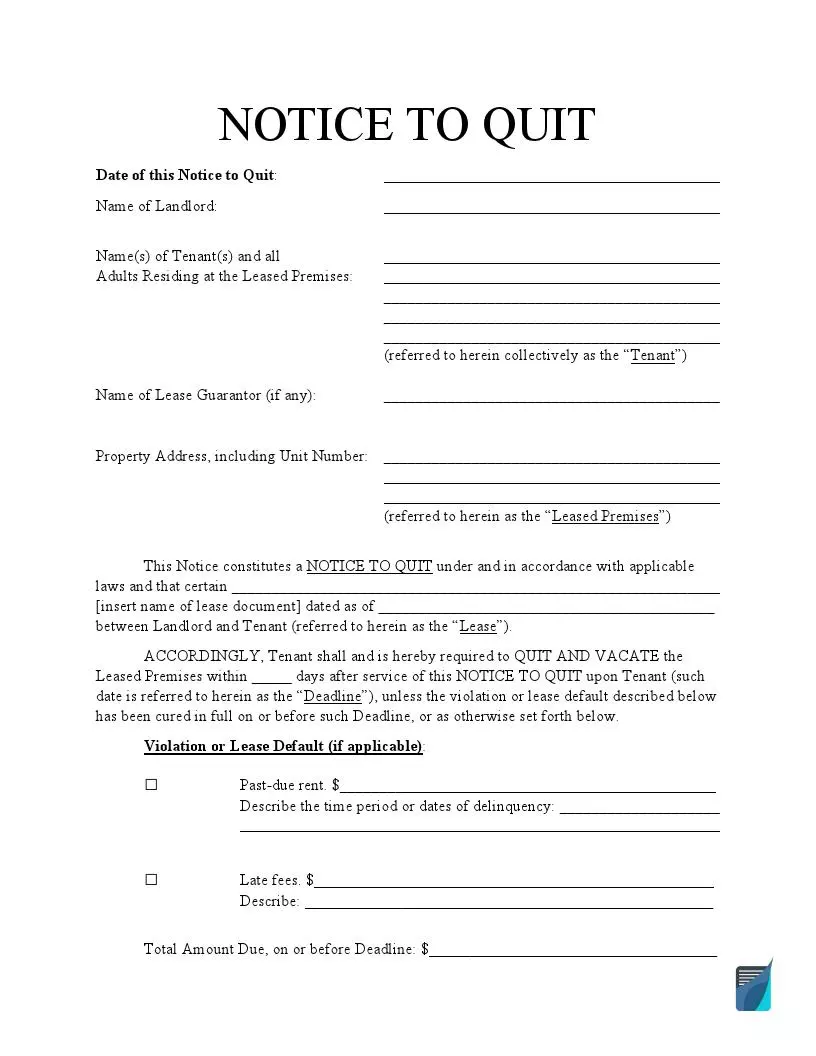
A 14-day eviction notice includes the parties, the rental, the reason and the deadline, so the tenant can see exactly what to do. The notice holds these parts:
Some states add required parts:
The 14-day eviction notice takes six parts, filled in order, with the lease agreement and payment history at hand so the names, dates and amounts match.
The reason section works best when a stranger could check every detail in it. Name the clause, the date and the amount, not a general complaint.
Example: "Tenant installed a new door lock without consent, in breach of clause 10 of the lease dated March 1. Tenant must remove the lock and return all keys by the cure date."
A 14-day notice works only once the tenant has it, and the way to hand it over depends on the rental's location. Washington sets the methods in Wash. Rev. Code § 59.12.040, starting with delivering a copy personally to the tenant or, if the tenant is absent from the premises, leaving a copy there with some person of suitable age and discretion and also sending a copy through the mail addressed to the tenant.
A notice to vacate example shows how the filled-in parts read together on one page. The sample below uses made-up names, dates and amounts.
Example only. 14-Day Notice to Pay Rent or Vacate. To: Jane Doe, tenant of 12 Oak Street, Apt 4. From: John Roe, landlord. Lease dated January 1. Reason: rent of $1,200 due on May 1 is unpaid. Pay $1,200 by May 16 or move out by that date. Signed: John Roe, May 2. Delivered by hand on May 2.
A 14-day notice with small errors becomes unclear, and an unclear notice leads to disputes. Compare the notice with the lease and the payment history before signing, and check each item below.
The end of the notice period does not let a landlord remove the tenant alone; the next step is an eviction case. In Minnesota, to bring an eviction action, the person complaining shall file a complaint with the court (Minn. Stat. § 504B.321, subd. 1).
In New York, no tenant or lawful occupant shall be removed from possession except in a special proceeding (N.Y. Real Prop. Acts. Law § 711). In Washington, it is unlawful for the landlord to remove or exclude the tenant except under a court order (RCW 59.18.290(1)).
A tenant who fixes the problem in time keeps the tenancy in some states. In South Carolina, if the tenant adequately remedies the breach before the date specified in the notice, the rental agreement may not terminate by reason of the breach (S.C. Code Ann. § 27-40-710).
Sending the notice is only the first step. In Washington, it is unlawful for the landlord to remove or exclude the tenant except under a court order (RCW 59.18.290(1)), and in New York no tenant shall be removed from possession except in a special proceeding (N.Y. Real Prop. Acts. Law § 711).
Keep these papers after you send the notice:
A 14-day notice sets its own deadline, so a tenant who receives one reads it the same day and starts gathering papers. These steps give a clear start.
A 14-day notice fits only where the rental's location uses a 14-day period for the reason at hand. Other periods use their own notice: FormsPal also offers a 3-day, 5-day, 7-day, 10-day and 60-day notice to vacate, and the full set of eviction notice templates.
A tenant who plans to move out sends a different letter, a notice of intent to vacate, to the landlord. In Alaska, the landlord or the tenant may terminate a week to week tenancy by a written notice given to the other at least 14 days before the termination date specified in the notice (Alaska Stat. § 34.03.290).
A 14-day notice to vacate sets a 14-day period, but what the tenant may do in it differs by state. In Kansas, the rental agreement ends on a date not less than 30 days after receipt of the notice, if the breach is not remedied in 14 days (Kan. Stat. Ann. § 58-2564). In Nebraska, the agreement ends not less than thirty days after receipt, if the breach is not remedied in fourteen days (Neb. Rev. Stat. § 76-1431).
In Kentucky, where the city, county or urban-county government has enacted the Uniform Residential Landlord and Tenant Act, the lease violation notice sets a date not less than fourteen (14) days after receipt, and the agreement ends if the breach is not remedied in fifteen (15) days (Ky. Rev. Stat. § 383.660). In Massachusetts, a tenant at will who has not received a similar notice within the twelve months before keeps the tenancy by paying the full rent due within ten days after receipt (Mass. Gen. Laws ch. 186, § 12).
The statutes in the table, as FormsPal's verified state data records them, do not say whether weekends count. Count from the event your state's section names, and allow extra days when unsure.
A notice to vacate is not an eviction; it is the warning before one. In Minnesota, to bring an eviction action, the person complaining shall file a complaint with the court (Minn. Stat. § 504B.321, subd. 1).
In Virginia, the landlord may terminate the rental agreement only if the tenant fails to pay rent within 14 days after written notice is served (Va. Code Ann. § 55.1-1245). Other states set their own rules on late payment.
Washington sets the wording: every 14-day notice served under RCW 59.12.030(3) must be in substantially the form in Wash. Rev. Code § 59.18.057(1). The form is titled a fourteen-day notice to pay rent or vacate the premises.
The form offers three reasons: illegal activity at the rental, a lease violation, or unpaid rent. Each reason has its own follow-up option, so pick the one that matches your situation.
General information, not legal or tax advice.
