
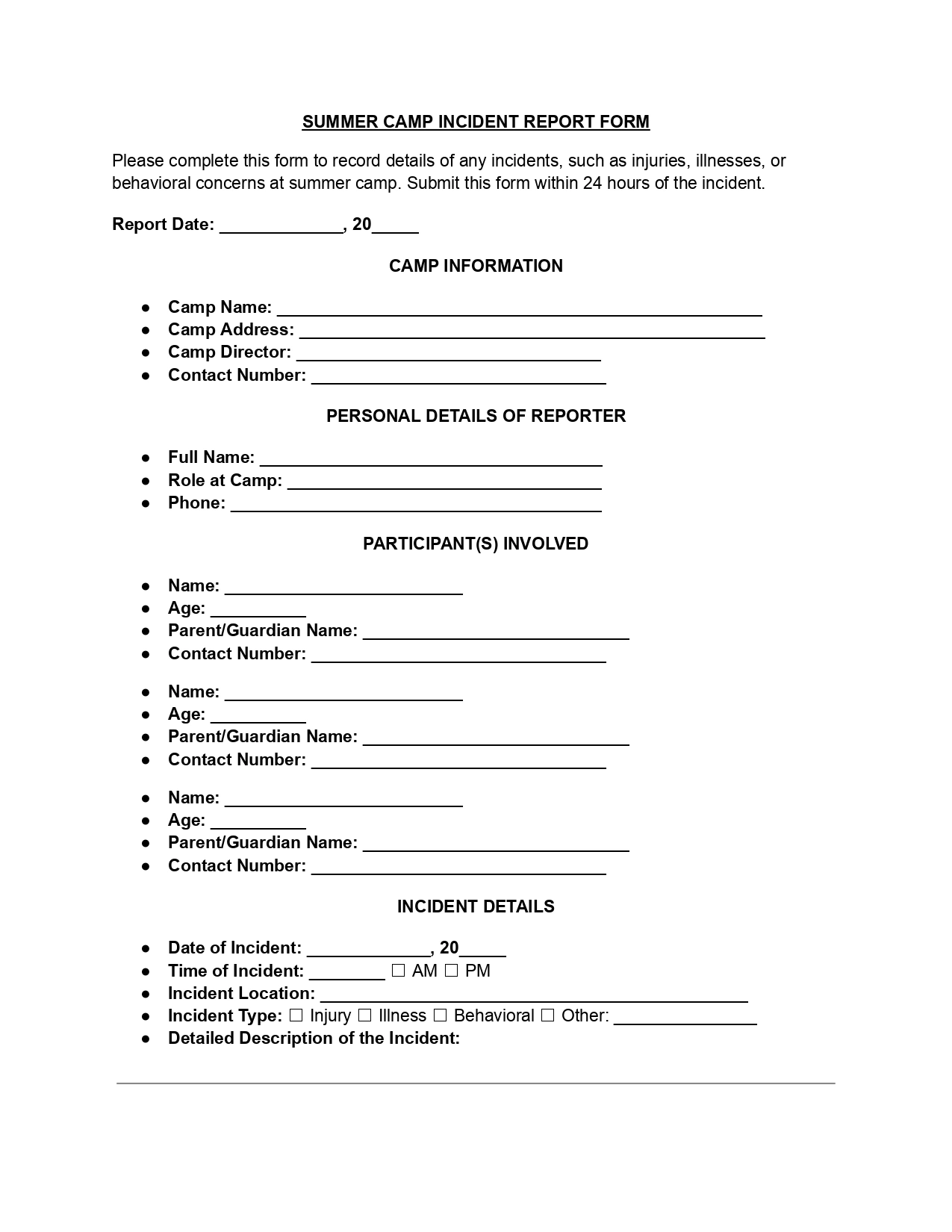
A summer camp incident report template is a document used to record any unusual or noteworthy events during camp activities. These events range from injuries, illnesses, and accidents to behavioral or safety concerns. The completed form shows what took place, when and where it occurred, who was involved, and how camp staff handled it.
At summer camps, the safety and well-being of participants are top priorities. Reporting incidents that could impact campers, staff, or the overall camp operations is crucial to upholding a safe environment. Timely and precise reporting assists in quickly addressing and avoiding future issues. Commonly reported incidents at summer camps include:
For example, reporting might cover a camper who slipped and sprained an ankle, a conflict during a game, or a camper found away from their group during an outing. Documenting these events allows camp administrators to immediately address and manage situations, enhancing safety measures and refining protocols. This diligent reporting improves the camp experience and builds a trustworthy bond with parents and guardians, reinforcing the camp’s dedication to safety.
The completed summer camp incident report is a record that helps camp administrators manage risks, improve safety protocols, and ensure appropriate responses to similar future incidents. It is also a legal record that can be important for insurance purposes or liability issues.
Staff at summer camps can efficiently complete reports with our forms, saving time and easing the workload in high-pressure scenarios. This enables them to get back to their main tasks more quickly while making sure all required information is recorded. Furthermore, a summer camp incident report template is crucial in legal claims or insurance investigations.
Filling out an incident report template takes a few minutes once you have the facts in front of you. You can type your answers into the fillable PDF with our online PDF editor, or print the template and write by hand. Work through the ten steps below in order, since they follow the sections of the form, and use plain, neutral words.
Have these details ready before you start:
Begin by entering the current date in the specified format (MM/DD/YYYY) on the form, marking the day you are documenting the incident. This can be a different day from the incident itself. You enter the incident date later, in step 5.
Input the name, address, director’s name, and a contact number for the camp, ensuring all details are accurate for any necessary follow-up. Double-check the phone number, since it is the one people will call if the camp needs to follow up.
Include your full name, your role or position at the camp, and your contact number to identify who is reporting the incident. Use your full name rather than a nickname, so anyone who reads the report later knows who wrote it.
For each participant involved in the incident, record their name, age, and the name and contact number of their parent or guardian. Add one entry for every camper involved, even a camper who was only nearby at the time.
Specify the date and time of the incident, where it occurred within the camp, and the type of incident (e.g., Injury, Illness, Behavioral, Other). If “Other” is selected, provide a specific description. Additionally, give a detailed account of what happened during the incident. Stick to facts, such as “the camper slipped on the wet dock,” and leave out guesses about the cause.
Check the box that shows whether anyone saw the incident. If someone did, add each witness’s name and phone number so the camp can reach them later.
Note whether first aid was provided and describe any other immediate actions taken following the incident. Name the person who helped, what they did, and the result, for example “counselor cleaned the cut and applied a bandage.”
State whether a medical professional was consulted and if the affected participant was taken to a hospital. If yes, include the hospital’s name. Add the time of any call to a doctor, a nurse, or an ambulance.
Mention if the police or other authorities were notified about the incident and whether a report was filed. If they were, write the name of the agency and a report number if you have one.
Conclude by signing the form to verify the accuracy of the information provided, including the date of completion and printing your name. Read the whole form once more before you sign. Then submit the original to the camp director and keep a copy for your own records.
A clear report is easy to read and easy to check. Counselors and camp staff do best when they write down the facts as soon as possible after the incident, while the details are fresh, and leave out guesses. These habits keep every report accurate and useful to the whole camp team:
Jot down a few words at the scene. Quick notes help you recall names, times, and what people said, and they make the full report faster to write. Share the finished report with the staff member who reviews camp paperwork, so the whole team has the same accurate picture of the event.
Most problems with incident reports come from rushing. A report written hours later from memory, or one that guesses at the cause, is harder for anyone else to rely on. Watch for these common mistakes when you complete a report:
The same incident report template works for every part of the camp day, but each setting has its own details worth noting. Use these prompts when you write the description, and add anything else a reader who was not there would need to picture the scene:
If the main problem was a conflict between campers instead of an injury, a behavior incident report may fit better. Whatever the setting, keep the same neutral tone and tell the story in the order it took place.
Once the form is signed, the report still has work to do. Passing it to the right person quickly helps the camp team follow up with the camper, the family, and anyone else affected, and it keeps the record safe for later.
Camp teams that read their reports together often spot patterns, such as several minor falls on the same path or repeated conflicts during the same activity. Use those patterns to improve training, supervision, and daily routines for the rest of the season.
Questions about camp incident reports tend to come up in the middle of a busy day. A quick answer helps you finish the report, get back to the campers, and leave clear records for everyone who reads them later.
It is a written record of an injury, illness, accident, or behavior issue that happens at camp. It lists who was involved, what took place, where and when, and what staff did next.
Usually the counselor or staff member who saw the incident or handled it first. A camp nurse or director can add details about medical care and follow-up.
As soon as possible after the incident, once everyone is safe and care has been given. Short notes made at the scene make the full report quicker to write.
Tell the story in order and stick to facts. Include these points:
Ask the witness to write their own account. A witness incident report form works well for that.
Read it once more, check that names and times match, then sign it. Give the original to the camp director and keep a copy for your own records.
Yes. FormsPal has many types of incident reports. Browse all of them on the incident report forms page.
General information, not legal or tax advice.

Last Updated: October 2026. This guide is reviewed and updated regularly to reflect current law. If you notice an error or outdated information, please contact us.