
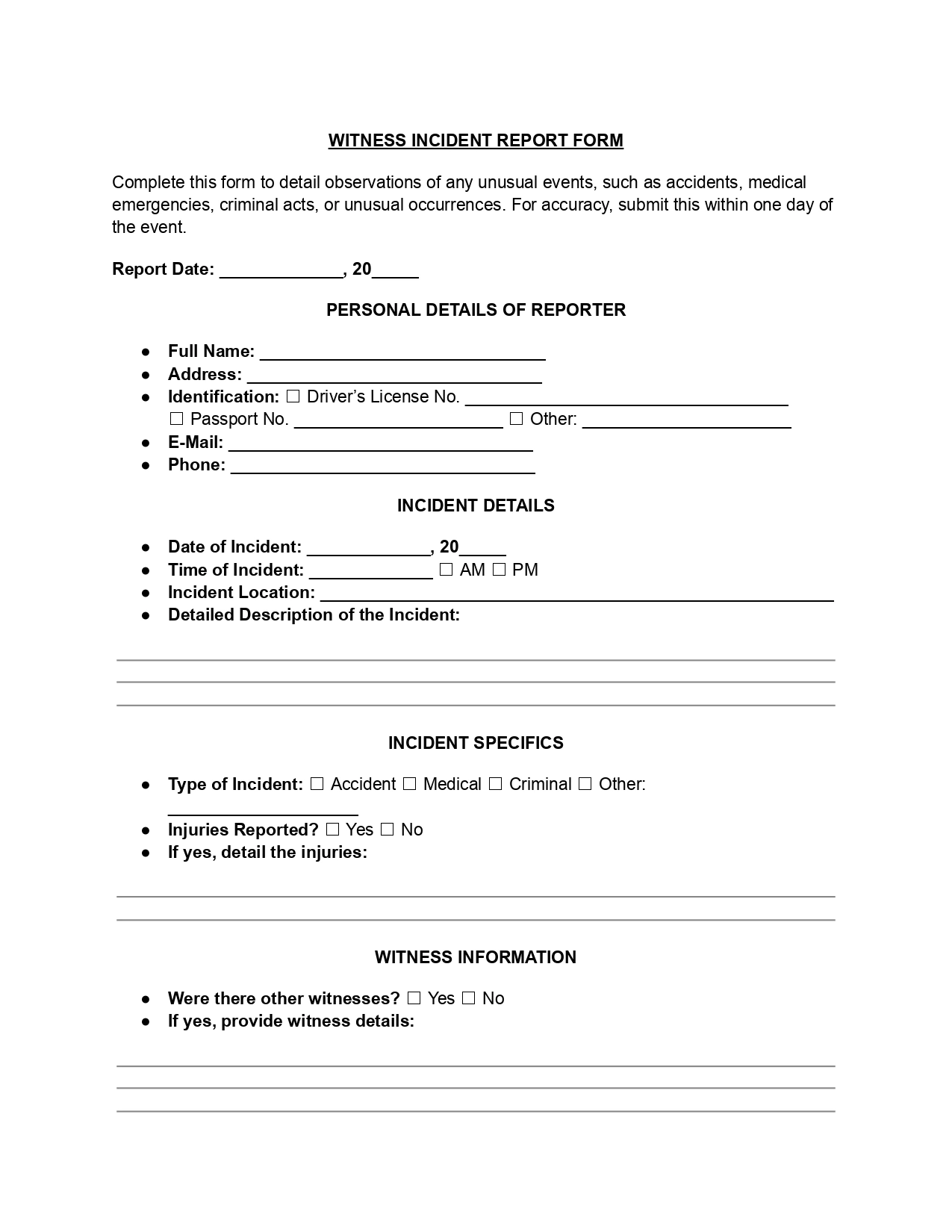
A witness incident report form is a document used to record the details of an incident from the perspective of a witness. Workplaces, schools, public places, and events use it to gather factual information from people who saw an accident, an injury, an altercation, or another unusual event. The form covers the time and place, the people involved, and the immediate actions taken, such as medical treatment.
A witness incident report should be used whenever an event may require official review or documentation for legal, safety, or administrative purposes. This type of report is essential in creating an accurate record of events from an eyewitness perspective, which can be invaluable in resolving disputes, determining liability, or enhancing safety protocols.
Situations where a witness incident report is helpful include:
In real-life scenarios, consider a situation where an employee slips on a wet floor in a warehouse. Witnesses can use the report to detail the incident, potentially highlighting the lack of visible warning signs.
Another example might be a bystander who sees a car accident. They can record their observation of the events leading up to the collision, which could be critical in determining fault in court or during insurance settlements.
A witness statement is a written account of what a person saw, heard, or experienced during an event. It is told from the witness’s own point of view and sticks to firsthand observations. Inside the form, it sits in a structured template, so the content comes out in a clear and consistent order.
A few terms come up often when you fill out the form:
People often mix up the different reports that follow an event. They overlap, but each one has its own job and its own author. Knowing the difference helps you pick the right form and write the right kind of account.
Many events call for more than one type. For example, a fall at a store may lead to a witness report from a bystander, an incident report from the manager, and photos of the spot.
Anyone who saw the accident or other event can fill out the form. That includes an employee, a customer, a student, a visitor, or a bystander. The person who wrote the account signs it, and the person or department that receives it completes the official use section.
Fill it out yourself, in your own words. Other witnesses fill out their own copies, so every account stands on its own. Employees and team members in any workplace can use the same form as customers and visitors. Managers and employers often hand the form out and collect it afterward.
A witness incident report fits many settings, from workplace accidents to events in public places. The wording of the form stays the same, but what a witness records changes from one place to the next. These examples show what people usually write down in common situations.
Employees often fill out a witness report after an incident at work. Employers can add the reports to the incident log, along with other employment and safety records, so the person reviewing the event has several viewpoints in one place. A reusable workplace template keeps every account in the same format. Common events include:
Team members who see a near miss can use the form too. Near misses and small incidents are worth logging, because they point to problems before someone gets hurt.
Teachers, staff members, and students may write down what they saw after a playground injury, a fight, or a problem on a school bus. A useful school account names:
A short, dated account helps school staff follow up with family members. The office can collect the forms in one folder.
Customers and visitors who see a fall, a spill, or a dispute can describe it while the memory is fresh. A business can keep a few printed copies at the front desk or give visitors online access to the form. Venue staff can then keep the accounts together in one file for later reporting.
Organizers, coaches, and club leaders can ask people who saw an injury or a dispute to write it down before the group leaves. Property managers can do the same after a problem in a common area, such as a hallway, a parking lot, or a laundry room.
A bystander who sees a collision or a parking lot scrape can describe each vehicle, the direction of travel, and the weather. Insurance adjusters and other reviewers may read these accounts next to photos and other evidence.
The form is designed to collect information in the order a witness would naturally tell the story. It starts with who you are, moves to what happened, and ends with the signature and the section for the person receiving the report. Here is what each part asks for:
A thoroughly recorded witness statement is beneficial for investigations and legal processes. It guarantees that all important information is correctly documented and can be trusted for future reference. Follow the eight steps below to complete our incident witness statement sample. If possible, fill in the form online, then print it for the signature.
Have these items ready before you start:
Start by entering the date you are filling out the form. This is important for record-keeping and timelines related to the incident.
Fill in your full name, address, and contact information, including your email and phone number. If applicable, provide your identification number from options such as a driver’s license, passport, or other forms of ID.
Enter the date and time the incident occurred, and mark AM or PM. Record the specific place where it happened. Then describe what you observed. Keep it a factual account that focuses on what you saw yourself.
Select the type of incident from the options provided (accident, medical, criminal, or other). If injuries were reported, check the appropriate box and detail the injuries observed.
If there were other witnesses besides yourself, indicate this by checking the appropriate box. If applicable, provide details of these additional witnesses, including their names and contact information.
Note whether law enforcement or other authorities were notified. If a formal report was filed with the police, indicate this by checking the correct box. Similarly, document if medical help was provided, where it was provided, and whether any medical treatment was refused.
After reviewing all the information you’ve entered for accuracy, sign the report and print your name. Include the date of signing.
The person or department receiving the report fills out this section. It includes the recipient’s name, the date received, and notes on any actions taken or planned in response to the incident.
You can complete the form on a computer, on a phone, or on paper. Each method works, so pick the one that is easiest where you are. Typing makes the text easy to read, while handwriting is handy when you are on site and have no device nearby.
When you finish, save the document with a clear file name, such as the day and place of the event. Keep the data somewhere you can find it later, and share it only with the people who asked for it.
A clear account is easy to follow for a reader who was not there. Write in plain words, keep to the order of events, and stick to what you saw and heard yourself. These habits help:
Most problems with a written account come from small slips, not big ones. A reader who was not there needs facts they can follow, so it helps to know which habits make an account harder to use. Watch for these:
A good account is short, specific, and in order. The sample below shows the pattern for a slip in a store, with a made-up name and an example address. Use it as a guide for structure only, and replace every detail with what you actually saw.
Sample text: On March 3 at about 2:15 PM, I was standing near the front counter at 123 Main Street. I saw Anna Baker step onto a wet patch of floor by the entrance and slip. She fell on her left side and said her wrist hurt. I did not see a warning sign near the spot. A coworker called the front office, and a staff member came to help a few minutes later.
Here is a second sample, this time for a near miss at work.
Second sample: On Tuesday at about 9:40 AM, I was working in the east warehouse aisle. I saw a pallet jack roll toward the loading door while the driver stepped away. A coworker stopped it before it reached the door. Nobody was hurt. I did not see who left the brake off.
Both samples share a few habits:
Once the form is filled in, a few quick checks finish the job, whether the event was a small accident or a serious one. Look the report over, sign it, and pass it to the person or department that asked for your account.
Looking for a different kind of report? FormsPal also has these related forms:
After a witness hands in the form, the person or department that receives it reads it with other records. These can include photos, supervisor notes, and accounts from other witnesses. Reviewers compare the accounts to see where they agree and where they differ.
The way a report is used depends on who collects it:
Over time, a set of reports can show patterns across several incidents, and employees can see that their reports led to changes. Because a clear report is easy to read and compare, the effort you put in pays off later. Reviewers can find the time, place, and sequence without asking you to explain them again.
Witnesses tend to ask the same few things before they start writing. They want to know who can fill out the form, what to include, what to leave out, and how much detail is enough. These answers cover the most common questions.
Anyone who saw the incident can fill it out. Each witness completes their own form, so every account is written in that witness’s own words.
A witness statement is one person’s account of what they saw. An incident report is the wider record of an event, and it can include several witness statements together.
Write only the part you saw, and say which part that was. For example, write “I saw the fall but not what caused it.” In any case, a partial account is still useful.
Write what you remember and leave the rest out. Do not fill gaps with guesses. If you remember more later, add a dated note.
A clear account answers the basic questions about the event. Cover these points:
Long enough to answer who, what, when, and where, and no longer. Short, specific sentences work better than long, detailed paragraphs.
Yes. Open the form with the Get Form Now button, or download the PDF and fill it in with the FormsPal PDF editor. You can also print the form and write on it by hand.
Yes. Write “I saw” and “I heard,” because first person keeps the account clearly yours and makes it easy to tell what you saw yourself.
If you took photos or drew a quick sketch, mention them in your description and attach them to the form. Label each one with your name, the day, and what it shows.
Send it to the person or group that asked for it, such as a manager, a school office, an insurer, or an event organizer. If nobody asked, keep a copy and ask who should receive the original.
Attach a separate page when the description does not fit. In that case, write your name and the date at the top, then sign it, so it stays tied to your form.
Keep opinions out of the description. Stick to what you saw and heard, and let the people reviewing the report draw their own conclusions.
General information, not legal or tax advice.

Last Updated: October 2026. This guide is reviewed and updated regularly to reflect current law. If you notice an error or outdated information, please contact us.