
Updated:
A job offer letter, or employment offer letter, is a written offer. It names the job title, start date, pay, schedule and benefits, plus the date the offer ends. An employer ready to hire its chosen candidate can build it here for free.
Below the builder you will find what to include, how to write each part, a sample letter, the common formats and what a candidate should check before signing.
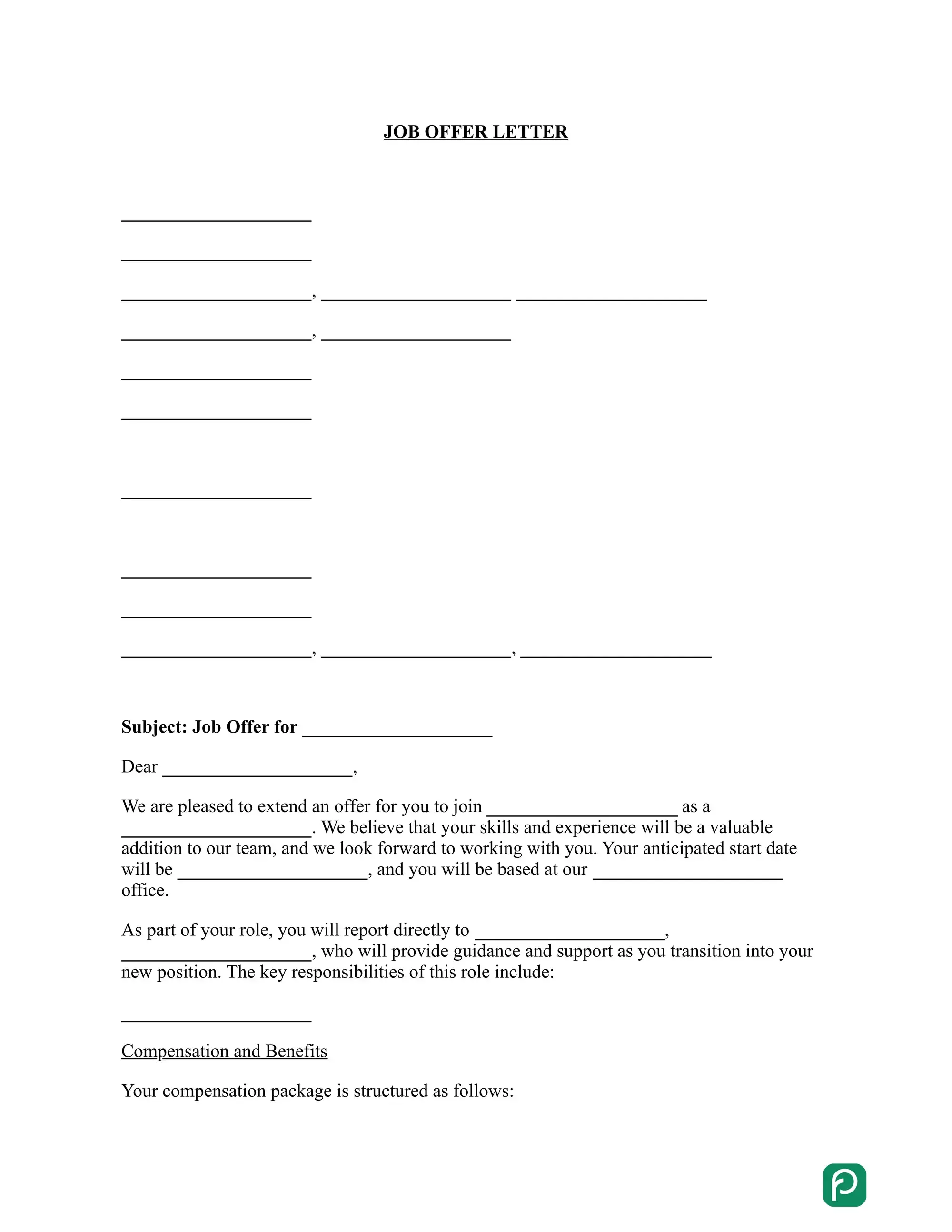
Build Your Document
Answer a few simple questions to make your document in minutes
Save and Print
Save progress and finish on any device, download and print anytime
Sign and Use
Your valid, lawyer-approved document is ready
A job offer letter is a message from an employer that offers a chosen candidate a specific job and sums up its main terms, such as the title, pay, schedule and when work begins.
Employers also call it an employment offer letter, a hiring letter or simply an offer letter. The letter comes after the final interview and before the new hire starts work. It tells the candidate the search is over, gives them the facts they need to decide, and asks for a reply by a time the employer names. A standard procedure for accepting a job offer letter is signing and returning the document to the sender.
An offer letter does these jobs for the employer and the candidate:
A good job offer letter names the company, the candidate, the job title, the schedule, when and where work starts, the supervisor, the pay, the benefits, how long the offer stays open and a place for the candidate to accept.
The table below lists each part, what to write in it and an example.
| Part of the letter | What to write | Example |
|---|---|---|
| Company name and logo | Your official company name at the top, with the logo if you have one | Northwind Coffee Co. |
| Candidate | The full name of the person you are offering the job to | Anna Baker |
| Job title | The position you are offering | Store Manager |
| Employment type and schedule | Full-time or part-time, hours per day and per week | Full-time, 40 hours a week |
| Start date and workplace | The first day of work and where the job is based | Monday, March 3, at 123 Main Street |
| Supervisor | The name and title of the person the new hire reports to | Jordan Lee, Regional Manager |
| Pay | The salary or hourly rate and how often it is paid | $48,000 a year, paid twice a month |
| Benefits and bonuses | Health insurance, bonuses, paid time off and other perks | Health insurance and a yearly bonus |
| Offer expiration | The last day the candidate can accept the offer | Please reply by Friday, February 14 |
| Signatures | A line for the candidate's signature and date, plus your own name and title | Signed: ______ Date: ______ |
Add or drop rows to match the role and your company. Candidates read the letter closely, so plain wording helps them see what they are agreeing to.
Some employers add terms that fit only certain roles or companies, such as conditions to clear before work starts, at-will wording and the role's overtime status.
How these terms work depends on where the job is located and on their exact wording. This page gives no rules for them, so ask an employment attorney before you add contingencies, at-will wording or an overtime classification.
To write a job offer letter, open with the offer, describe the job, give the pay and benefits, name any conditions, set a reply date and leave lines for both signatures.
The sample offer letter below shows how the steps above fit together in a short, finished letter for a store manager role. Replace the example details with your own.
Dear Anna Baker,
We are pleased to offer you the position of Store Manager at Northwind Coffee Co. This is a full-time role of 40 hours a week at our 123 Main Street location. Your supervisor will be Jordan Lee, Regional Manager, and your first day will be Monday, March 3.
Your pay will be $48,000 a year, paid twice a month. The position also includes health insurance and a yearly bonus.
Please sign and return this letter by Friday, February 14 to accept the offer. We look forward to working with you.
Sincerely,
Jordan Lee, Regional Manager, Northwind Coffee Co.
The tone of an offer letter can be formal or warm, as long as the terms stay clear and a single tone runs through the whole letter. Compare these openings:
Formal: "We are pleased to offer you the position of [Job Title] at our company. Please take time to read this letter, which holds the essential details of your employment."
Warm: "You were our first choice for this role. Your skills, your experience and the way you approached the interviews made the decision easy."
Employers send a job offer in a few common formats: a formal letter, an email offer with the letter attached, or a short warm-up email before the formal offer.
Pick the format that matches how you usually talk to new hires, then use the same layout for every offer so each letter looks consistent.
A formal offer letter suits larger companies and senior roles, where the candidate expects a signed letter on company letterhead. Print it on letterhead or export it as a PDF, address it to the candidate by name and have the hiring manager sign it. The tone is polite and the layout is simple, with one idea per paragraph.
An email offer is a shorter, friendlier job offer sent as an email message, with the full letter attached for the candidate to sign. Put the role, the start date and the pay in the message itself. Small teams and startups often prefer this style because it feels personal.
A warm-up email tells the candidate they are the best fit and invites them to talk through the package before the formal letter goes out. It is shorter than an offer letter and names a time to meet the hiring manager. Use it when you are nearly ready to make an offer but want to agree on the details first.
For an hourly role, name the hourly rate, the expected hours each week and how schedules are shared. For a salaried role, name the yearly salary, the pay frequency and any bonus plan. In both cases, say who the new hire reports to and where the work takes place.
A job offer letter and an employment contract are different documents: the letter offers the job and sums up its main terms, while the contract sets out the terms of the work in full detail.
| Point | Job offer letter | Employment contract |
|---|---|---|
| Purpose | Offers the job to the chosen candidate | Sets out the duties and terms of the job in full |
| Content | Title, pay, schedule, start date, benefits, reply date | Duties, length of employment, ending the job, confidentiality and other clauses |
| Length | Short, focused on the key terms | Longer, with detailed clauses |
| Timing | Sent first, after the final interview | Usually signed after the candidate signs the offer letter |
Some employers use both documents for a hire. If you need a contract as well, you can find a contract among our employment forms.
Before you send an offer letter, check every name, figure and date against what you discussed in the interviews, and call the candidate to share the news first.
A final check of the offer letter catches the small errors that confuse a new hire, so confirm each point below:
Most employers who send offers by email follow a few simple habits that get the letter read and answered quickly:
A candidate who gets an offer letter should read it from start to finish, compare each term with what was said in the interviews and ask about anything unclear before signing.
An offer letter means the employer has chosen you, but the job is settled only once you accept and clear any conditions the letter lists, such as a background check. Until then, it is wise to keep other applications open.
Red flags in a job offer are terms that are missing, vague or different from what you were told during the hiring process. Watch for these signs:
Pause before you accept a job offer when the written terms differ from what you agreed, when key details are missing, or when the role does not fit your goals. Ask the employer to correct or add the terms in an updated letter, and sign only the version that matches the offer you want.
To turn down a job offer and keep the door open, reply promptly, thank the employer, decline in a single clear sentence and say you would like to stay in touch. A short note is enough:
"Thank you for offering me the Store Manager role. After careful thought, I have decided to decline. I enjoyed meeting the team and would be glad to stay in touch about future openings."
After you send an offer letter, the candidate either asks for changes, accepts or declines, and each answer calls for a quick, written reply from you.
Some applicants reply with questions or ask for a higher salary or a different start date. Listen to the request and decide what you can change. If you agree on new terms, send an updated letter so both sides have the final offer in writing.
A signed offer letter is the start of onboarding, not the end of the hiring process. A warm welcome in the first days helps the new hire feel confident about the choice they made. Follow this order:
Whether an offer letter is legally binding depends on its wording and on where the job is, so no single answer fits every letter. Some employers add a short disclaimer saying the letter is for information only and is not a contract. An employment attorney can check the wording before you send it.
Employers do withdraw offers, for instance when the candidate does not clear a condition such as a background check. Whether a withdrawal is allowed in a given case depends on the letter's terms and on where the job is, so get advice from an employment attorney before you withdraw an offer.
Most job offer letters fit on one page. Keep the key terms short and clear, and share longer details, such as the full benefits plan, in a separate document.
Yes. Many employers attach the letter as a PDF to a short email. Ask the candidate to sign it and send it back the same way, then keep both copies.
Give the candidate enough time to read the letter, ask questions and weigh the offer, and print the exact reply date in the letter. A clear date keeps both sides on the same timeline.
Yes, a hiring letter is another name for an offer letter: both offer a chosen candidate the job and sum up its terms. The template on this page works for either name, since the content of the letter is the same.
You can create a free employment offer letter with the template at the top of this page. Answer the builder's questions about the role, pay and start date, then save, print and sign the finished letter.
General information, not legal or tax advice.
