
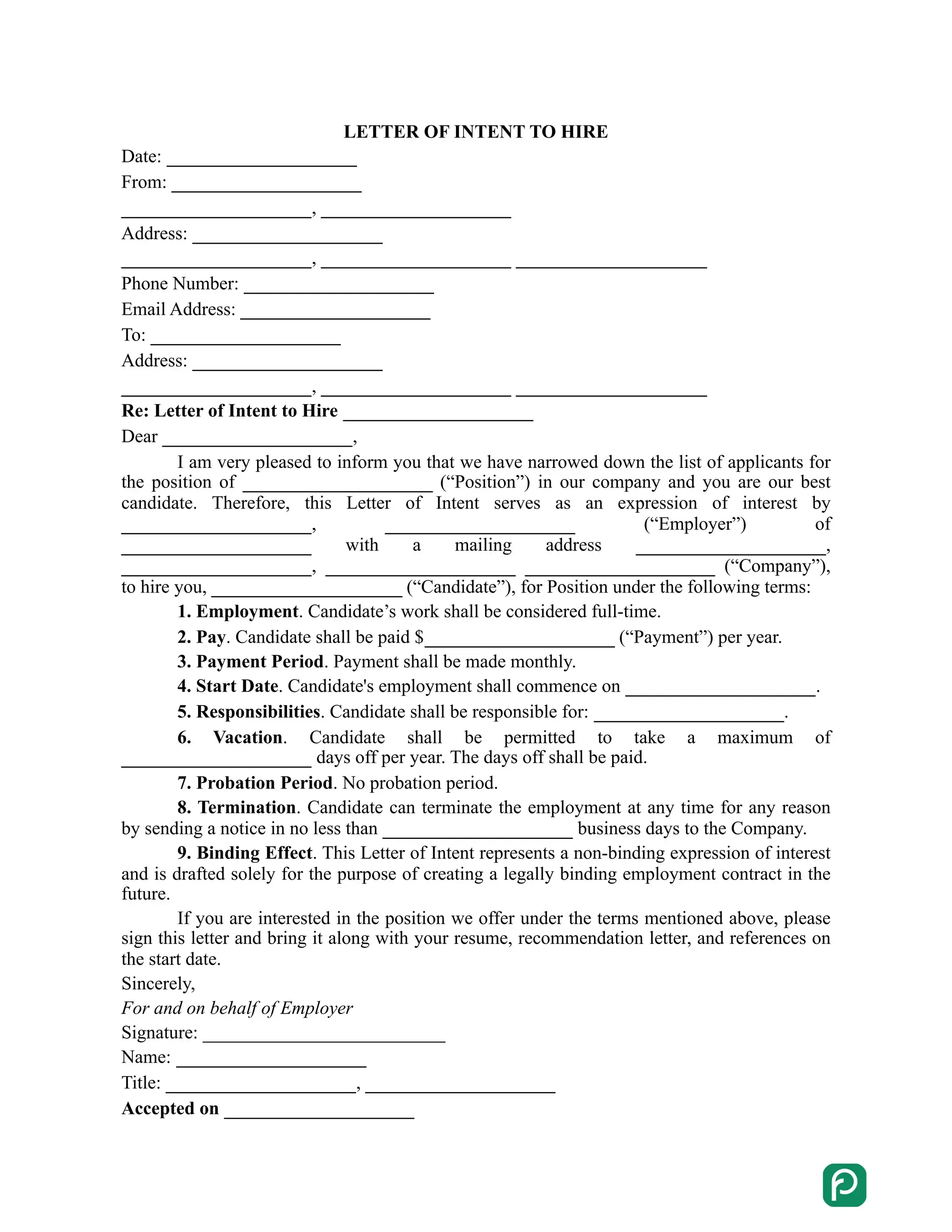
A letter of intent to hire is a letter an employer sends to a job candidate to show that the company wants to hire them. It lists the main details of the position, such as the responsibilities, pay, and terms of employment. This form is considered non-binding as it states only basic terms of the future work contract.
Last Updated: October 2026. This guide is reviewed and updated regularly to reflect current law. If you notice an error or outdated information, please contact us.
Build Your Document
Answer a few simple questions to make your document in minutes
Save and Print
Save progress and finish on any device, download and print anytime
Sign and Use
Your valid, lawyer-approved document is ready
A candidate may apply to several companies at once. When an employer likes an application, a letter of intent to hire is a formal way to show that interest. The candidate’s reply tells the employer whether they still want the job or have already found one somewhere else.
Our free letter of intent for a job has a simple goal. It tells the candidate they can stop their active job search if the conditions offered suit them.
The letter also helps the candidate. It shows what the company expects next. If it asks the candidate to come to an interview or send certain documents, doing so shows that they are still interested in the position.
A letter of intent to hire describes:
Use the steps below to build your letter, or let the online form above guide you through each part. You can write it as a standard business letter with an opening, main body, and closing. You can also split it into separate sections for each condition of the employment.
Employers send this letter once the interviews are complete and the hiring team has selected a favorite. It tells the candidate that the job is theirs to accept, and it gives both sides time to discuss the details before the first day.
The letter suits many kinds of roles and companies:
Sending the letter early shows the candidate that the company is serious about the position. It also gives the hiring manager a chance to discuss the schedule, the pay, and the first-week plan in one place. Candidates tend to appreciate having every detail in writing while they consider the opportunity.
Collect the information first, and the letter takes only about 15 minutes to write. Keep these items within reach when you open the template, because each one appears somewhere in the finished letter and the candidate will read all of them carefully.
If the job posting listed hours, benefits, or a trial period, carry the same wording into the letter. A candidate who reads the same terms in the posting and in the letter feels more confident about the job. Expectations for the first weeks, such as training sessions or a first project, also fit well in the letter when you want to discuss them early.
Write the draft in Microsoft Word or Google Docs, and then save the finished version as a PDF document for distribution. Send it from your company email address, such as Gmail or Outlook, and attach the PDF to a short, professional message.
The same letter can be adapted to fit the job. These short examples show how the key lines change from one role to another. Copy the style that matches your position and replace the details with your own. A typical letter runs between 250 and 350 words.
Each example names the company, the role, and the start date in the first sentence. That opening gives the candidate the key facts at a glance, and the rest of the letter can add the pay, the schedule, and the expectations.
A good hire letter is short, polite, and easy to scan. Explain each key term in plain words, so the candidate knows exactly what is on offer. Use the tips below to polish your draft before it goes out.
You can also start from a hire letter template and fill in the details. The online form at the top of this page builds one for you in a few minutes.
The tone of the letter sets the mood for the whole working relationship. Write the way you speak to a valued colleague: warm, direct, and clear. Concise sentences and familiar vocabulary help the candidate read the letter quickly and understand every important point.
Begin with good news. Say that you are glad to extend the offer, then move on to the details. Describe the role in straightforward language, and avoid industry terminology that a new employee may not recognize yet. When you list the duties, pick action words such as manage, prepare, support, and lead, so the candidate can picture the daily work.
Close the letter with a friendly note. Thank the candidate for their time, say that you look forward to hearing back, and give a contact name and phone number for questions. A positive ending leaves a favorable impression, even when the candidate needs several days to respond.
Small slips can make a hire letter confusing for the candidate. Most of them are easy to catch with a quick read-through before the letter goes out. Watch for these common ones.
This sample shows how the steps above come together in one letter. The names, addresses, and numbers are made up, so replace them with your own details. Keep the terms that fit your job offer and remove the rest.
To: Irvin Jones
8058 East Clinton Drive
Mesquite, TX 75149
April 4, 2021
From: Tony McLaren
Human Resources Manager
Mega Money Company
991 Woodsman St.
Edinburg, TX 78539
RE: Letter of intent to hire
Dear Mr. Jones,
I am very pleased to inform you that we have narrowed down the list of applicants for the position of Sales Manager in our company and you are our best candidate. Therefore, I am informing you about our intention to hire you for this position under the following terms:
Yours sincerely,
Tony McLaren
Many employers send the letter as an email attachment. A short cover email keeps the message friendly and tells the candidate what to do next. Here is a sample you can adapt to your own role, company name, and contact details.
Subject: Next steps for the Sales Manager position
Hello Irvin,
Thank you for your time during the interview process. We were impressed by your experience and would like to welcome you to Mega Money Company as our Sales Manager.
Please find the letter of intent to hire attached. It lists the pay, starting date, and responsibilities for the role. Review each term and let me know if you have any questions.
If you are happy with the terms, sign the letter and reply to this email to confirm your interest. We will then share the details for your first day.
Best regards,
Tony McLaren
Human Resources Manager
Mega Money Company
Once the letter is out, the next move belongs to the candidate. They review the terms, ask questions if anything is unclear, and reply to the company. The employer then knows whether to move ahead with the hire or look at other applicants.
The reply is an important step in the hiring process, because it confirms that the candidate wants the opportunity. A candidate who accepts:
The company can keep the signed letter in the candidate’s file and tell the team about the new start date. Some employers also send a welcome message before the starting date.
The letter names the position and its responsibilities, the pay and how often it is paid, whether the job is full-time or part-time, and the start date. It can also cover time off and any probation period.
One page keeps the letter easy to read. Focus on the key terms of the offer and leave out extra background.
A representative of the company signs the letter and adds a printed name. The candidate signs it too, with a printed name, once they receive it.
Read each term and compare it with what you discussed in the interview. Then reply to the company to say whether you are still interested. If the letter asks you to attend an interview or send documents, take care of those as well.
Yes. Many employers attach a PDF of the letter to a short cover email, like the sample above. Request that the candidate sign the document and return it by reply.
Keep it short and specific, so the candidate knows what the message is about before opening it. Two good examples:
Invite them to reply or call. A brief conversation helps clarify any uncertain point and demonstrates that the company values open communication. If the wording changes after the talk, send a new copy of the letter so both sides keep the same version.
General information, not legal or tax advice.
