
A maternity leave letter of intent is a letter that a worker sends to an employer to ask for time off work to care for their newborn or adopted baby. This type of letter of intent for a job written by a father-to-be is referred to as a paternity leave letter. A clear, friendly letter helps your manager understand your plans and arrange cover for your work.
Last Updated: October 2026. This guide is reviewed and updated regularly to reflect current law. If you notice an error or outdated information, please contact us.
Build Your Document
Answer a few simple questions to make your document in minutes
Save and Print
Save progress and finish on any device, download and print anytime
Sign and Use
Your valid, lawyer-approved document is ready
The USA law, namely the Family and Medical Leave Act of 1993, gives both fathers and mothers who qualify under federal and state codes an ability to spend up to 12 unpaid weeks off to care for a newborn or adopted baby. The law gives them the guarantee of having their job back when the maternity or paternity leave ends. Some states also offer partially-paid maternity leaves.
The federal requirement is that to seek maternity or paternity leave, a worker should have worked at their company for at least a year, and the organization should have no less than 50 employees.
A letter of intent for maternity or paternity leave should be written carefully. It should convince the employer that the worker is aware of the company’s policies as well as state and federal laws on time off due to maternity and paternity. It especially concerns future fathers as they typically have less leave time when compared to mothers. Here are some tips to follow:
A little preparation makes your maternity leave letter faster to write and easier to read. Collect the items below before you open the template, so you can fill in every bracket in one sitting.
Follow these six steps to build your maternity leave letter from top to bottom. Each one covers a single part of the page, from your name to your signature. Replace the text in brackets with your own information.
Add your name and the date
Start with your name and address in the top left corner of the page. Add your contact information, then write the date of the letter.
Add your employer’s details
Add the same information for your employer, such as the recipient’s name, job title and business address. The free letter of intent template uses the same layout.
Write the opening
State the purpose of the letter in the first sentence. For instance, you might say: “I am writing to inform you that I am pregnant and plan to take maternity leave.”
For paternity leave, you can open with: “I am happy to inform you that my wife, [wife’s name], and I will be parents of a new baby girl, so I am requesting paternity leave.”
Write the main body, first paragraph
Next, the employee should tell the approximate dates of their maternity or paternity leave. It should be based on the estimations of the physician, and according to the law, a worker can get 12 unpaid weeks off work from this date.
The letter might say: “My physician has estimated that the baby is due around [approximate date of birth]. I would like to keep working until [start of the maternity leave period]. I intend to take 12 weeks off. If there are no medical complications, I would like to return to my current position as Java Developer.”
A father-to-be might write: “My wife has been experiencing some minor complications and has been unwell for the past few days. We do not have family support at the moment, so I would like to stay with her until the due date and for the next few weeks after delivery. Therefore, I request paternity leave from [start date] to [end date].”
Write the main body, second paragraph
Explain how your work will be covered. If possible, ask a colleague to take over your duties while you are away. The letter might state: “I have approached [name of the colleague] to take care of my most important tasks. [He or she] agreed to take over my duties before I come back.”
Write the closing
Say how your employer can reach you with questions, by email or by phone. You can also ask for the list of forms or any other information you need to formalize your leave.
Thank your employer for letting you take time off to care for your baby. Finish with your name and signature.
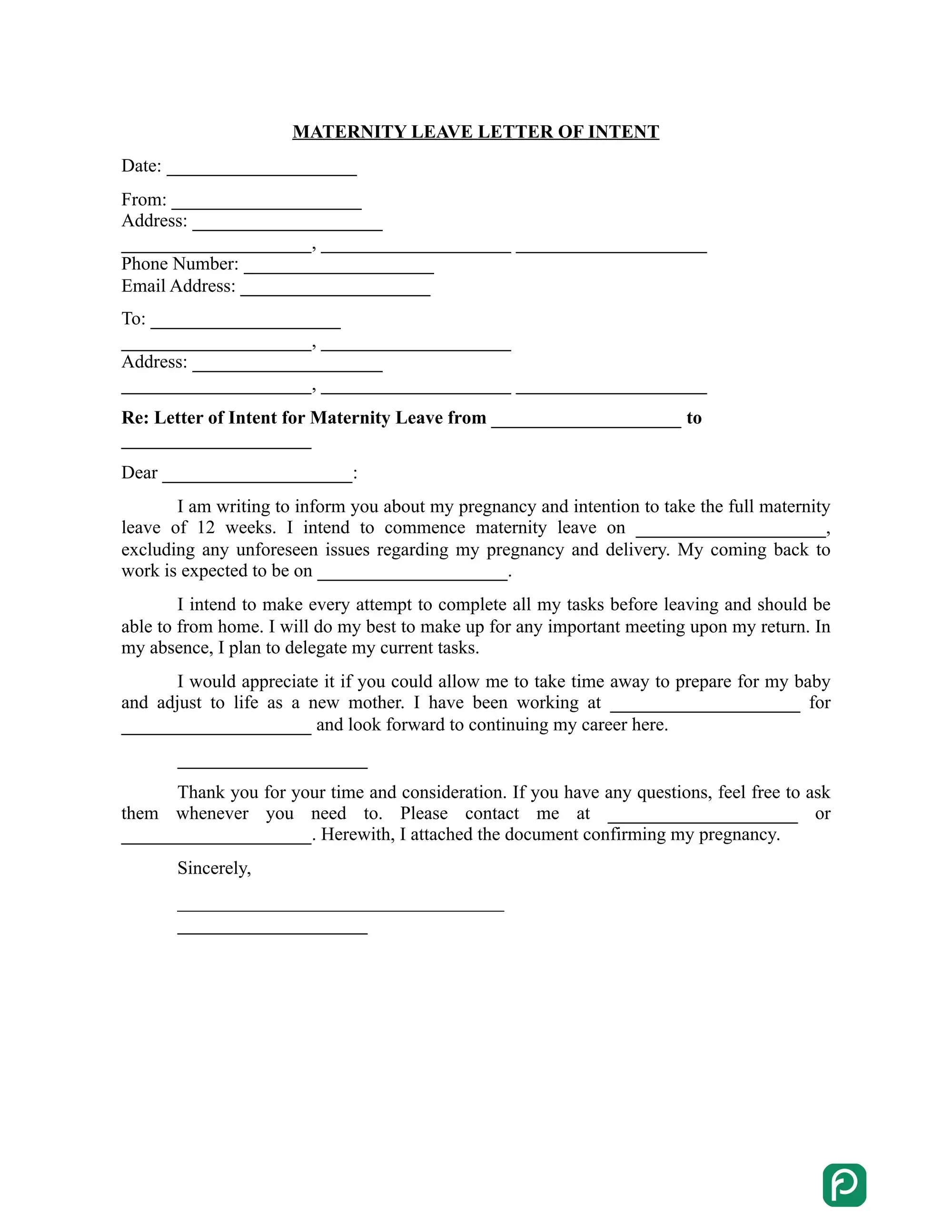
Use this sample maternity leave letter as a model for your own. The names, dates and business names are made up, so replace them with yours. Keep your own version short, polite and specific.
From: Anna Baker
123 Main Street
Plano, TX 75025
Phone number: (555) 010-0123
Email: anna.baker@example.com
April 4, 2027
To: Melissa Jones
Head of the Marketing Department
Acme Corp.
456 Oak Avenue
Houston, TX 77001
Dear Ms. Jones,
I am writing to inform you about my pregnancy and my intention to take the full maternity leave of 12 weeks. I plan to start my leave on April 25, unless there are unforeseen issues with my pregnancy or delivery. I expect to return to work on July 18.
I will make every effort to complete my tasks before I leave. I can also oversee my current project, the Lakeside marketing strategy, from home. I will catch up on any important meetings when I return.
While I am away, I plan to hand my current tasks to Peter, my marketing assistant, who knows the goals of the project well. He can answer any questions about the project during my time off.
I would appreciate your support as I prepare for my baby and adjust to life as a new mother. I have worked at Acme Corp. for three years and look forward to continuing my career here.
My email address and phone number are at the top of this letter if you need to reach me for any reason. I have attached the document confirming my pregnancy. Thank you in advance.
Sincerely,
Anna Baker
Before you send your own letter, run through this quick check:
Sending the letter is the start of the conversation, not the end. A short follow-up ensures your dates are confirmed in writing and keeps everyone on the same page. Planning ahead also lowers stress for you and your team.
It is a short letter that tells your employer you plan to take time off to care for a newborn or adopted baby. It states your planned start and return dates and explains how your work will be covered.
Send it to your direct manager and copy your HR representative. Check your employee handbook or ask HR for the preferred way to submit it, such as email or an online portal.
Yes. Change the opening to say you are requesting paternity leave and adjust the dates. The rest of the letter, including the handover plan and closing, works the same way.
Reply in writing and stay open to a conversation. You can suggest options such as a flexible schedule or remote work, and you should keep a copy of the final dates you agree on.
General information, not legal or tax advice.
