
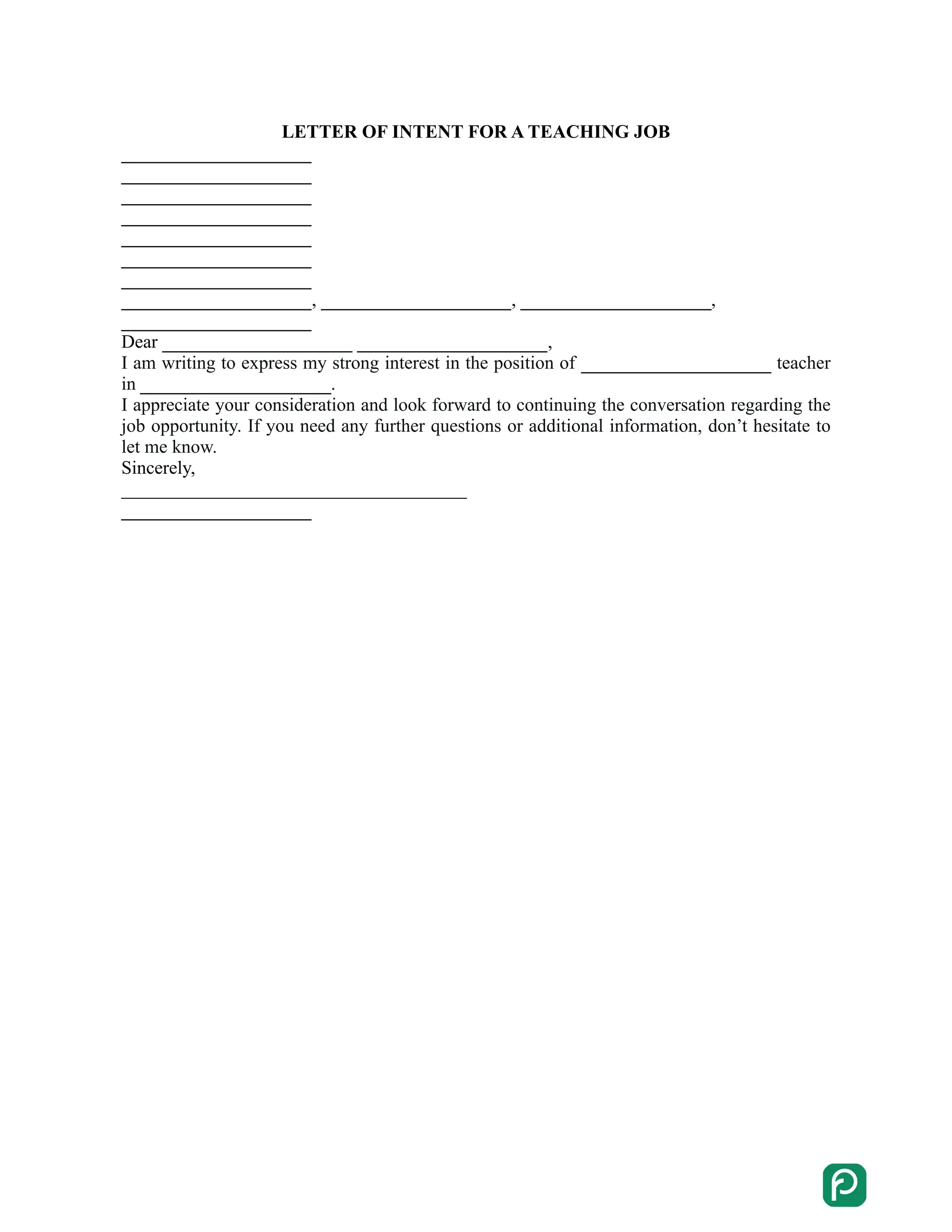
A letter of intent for a teaching job is a short letter that tells a school why you want to teach there and why you are a strong candidate. It works like a cover letter for the education field. Build yours online with the template below, or read the steps and the sample letter first. For other careers, see our job letter of intent guide.
Last Updated: October 2026. This guide is reviewed and updated regularly to reflect current law. If you notice an error or outdated information, please contact us.
Build Your Document
Answer a few simple questions to make your document in minutes
Save and Print
Save progress and finish on any device, download and print anytime
Sign and Use
Your valid, lawyer-approved document is ready
A teaching letter of intent, or LOI, tells a school that you want to work there and explains why. You add it to your job application to show your enthusiasm and how well you would fit the school. It gives you room to speak in your own voice.
A LOI for a teaching job might be one of the requirements of a teaching position, but an applicant might decide to send it even when it is not required in order to accompany their resume and provide some insights into their personality and passion for teaching.
If you want to work at a specific school, the letter lets you explain why you want to join that school. Point to your key accomplishments and experiences to show how you would fit in.
The two letters look alike, and many teachers write both. They differ in focus. A cover letter answers one job posting and lists the qualifications that match it. A letter of intent shows your interest in the school itself, so it also works when no opening is advertised.
A strong letter gives the school a clear picture of who you are as a teacher. Work through the five steps below from top to bottom. Each step covers one part of your draft, from the opening to the closing.
Opening. In the top left corner of the letter, write your name, phone number and email address. Then add the date.
Also find the name of the person you are addressing. Usually, it is the principal of the school, not a general hiring manager. School administrators are usually listed by name, so check the school’s website.
Next, open the letter with a brief presentation of yourself and the type of teaching work you are interested in. This small section should be used to explain why you consider yourself a good fit for the position based on the aspects of your personality and your background.
Educational background. The next thing to include in a free fillable letter of intent template is the educational background that links you with the position you are applying to. Keep it to a brief summary of your resume.
This is also a good chance to mention any distinctions or honors from your studies. Add a line on how your interest in educating people began.
Work experience. Add any previous work experience that relates to the job. If you have no teaching experience yet, outline the background that prepared you for teaching work, such as tutoring, coaching or volunteering.
This is the section to include achievements at previous work that made you most proud of yourself.
Your teaching style. Apart from your educational and work background, describe what kind of teacher you are. Share your unique ideas on how to teach students. If you follow a specific style that schools like this one look for, say so.
Tell how you developed your teaching vision. Maybe one of your students helped shape your way of teaching, and that story makes the letter memorable.
Add some of your most important personal traits. It might be patience, excellent communication skills, or skills gained at specific training to teach students with learning and mental disabilities.
Closing. In the last section of the letter, thank your readers for taking time to consider your letter of intent.
Here, you might mention that you look forward to an in-person interview. Say how you plan to follow up, such as a phone call or an email to the hiring manager.
As the final sentence, say briefly how your qualifications make you a good fit for the role. Try to make this part of the letter memorable for the readers.
Use this checklist to make sure your draft covers the basics before you send your job application. A reader who skims the letter should still find your name, the role you want and the reasons you are a good fit.
Keep each item to a sentence or two. One page is easy for a busy principal to read, and it leaves them wanting to know more about you.
Good teaching letters are warm, specific and short. These five tips help you move from a blank page to a finished draft, whether you are a new graduate or a teacher with years in the classroom.
A clean layout helps a busy principal read your letter in a minute or two. Use a standard business letter format, a readable font and short paragraphs. Save the file as a PDF so the layout looks the same on any device, then choose how to send it.
The first sentence sets the tone for the whole letter. Name the subject you teach, the school and one reason you care about the work. The made-up examples below show three ways to start, and you can adapt each pattern to your own subject and grade level.
Each line names a subject, a school and a clear reason for interest. Keep the rest of the paragraph just as focused.
Small slips can distract a reader from your strengths, even when the rest of the letter is strong. Check your draft for these four before you send it, and fix any that you find.
The sample below shows how the five steps fit together in one page. Lola Greenfield is a made-up History teacher who applies to a high school in Texas. Use it as a model, then swap in your own details, subjects and achievements.
From: Lola Greenfield
17 Mill Pond Rd.
Keller, TX 76248
Email: lola.g@gmail.com
Phone number: +13334445551
April 4, 2021
To: Tony Frederic Franco
Principal of Texas City High School
Texas City, Texas
Dear Mr. Franco,
I have been a History teacher for more than five years, and my dedication to the educator’s job has only been developing every year. Currently, the educational field has its obvious complexities. But they all take the back seat when I get this overwhelming feeling of seeing students who didn’t first show their interest in the subject start asking for in-depth information on the events after classes!
I have dedicated my career to teaching students of all levels the history of their country and the entire world. With the goal of helping them broaden their minds and pass state-mandated testing well, I would love to continue this path with Texas City High School.
In my current position, I teach US and World History to students in grades 9 through 12. Over my five years of teaching, I’ve made it a point to stay up-to-date on the most current pedagogy and teaching methods. I have also been utilizing creative and engaging techniques that would appeal to my students.
For example, to enhance the education methods and maximize students’ engagement, I carry out monthly surveys among them. I’ve also presented on curriculum planning at the National Federation of Teachers Conference and would gladly share my enthusiasm and expertise with your school.
Knowing Texas City High School’s strong reputation for putting students first, I would love to continue my career as a teacher with your school. If you have any additional questions or need any additional information from me, please contact me at my email or phone number placed at the top-left corner of this letter. Again, thank you for taking your time, and I look forward to hearing more about this teaching opportunity.
Sincerely,
Lola Greenfield
It is a short letter that tells a school why you want to teach there and what you bring to the classroom. You can send it with your resume or on its own.
No. A cover letter answers a specific job posting. A letter of intent shows your interest in the school and explains why you are a good fit.
Keep it to one page, in three or four short paragraphs. Brief letters are easier to read and easier to remember.
Yes. Name the subject and grade levels you teach, and ask the school to keep your details in mind for future openings.
Select Create My Document at the top of this page and answer a few questions to build your letter online. The sample above shows what a finished letter looks like.
General information, not legal or tax advice.
