
Updated:
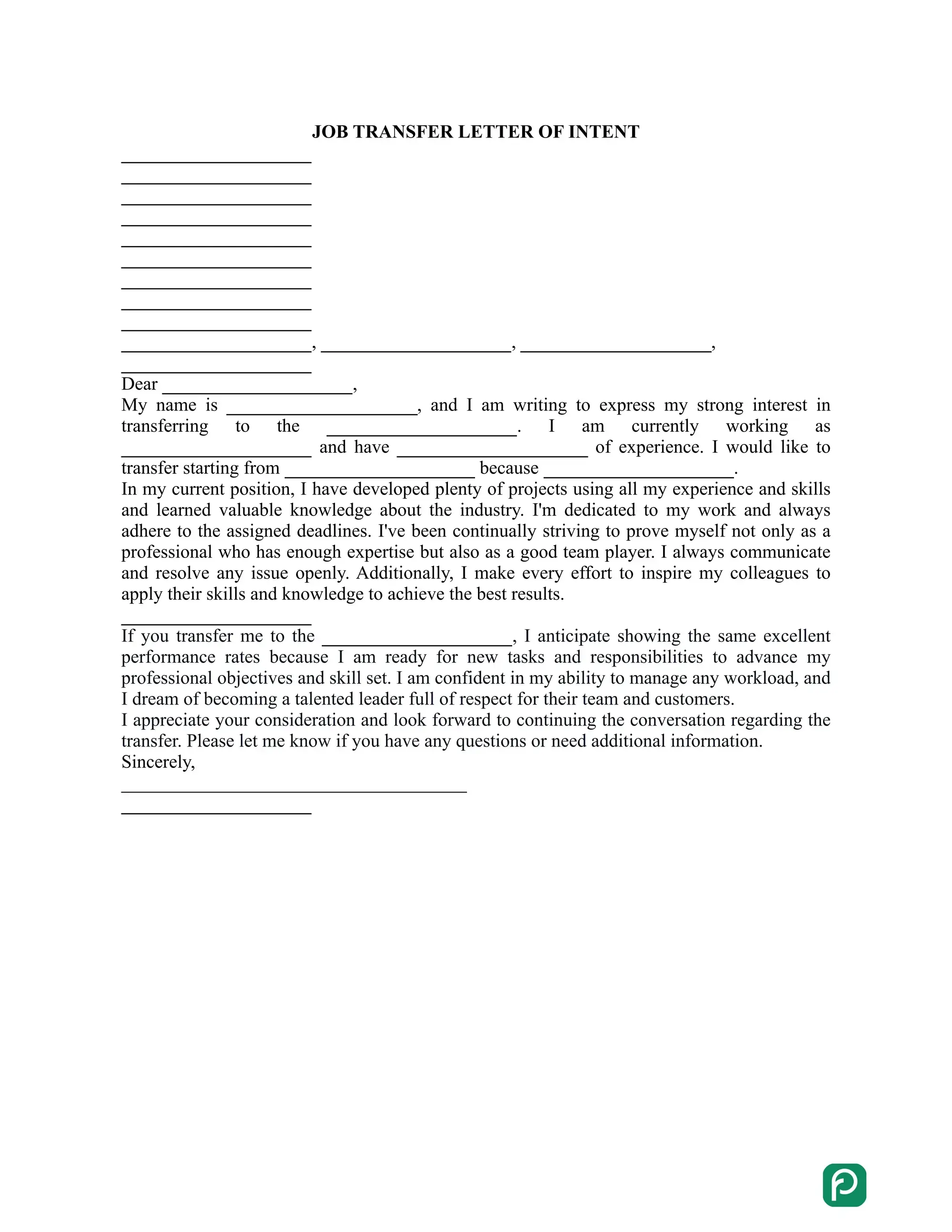
A job transfer letter of intent is a formal internal transfer request. The letter names the department or office the employee wants, the reason and the benefit to the company. Employees use it to seek a new role or city with the same employer.
This guide covers each part of the letter, the steps to write and send it, good reasons to give and a sample. For other kinds of letters, see the letter of intent for a job and the main letter of intent page.
Key facts
Build Your Document
Answer a few simple questions to make your document in minutes
Save and Print
Save progress and finish on any device, download and print anytime
Sign and Use
Your valid, lawyer-approved document is ready
A job transfer letter of intent is written from top to bottom in five parts: the header, the request, the reason, the benefit to the company and a polite close with your signature. The steps below follow that order, one action each.
A job transfer letter includes the standard parts of a business letter plus five transfer details that let a manager decide. The standard parts are the sender, the recipient, the date, a subject line, a greeting, a closing and a signature. The transfer details each have a section below.
The letter names the exact department, team, branch or job title the employee wants. A posted opening is best named by its title or reference number from the internal listing. A vague request such as "any role in sales" gives the manager nothing to act on.
The reason tells the manager why the move matters now. It can be about career growth, such as new skills or more responsibility, or about life outside work, such as a family move. One honest, specific reason reads better than several general ones.
The benefit section turns a personal request into a business case. It links the employee's skills and results to the needs of the new team, or shows that the move keeps an experienced person in the company. Managers approve transfers more readily when they see what the company gains.
The start date gives the request a clear timeline. The letter can propose a specific date, such as the start of a new quarter or a school year, or a flexible window. A flexible date shows the employee understands the current team's needs.
The handover plan shows how current work will be covered after the move. It can offer to finish an open project, document daily tasks or train a colleague. This part answers the first worry a current manager has about losing a team member.
Good reasons for a job transfer are career growth, a better fit for your skills and a change in your personal life, each stated plainly. The table matches the type of transfer to a typical reason and to what the letter highlights.
| Type of transfer | Typical reason | What to highlight |
|---|---|---|
| Another department | You want to build new skills and take on more responsibility. | Your results so far, the knowledge you have gained and how your skills fit the new role. |
| Another office or location | Your family is moving, or the commute to your current site is no longer realistic. | Your steady work history, a plan for a smooth handover and your wish to keep performing well. |
| New department and new location | An open role in a branch in another city fits your goals. | Your readiness for the role, a flexible start date and the value you add to the new team. |
| Same department, new team or shift | A different schedule or project area suits your skills or family needs. | Your reliability, the skills the other team uses and your plan to keep your current duties covered. |
The reason in the letter is one or two sentences that are true, specific and tied to work where possible. Two examples of wording follow.
A reason never needs private detail. "A family move" is enough; the letter does not have to explain a health matter or a partner's new job.
A persuasive transfer request looks at the move from the employer's side: what you bring, why the timing works and how the company gains. Three habits help.
A job transfer letter is weakened most by a demanding tone and a missing business case. Read the draft once more with a manager's eyes and check it against this list.
This sample job transfer letter shows an employee asking to move to a branch in another city so their children can start at a new school. The names, places and dates are made up; replace them with your own details.
Bob Russell
Account Specialist, Client Services
The Major Investment Company
123 Main Street, Gallup, NM 87301
June 2, 2026
Anna Baker
Head of Human Resources
The Major Investment Company
Gallup, NM
RE: Request for transfer to the Austin branch
Dear Ms. Baker,
I am writing to request a transfer to our Austin, Texas branch in the same role of Account Specialist. My children have been admitted to a high school in Austin, and our family is moving there this summer.
I have worked in Client Services for three years. In that time I have kept a client retention rate of 95 percent and trained two new team members.
The Austin branch posted an opening for an Account Specialist in May. I know our products and clients well, so I could take on a full client list from my first week there.
I would like to start on September 1, when the school year begins. Before I leave, I will finish the Q3 client reviews and train my replacement on my accounts.
Thank you for considering my request. I would welcome a meeting to discuss it at any time.
Sincerely,
Bob Russell
Notice what makes this sample work.
A transfer letter works best after a short talk with your manager, sent as a signed letter or an email the same week. These steps cover sending it and what comes after.
These answers cover the questions employees ask most often before they send a transfer request.
A letter of intent for a new internal position names the job title, explains why you fit it and links your results to its duties. It follows the same steps as a transfer letter: header, request, reason, benefit, timeline and signature.
A job transfer letter is usually one page long, formal and respectful, with a positive tone. Short paragraphs of two to four sentences are easiest for a busy manager to read.
A transfer request can go by email at most companies, unless the employer's policy asks for an internal form or a signed letter. Use a clear subject line and attach a signed copy if your workplace prefers paper.
The best reason is the true one, framed around growth and value to the company. "I want to use my data skills on the analytics team" reads better than "I am bored in my current role".
A short talk with your manager before the letter usually helps the request. The manager hears it from you first and can support the move instead of being surprised by it.
A declined request is a chance to ask what would make a future move possible. Ask for feedback, agree on skills to build, and ask when you could apply again or which openings to watch.
General information, not legal or tax advice.
