
Updated:
A commercial real estate LOI is a buyer's outline of proposed purchase terms. It lists the price, financing, due diligence, closing date and escrow before anyone drafts the purchase agreement. Buyers need it most when opening price talks on an office, retail or industrial building.
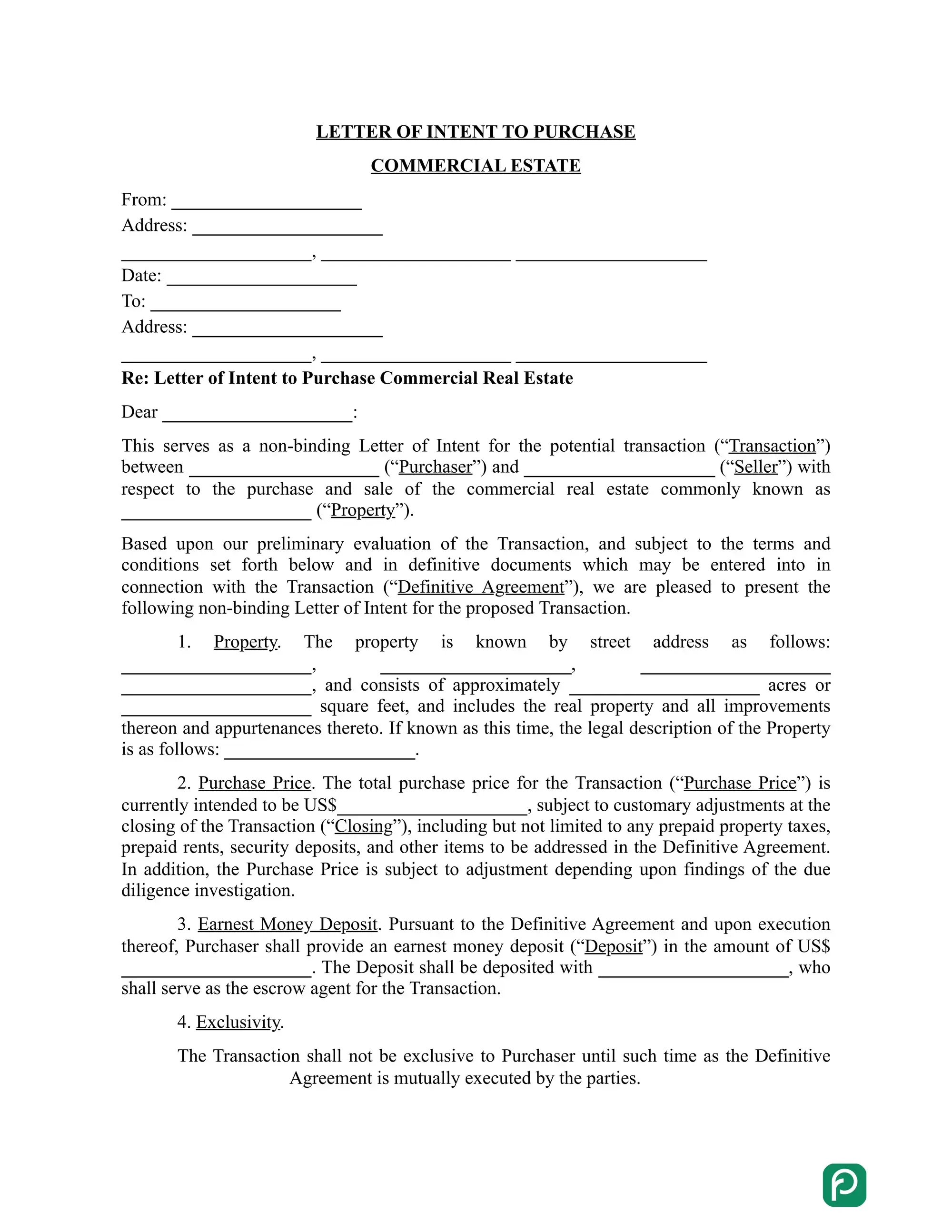
This page gives you a free letter of intent to purchase commercial real estate that you build online, a guide to each section, a sample letter and answers to common questions.
Build Your Document
Answer a few simple questions to make your document in minutes
Save and Print
Save progress and finish on any device, download and print anytime
Sign and Use
Your valid, lawyer-approved document is ready
A letter of intent to purchase commercial real estate is a short letter in which a buyer proposes the main terms for buying a property used for business, such as an office building, a store, a warehouse or a commercial lot.
The letter is shorter and simpler than a full contract and uses far less formal wording. The seller or the seller's broker reads it, marks the points they do not accept and answers with a counteroffer. Once both sides agree on the outline, they turn it into a purchase agreement.
A buyer who is serious about a property usually writes the LOI. The seller or the seller's broker typically supplies most of the details, and the buyer finds the rest during early due diligence, a first check of the property and its papers.
Whether a commercial real estate LOI binds the parties is not settled by one rule: it turns on the letter's wording, how complete its terms are and how the parties acted, and the answer can differ from place to place.
The letter should name plainly which terms bind and which are only proposals for the purchase agreement.
The letter can leave the price, financing and closing terms open and make a few clauses binding, such as confidentiality or an exclusivity period. Put that split in its own section so neither side reads a proposal as a promise, and ask a real estate attorney to read that clause before you sign.
For letters of intent in general, read our letter of intent guide.
A letter of intent for buying a business proposes terms for the company itself, while this letter proposes terms for a building or land. Pick the letter that matches what changes hands in your deal: to buy a company, use our letter of intent to purchase a business.
| What you are buying | Letter to use | Main terms it covers |
|---|---|---|
| A company, its assets or its shares | Letter of intent to purchase a business | Assets or shares, staff, customer contracts, confidentiality, the seller's role after the sale |
| An office, store, warehouse or commercial lot | Letter of intent to purchase commercial real estate (this page) | Property description, price, financing, due diligence, inspection, escrow, closing |
| A home or another kind of property | Real estate letters of intent | Property, price, financing and closing terms for that kind of sale |
When a deal covers both a company and the building it runs from, the buyer can propose terms for each in separate letters or list the building as an asset in the business letter. An attorney can say which approach fits the deal.
A commercial real estate LOI includes the parties, the property, the price, the financing, the due diligence and inspection periods, the escrow deposit, the closing date and a clause saying which terms bind the parties.
Optional terms include confidentiality, an exclusivity period during which the seller does not talk to other buyers, a broker commission and the handover of existing leases.
To fill out a letter of intent to purchase a commercial property, gather the property address, the names of both parties and the offered price, then complete each section below in order.
A commercial real estate LOI often runs from one to three pages, depending on how complex the property is. Our free fillable letter of intent to purchase real estate walks you through the same sections.
Use this sample as a model for your own letter. The names, addresses and dollar amounts are made up. Swap in the real details of the property, the buyer and the seller, then compare each line with the steps above before you send it.
From: Lory Markle
7097 W. Princess Street
Angleton, TX 77515
April 4, 2021
To: Theon Black
74 Thompson St.
San Antonio, TX 78211
RE: Letter of intent to purchase commercial property at 49 West James Ave. Houston, TX 77081.
Dear Mr. Black,
Pursuant to this letter of intent, Lory Markle (Buyer) intends to purchase from Theon Black (Seller) the commercial property located at 49 West James Ave. Houston, TX 77081, herein referred to as Property, on the following terms and conditions:
Buyer: Lory Markle Date:
Seller: Theon Black Date:
A letter of intent to purchase is a short outline of the main deal terms, while a purchase agreement is the full contract that spells out every term of the sale.
| Point | Letter of intent | Purchase agreement |
|---|---|---|
| Purpose | Opens talks on the main terms | Sets every term of the sale |
| Length | Short, often a few pages | Longer and more detailed |
| Wording | Plain, with far less formal language | Formal contract wording |
| When it comes | Before or at the start of due diligence | After both sides agree on the outline |
| Who writes it | Usually the buyer or the buyer's broker | The parties, often with their attorneys |
Think of the LOI as the first draft of the deal and the purchase agreement as the finished version. When the terms are settled, move on to a real estate purchase agreement.
After both sides sign the LOI, the buyer starts due diligence and the parties draft a purchase agreement that turns the agreed outline into a full contract.
If the inspection or the documents turn up a problem, the buyer can reopen talks on the price, or walk away and recover the deposit on the inspection and financing terms written into the signed purchase agreement.
Most LOIs run one to three pages. A simple deal for one building often fits on a single page, while a larger property with many leases takes more room.
The buyer sends it to the property owner, or to the owner’s broker when the owner works with one. Keep a copy of what you send, so both sides can look back at the same wording during talks.
A seller can send a letter of intent to sell that proposes terms to a chosen buyer, though in a commercial property deal the buyer usually writes the letter.
The builder on this page creates the letter of intent online: answer the questions, save your progress on any device, then download and print the finished letter.
This letter proposes a purchase, not a lease. For renting an office or a store, the terms differ, so browse our letter of intent templates.
Read every line once more. Confirm the price, the dates and the names of both parties, and make sure the property address matches on every page. If anything is unclear, ask a real estate attorney or your broker to take a look.
General information, not legal or tax advice.
