
Updated:
An intent to rent letter is a summary of proposed lease terms. The letter names the parties, the home, the rent, the deposit and the lease start date. Tenants and landlords use it to agree on terms before drafting the full lease.
Key facts
Build Your Document
Answer a few simple questions to make your document in minutes
Save and Print
Save progress and finish on any device, download and print anytime
Sign and Use
Your valid, lawyer-approved document is ready
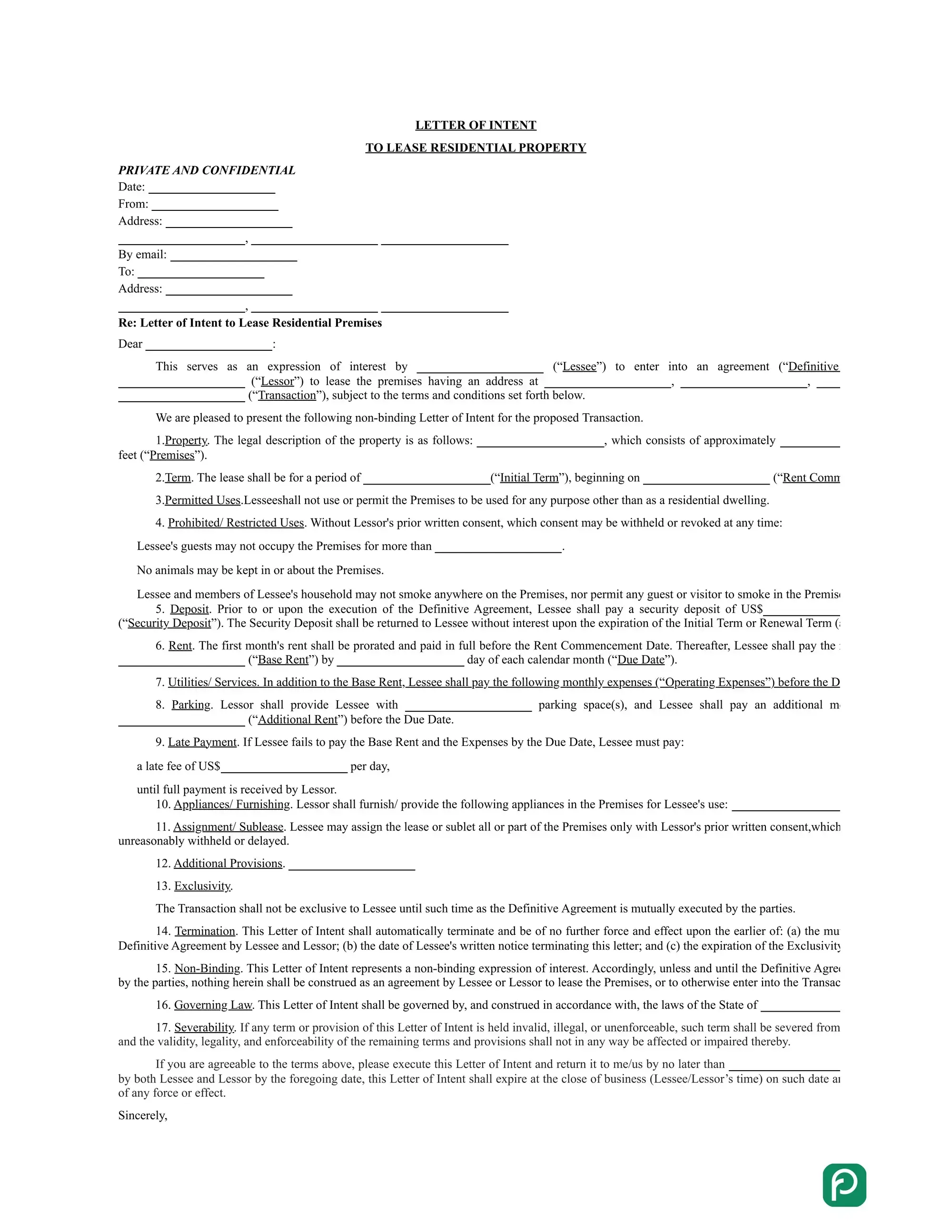
A letter of intent to rent is a short written offer that lists the main terms of a residential lease before the parties sign the lease itself. The letter covers the home, the rent, the lease term and the deposit, and it gives both sides one page to check against their own understanding.
The letter works as a bridge between a conversation and a contract. It turns a viewing, a phone call or an email exchange into written terms that the tenant and the landlord can accept, change or reject.
The same document goes by several names: letter of intent to lease residential property, intent to lease letter, rental letter of intent or LOI. Each name describes the same thing for a house, an apartment or a room.
A letter of intent to rent proposes specific lease terms, while a letter of interest introduces a tenant and asks the landlord to consider an application. The two letters serve different stages of a rental search.
| Point | Letter of intent to rent | Letter of interest to rent a house |
|---|---|---|
| Purpose | Sets out the terms both sides plan to sign | Introduces the tenant and shows interest in a home |
| Who writes it | The tenant or the landlord | The tenant |
| Main content | Rent, term, deposit, start date, house rules | Background, job, reasons for moving, references |
| Signatures | A line for each party | The tenant's signature only |
| Next step | The full lease agreement | A rental application or a viewing |
Many tenants send a letter of interest first and a letter of intent once the landlord shows interest back. The sample further down this page is a letter of interest; the short terms example after it shows a letter of intent.
An intent to rent letter is useful when the parties agree in principle but have not drafted the lease yet. The letter fixes the terms while they are fresh and shows where the two sides still differ.
Common situations for the letter:
A different document fits once both sides are ready to sign the final terms. In that case the parties go straight to a residential lease agreement.
A letter of intent to rent includes the parties, the property, the rent, the lease term, the deposit and the house rules, followed by the signature lines. Each term gets its own short paragraph so both sides read it the same way.
The core parts of the letter:
The property description identifies the home by its street address and, for an apartment, its unit number. The description can add the floor area, the number of bedrooms and any storage space or yard that comes with the home.
The rent clause gives the base rent, how often it is paid (weekly, monthly or yearly) and the day it falls due. The clause also names the payment method and what happens when rent arrives late, such as a fee for late rent.
The term clause states the move-in date and the length of the lease, written out in words or in a fixed end date. The clause can also say whether the tenant has an option to renew and on what terms.
The deposit clause gives the amount of the security deposit, the date it is due and the terms of its refund. When pets are allowed, the same clause names the kinds of animals the home accepts and any separate pet deposit.
The extras clause says whether a parking space comes with the home and whether its cost is part of the rent. The clause lists the utilities, cleaning or upkeep of common areas that the rent covers, and any furniture or appliances the landlord provides.
The subletting clause says whether the tenant may sublet the home and, if so, whether the landlord's written consent comes first. The termination clause sets how much notice a tenant gives to leave before the end date and any charge for leaving early; a notice of termination later puts that notice in writing.
A letter of intent to rent says in its own words whether it binds the parties or only records their plans until the lease is signed. Most rental letters are written as non-binding, and a clear clause keeps both sides from reading the letter differently.
A non-binding clause usually says that the letter expresses the parties' intent and that only a signed lease creates the rental. A letter meant to bind says so in plain words, but its label alone does not settle whether it binds. A party who plans to sign a binding letter has a lawyer read it first.
Some letters mix the two: the rental terms stay non-binding while a few points bind at once, such as keeping the talks confidential or holding the home off the market for a set period. The letter then names each binding point by itself.
A letter of intent to rent is written in a fixed order: parties, property, money terms, house rules, then acceptance and signatures. Keep the tenant's and landlord's details, the property address, the rent and the key dates at hand before you start.
The finished letter passes a short check before it goes out:
A letter of intent to rent is signed by both parties at the end of the letter, usually one side first and the other on return. Commonly, the landlord sends a signed letter to the tenant, and the latter returns the signed duplicate copy to the landlord.
This sample letter is written by a tenant who wants to rent an apartment. It introduces the sender, explains why the apartment is a good fit and lists what is attached. Use it as a model for your own wording.
From: Laura Hopkins
23 Lakeview Lane
Austin, TX 78745
Phone number: +1556778995
Email: laura.h@gmail.com
April 4, 2021
To: Greg Tolkien
236 South Buckingham Drive
Waco, TX 76706
Dear Greg Tolkien,
My name is Laura Hopkins, and I have a strong interest in renting the apartment you have available at 236 South Buckingham Drive Waco, TX 76706.
I currently live at 23 Lakeview Lane Austin, TX 78745, and have lived there for a year. I am looking for a new place to live after getting a nursing job at a clinic in your neighborhood. The commute from my current residence takes me more than two hours one way, so I would want to reduce this time by finding a home close to my work.
I also find your community very peaceful and nice with the abundance of greenery there. About the studio you offer, I find it really appealing with its minimalistic interior design, smart kitchen, and cozy balcony.
I believe I’d be a wonderful addition to your rental community. I have been working in the nursing field for three years, two of which I spent at my previous workplace. My new job offers better financial opportunities, so I believe I can be a diligent tenant who always pays rent on time.
In my spare time, I enjoy cycling, hiking, and any other outdoor activities. I also have a dog named Friend, who is currently living with my parents. Considering your apartment is pet-friendly, being able to unite with my friend is another important reason I would cherish living in your rental property.
I am quiet, friendly, clean and I hope you will consider me a suitable tenant for your rental premises. Along with this letter, I have attached my renter’s resume and two recommendation letters from my neighbor and co-worker. If you have any questions, please don’t hesitate to call or email me at the contacts provided at the top-left corner of this letter.
Thank you very much for considering my rental application. I look forward to hearing from you.
Sincerely,
Laura Hopkins
What makes this sample easy to follow:
The terms section of a letter of intent lists each point on its own line. The example below uses made-up figures.
Property: 236 South Buckingham Drive, Unit 4B, Waco, TX 76706
Rent: $1,250 per month, due on the 1st, paid by bank transfer
Late rent: $50 fee if rent is more than 5 days late
Term: 12 months, starting June 1, 2026
Security deposit: $1,250, due at lease signing
Pets: one dog allowed, pet deposit $300
Parking: one space included in the rent
Status: This letter is non-binding. Only a signed lease creates the tenancy.
Acceptance: Sign and return a copy by May 10, 2026.
It is a short letter that lists the basic terms of a residential lease, such as the rent, the lease term and the move-in date. People use it to confirm the main points before they work on the full lease agreement.
Either side can start it. A tenant often writes one to show interest in a home, and a landlord can send one to confirm the terms on offer. The sample above comes from a tenant.
One or two pages is plenty for most rentals. Give each term its own short paragraph, and keep the wording simple so both sides read it the same way.
Yes, the same parts work for a stall, a storage space or a room: the parties, the space, the rent, the term and the signatures. For a shop or an office, a real estate letter of intent covers the extra business terms.
A non-binding letter leaves room for changes until the lease is signed. Any change goes into a revised letter or straight into the lease, and both sides check it against the letter before they sign.
Keep a signed copy for your records and check these points:
Then use the same terms when you prepare the full lease agreement.
General information, not legal or tax advice.
