
Updated:
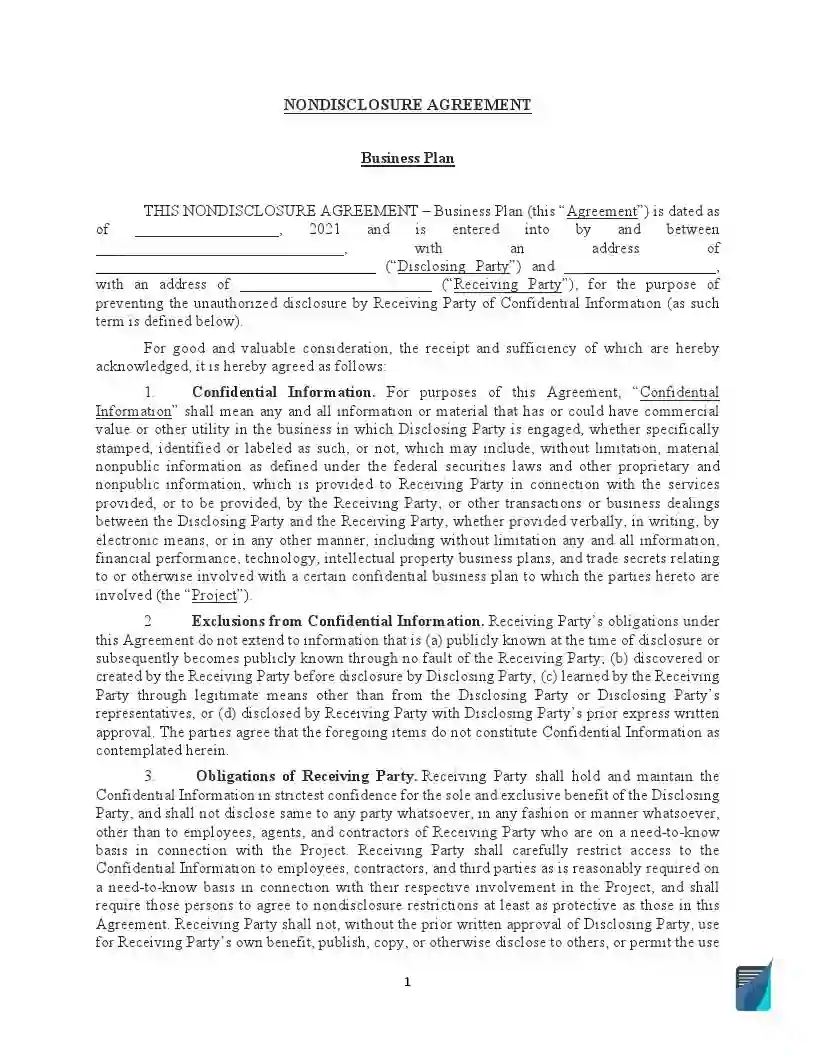
A business plan NDA is a contract that keeps your plan confidential. The receiving party agrees not to disclose or use the plan's private details beyond evaluating it. Owners need one before showing a plan to investors, lenders, consultants or buyers.
This page covers each clause of a business plan confidentiality agreement, the short-form statement, the signing steps and the trade secret statutes behind it.
Key facts
Build Your Document
Answer a few simple questions to make your document in minutes
Save and Print
Save progress and finish on any device, download and print anytime
Sign and Use
Your valid, lawyer-approved document is ready
A business plan NDA protects the private parts of a business plan that give the business an edge, from financial projections to the list of competitors. The agreement names this material as confidential information and limits what the reader may do with it.
A business plan covers marketing, competition, finances and operations. These are the parts a business plan NDA most often protects:
This information keeps its value only while it stays private. An NDA signed at the first meeting also sets a habit the business can repeat with employees, contractors and partners, using the same NDA template as a base.
A business plan confidentiality agreement is needed whenever a plan leaves the owner's hands for review by someone outside the business. Typical moments include:
A plan shared without an NDA leaves no signed promise that the reader will keep it private. The owner then faces these risks:
A signed agreement settles these points in advance. Both parties know what may not be shared, which makes any later dispute shorter and easier to resolve.
A business plan non-disclosure agreement includes eight core clauses: the definition of confidential information, the permitted purpose, the duty of confidentiality, exclusions, return of materials, the term, remedies and general provisions. Each clause below answers one question the reader will ask before signing.
The definition names what the agreement protects. A useful definition lists categories, such as revenue predictions, spending plans, predicted trends, customer data and product designs, and adds any other part of the plan the owner marks as confidential.
The permitted purpose limits the reader's use of the plan to one task, such as deciding whether to invest. A need-to-know clause lets the reader show the plan only to the people who help with that task, such as a partner at the same fund, and makes the reader answer for them.
The duty clause is the receiving party's promise to keep the information private. It covers talking about the meeting, making copies of documents and using the plan's ideas in the reader's own marketing or products.
Exclusions list information the agreement does not treat as confidential:
The return clause sets what happens to printed copies, slides and files once talks end. The receiving party returns or destroys them when the owner asks and does not keep copies without the owner's consent.
The term sets how long the duty lasts. It can end on a set date, when a stated event happens, such as a written release, or when the information stops being a trade secret.
The remedies clause states what the owner can ask for if the reader breaks the agreement, such as an order to stop the disclosure, money for the loss and the owner's legal fees. The trade secret section below shows what one state's statute adds.
General provisions keep the rest of the agreement in force if one clause is found void, and state that this agreement replaces earlier agreements on the same subject. A governing law clause names the state whose law applies, and a no-license clause confirms the reader gains no ownership of the ideas.
A business plan confidentiality statement is a short notice on the plan's cover page or first page that asks every reader to keep the contents private. The statement differs from an NDA: the NDA carries the reader's signature, while the statement is a notice the reader may never sign.
The statement fits a plan sent to many readers at once, such as a lender's review team. For a pitch to one investor or a buyer, the short form works best together with a signed NDA.
Example statement: This business plan is confidential and is provided to [Reader Name] only to evaluate [Company Name]. By accepting this copy, the reader agrees not to copy it or share its contents without the written consent of [Company Name], and to return it on request.
Signature of reader: ____________ Date: ____________
A business plan disclaimer is a different notice. The disclaimer says the plan's projections are estimates, not promises, while the confidentiality statement says the plan is private. Many plans print both on the same page.
Confidential business information is anything in the plan that gives the business an edge and is not public. Sorting it into groups before a meeting makes it easier to describe in the agreement and easier to explain to the receiving party.
Details that are already public, such as the website or a press release, do not belong on this list. A list that names only truly private details keeps the document clear for everyone who reads it.
The disclosing party is the business owner who shares the plan, and the receiving party is the investor, consultant, lender or partner who reviews it. The agreement names both at the start so everyone knows who shares information and who keeps it private.
The form lists each party's full name and address. When a company is a party, the form gives the company's full name and the name and title of the person signing for it.
Some meetings involve more than one receiving party, such as a whole investment team. The agreement then lists everyone who will see the plan.
Example: Anna Baker is opening a bakery and wants to show her plan to a possible investor, Ben Carter. Before the meeting, Anna asks Ben to sign the NDA. Anna is the disclosing party and Ben is the receiving party. The NDA lists her financial projections and supplier list as confidential information.
A one-way NDA, also called a unilateral NDA, protects only the party that shares information, while a mutual NDA protects both parties when each shares with the other. The right type depends on who will share at the meeting.
A business plan NDA is filled out clause by clause, then signed by each party, before the plan changes hands. Follow these steps in order:
A business plan NDA works next to state trade secret statutes, which give the owner of a trade secret a claim for misappropriation in addition to the contract claim. The facts below come from each statute's own text.
California's statute, Cal. Civ. Code § 3426.1, defines a trade secret as information that derives independent economic value from not being generally known and is the subject of efforts that are reasonable under the circumstances to maintain its secrecy. Fla. Stat. § 688.002 and Wash. Rev. Code § 19.108.010 use the same reasonable efforts test. A signed NDA, pages marked Confidential and numbered copies each document an effort to keep the plan secret.
Under Cal. Civ. Code § 3426.1, misappropriation includes disclosure or use of a trade secret without express or implied consent by a person who knew or had reason to know that the knowledge of it was acquired under circumstances giving rise to a duty to maintain its secrecy.
California's statute lets the owner stop a misuse and recover money for it:
Other states' trade secret statutes set their own terms for these remedies, and this page lists them only for California.
Each statute in the table counts its deadline from the day the misappropriation is discovered or, by the exercise of reasonable diligence, should have been discovered. The table covers trade secret claims only, not a claim for breach of the NDA itself.
| State | Deadline to bring a misappropriation action | Statute |
|---|---|---|
| Alabama | 2 years after the misappropriation is discovered or should have been discovered | Ala. Code § 8-27-5 |
| Alaska | 3 years after the misappropriation is discovered or should have been discovered | Alaska Stat. § 45.50.925 |
| Arkansas | 3 years after the misappropriation is discovered or should have been discovered | Ark. Code Ann. 4-75-603 |
| California | 3 years after the misappropriation is discovered or should have been discovered | Cal. Civ. Code § 3426.6 |
| Colorado | 3 years after the misappropriation is discovered or should have been discovered | Colo. Rev. Stat. § 7-74-107 |
| Connecticut | 3 years after the misappropriation is discovered or should have been discovered | Conn. Gen. Stat. § 35-56 |
| Delaware | 3 years after the misappropriation is discovered or should have been discovered | 6 Del. C. § 2006 |
| District of Columbia | 3 years after the misappropriation is discovered or should have been discovered | D.C. Code § 36-406 |
| Florida | 3 years after the misappropriation is discovered or should have been discovered | Fla. Stat. § 688.007 |
| Georgia | 5 years after the misappropriation is discovered or should have been discovered | O.C.G.A. 10-1-766 |
| Hawaii | 3 years after the misappropriation is discovered or should have been discovered | Haw. Rev. Stat. § 482B-7 |
| Idaho | 3 years after the misappropriation is discovered or should have been discovered | Idaho Code § 48-805 |
| Illinois | 5 years after the misappropriation is discovered or should have been discovered | 765 ILCS 1065/7 |
| Indiana | 3 years after the misappropriation is discovered or should have been discovered | Ind. Code § 24-2-3-7 |
| Iowa | 3 years after the misappropriation is discovered or should have been discovered | Iowa Code § 550.8 |
| Kansas | 3 years after the misappropriation is discovered or should have been discovered | Kan. Stat. Ann. § 60-3325 |
| Louisiana | 3 years after the misappropriation is discovered or should have been discovered | La. R.S. 51:1436 |
| Michigan | 3 years after the misappropriation is discovered or should have been discovered | Mich. Comp. Laws § 445.1907 |
| Minnesota | 3 years after the misappropriation is discovered or should have been discovered | Minn. Stat. § 325C.06 |
| Mississippi | 3 years after the misappropriation is discovered or should have been discovered | Miss. Code Ann. § 75-26-13 |
| Montana | 3 years after the misappropriation is discovered or should have been discovered | Mont. Code Ann. § 30-14-407 |
| Nebraska | 4 years after the misappropriation is discovered or should have been discovered | Neb. Rev. Stat. 87-506 |
| Nevada | 3 years after the misappropriation is discovered or should have been discovered | Nev. Rev. Stat. § 600A.080 |
| New Hampshire | 3 years after the misappropriation is discovered or should have been discovered | N.H. Rev. Stat. Ann. § 350-B:6 |
| New Jersey | 3 years after the misappropriation is discovered or should have been discovered | N.J.S.A. 56:15-8 |
| New Mexico | 3 years after the misappropriation is discovered or should have been discovered | N.M. Stat. Ann. § 57-3A-7 |
| North Dakota | 3 years after the misappropriation is discovered or should have been discovered | N.D.C.C. § 47-25.1-06 |
| Ohio | 4 years after the misappropriation is discovered or should have been discovered | Ohio Rev. Code 1333.66 |
| Pennsylvania | 3 years after the misappropriation is discovered or should have been discovered | 12 Pa.C.S. § 5307 |
| Rhode Island | 3 years after the misappropriation is discovered or should have been discovered | R.I. Gen. Laws § 6-41-6 |
| South Carolina | 3 years after the misappropriation is discovered or should have been discovered | S.C. Code Ann. § 39-8-70 |
| South Dakota | 3 years after the misappropriation is discovered or should have been discovered | S.D. Codified Laws § 37-29-6 |
| Tennessee | 3 years after the misappropriation is discovered or should have been discovered | Tenn. Code Ann. 47-25-1707 |
| Utah | 3 years after the misappropriation is discovered or should have been discovered | Utah Code § 13-24-7 |
| Virginia | 3 years after the misappropriation is discovered or should have been discovered | Va. Code Ann. § 59.1-340 |
| Washington | 3 years after the misappropriation is discovered or should have been discovered | Wash. Rev. Code § 19.108.060 |
| West Virginia | 3 years after the misappropriation is discovered or should have been discovered | W. Va. Code § 47-22-6 |
| Wyoming | 4 years after the misappropriation is discovered or should have been discovered | Wyo. Stat. Ann. § 40-24-106 |
The table covers only the states listed above. For any other state, check that state's own trade secret statute for the time limit to sue.
A signed NDA works best together with careful sharing habits: show the reader only what the review needs, share in stages and keep track of every copy. These habits also show who received which information.
The meeting log belongs with the signed NDA, so the owner has a clear timeline if a question comes up later.
A refusal to sign usually starts a short conversation, not the end of the deal: some readers hesitate to sign an NDA before they see a business plan. Ask why, and explain what the agreement covers.
The owner decides how much of the plan to share and can wait until the right agreement is in place.
Yes, a business plan NDA gives the disclosing party a contract claim against a receiving party who breaks it, and its remedies clause sets what the owner can ask for. A trade secret claim can stand beside it; in California, Cal. Civ. Code § 3426.6 sets 3 years after the misappropriation is discovered or should have been discovered.
A business plan NDA protects little when its definition of confidential information is vague. It also leaves out anything the exclusions clause names, such as information that was already public or that the reader already knew.
Some investors sign one and some decline, often before they see more than a summary. The section on what to do if the other party will not sign lists the options.
Mark anything you would not want a competitor to see, such as financial projections, customer lists, pricing plans, and trade secrets. Adding the word Confidential to each page makes your intent easy to see.
Have it signed before you share any confidential details. That keeps it clear what was shared and when.
An existing contract can replace a separate NDA only if it has its own confidentiality clause that covers the business plan. Without such a clause, a separate NDA fills the gap.
General information, not legal or tax advice.
