
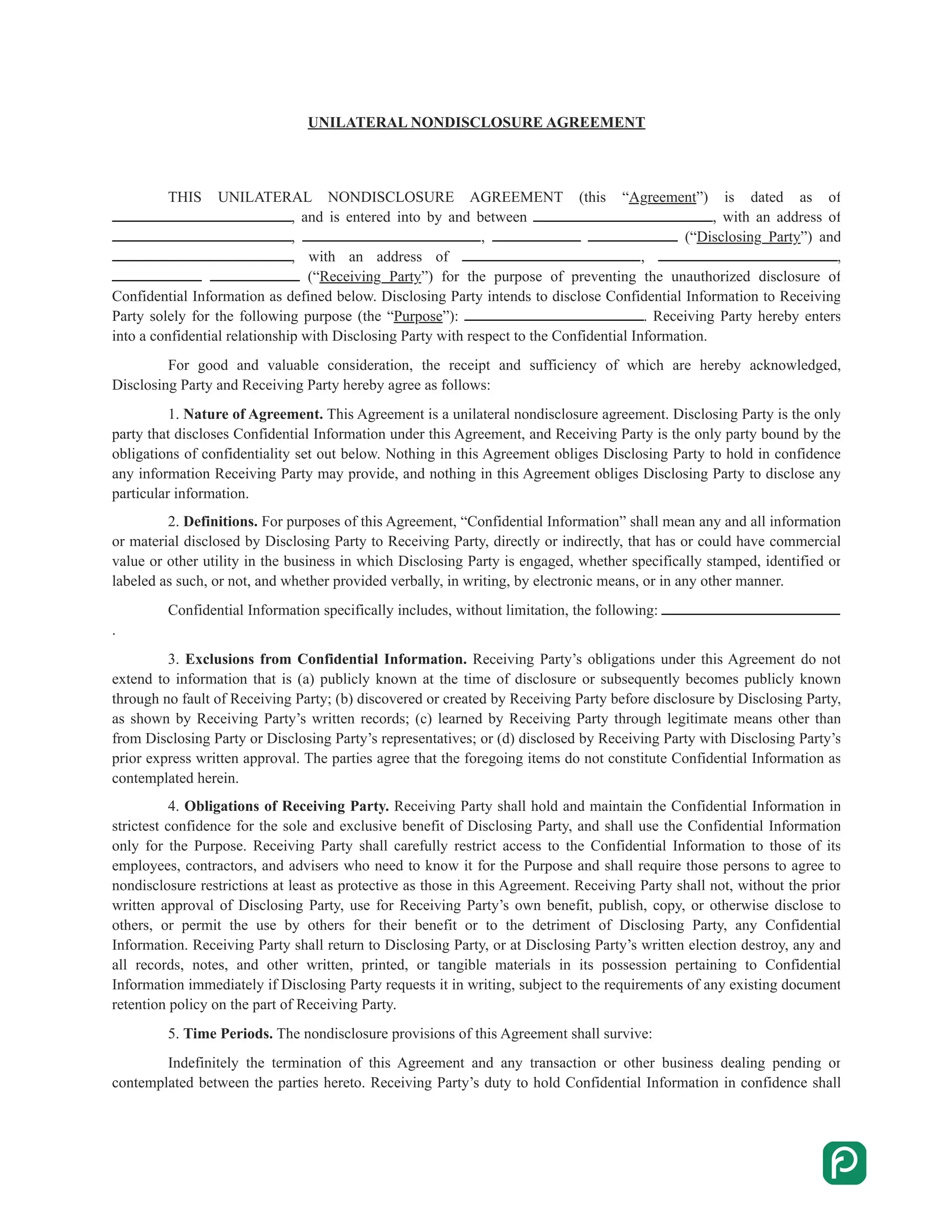
A unilateral NDA template, also called a one-way NDA, is a confidentiality agreement for deals where one party shares confidential information with at least one other party. The parties receiving the confidential information will keep the disclosed information private to uphold the contract. Information shared with a one-way NDA includes financial information, business plans, and other trade secrets.
Last Updated: October 2026. This guide is reviewed and updated regularly to reflect current law. If you notice an error or outdated information, please contact us.
Build Your Document
Answer a few simple questions to make your document in minutes
Save and Print
Save progress and finish on any device, download and print anytime
Sign and Use
Your valid, lawyer-approved document is ready
A unilateral NDA is different from a mutual NDA for one main reason. In a mutual non-disclosure agreement, both parties are sharing confidential information. All information shared with a mutual NDA is treated the same and both parties learning confidential information are legally bound to keep it confidential.
| Question | Unilateral NDA | Mutual NDA |
|---|---|---|
| Who shares confidential information? | One party | Both parties |
| Which way does the information flow? | One way | Both ways |
| Where is it often used? | Hiring a third party to manage data or meeting with investors | Mergers and acquisitions, partnerships, and joint ventures |
These agreements can be used in business dealings with mergers and acquisitions. In these business settings, both parties will need to disclose confidential information for the business plan to succeed. Another example where a mutual NDA can be used is for partnerships or joint ventures.
In times when a business venture or plan requires full cooperation from at least two parties, using a mutual NDA is beneficial. It ensures that confidential information is safe when sharing that information with a business partner.
This NDA template should be used when there is no need for two-way communication. A one-way NDA fits any deal where only one side reveals confidential information and the other side only receives it. In these agreements, the information that the disclosing party reveals is confidential and the receiving party must keep it confidential.
Anytime that restricting or limiting information shared one-way is important, that is the time to use a unilateral NDA. Common cases include:
A unilateral confidentiality agreement protects trade secrets that will be revealed while working with third parties. Confidential information can range from professional to private. Some information may be disclosed to the public in the future while other information may not. A non-disclosure agreement protects all of that.
For many businesses, having an NDA in place protects trade secrets. A Trade secret is a commercial secret that provides a business a competitive edge. Every business has trade secrets that they’re keeping confidential to help their business succeed. A trade secret can be as broad as business plans or as specific as a secret ingredient, as long as it’s confidential it counts.
A one-way NDA will define what the confidential information is and the obligations of the third party to keep it confidential. An NDA will also outline what can happen if there is a breach in contract and information is revealed.
When an NDA is not in use, it can make establishing that confidential information was revealed difficult. An NDA will also establish what the consequences will be for a breach of contract.
While having people sign a one-way NDA may seem demanding, it will help both parties involved. By defining confidential information and the obligations of both parties, it will be easier to keep the information a secret. It will also be easier to determine what the ramifications are for revealing trade secrets or other confidential information.
An NDA sample will include the necessary information and format for a unilateral NDA to be legally binding and effective. It will help both parties know what they are agreeing to and define the important terms.
Having the right form and language in a unilateral NDA is important to ensure that all parties know what they are agreeing to. It will also help the agreement stand up in court if it is ever challenged. When protecting your confidential information and trade secrets you want everything to be covered.
FormsPal builds your unilateral NDA from a few plain questions, so you can finish it in minutes on any device. Select Create My Document at the top of the page and work through these steps.
A unilateral NDA, also called a one-way NDA, is a confidentiality agreement where one party shares private information with another party. The party that shares it is the disclosing party, and the party that gets it is the receiving party.
In a one-way NDA, only one side reveals confidential information. In a mutual NDA, both sides reveal it. Pick the type that matches how information will move between you and the other party.
It can cover items such as:
A short, clear list of what you consider confidential helps both sides stay on the same page.
Use a unilateral NDA when you are the only one sharing private details, for example when you hire a third party to manage data or meet with investors.
Yes. Select Create My Document at the top of the page, answer a few simple questions, and save your progress or finish on any device. You can then download and print the agreement.
General information, not legal or tax advice.
